

More news on this day
Germany and Malaysia are set to deepen their aviation and economic ties with Lufthansa’s decision to launch a new nonstop Frankfurt–Kuala Lumpur service in late October 2026, restoring a direct air bridge between the two countries for the first time in more than a decade.
New Nonstop Link Between Germany and Malaysia
Lufthansa confirmed this week that it will introduce a year-round nonstop connection between Frankfurt and Kuala Lumpur from October 25, 2026, operating five times a week. The route will run daily except Tuesdays and Thursdays, reconnecting Germany’s largest hub with the Malaysian capital after direct services on the corridor ceased in 2015.
The new service positions Lufthansa as the only carrier offering direct passenger flights between Germany and Malaysia, in a market that has long relied on one-stop itineraries via Gulf and Asian hubs. By flying nonstop, travelers are expected to save several hours compared with common connecting routings through Doha, Dubai, Istanbul or Singapore.
Flight LH 704 will depart Frankfurt Airport at 9:30 p.m., arriving at Kuala Lumpur International Airport at 4:40 p.m. local time the following day. The return service, LH 705, is scheduled to leave Kuala Lumpur at 11:55 p.m., touching down in Frankfurt at 6:00 a.m., giving passengers convenient onward connections across Europe and North America.
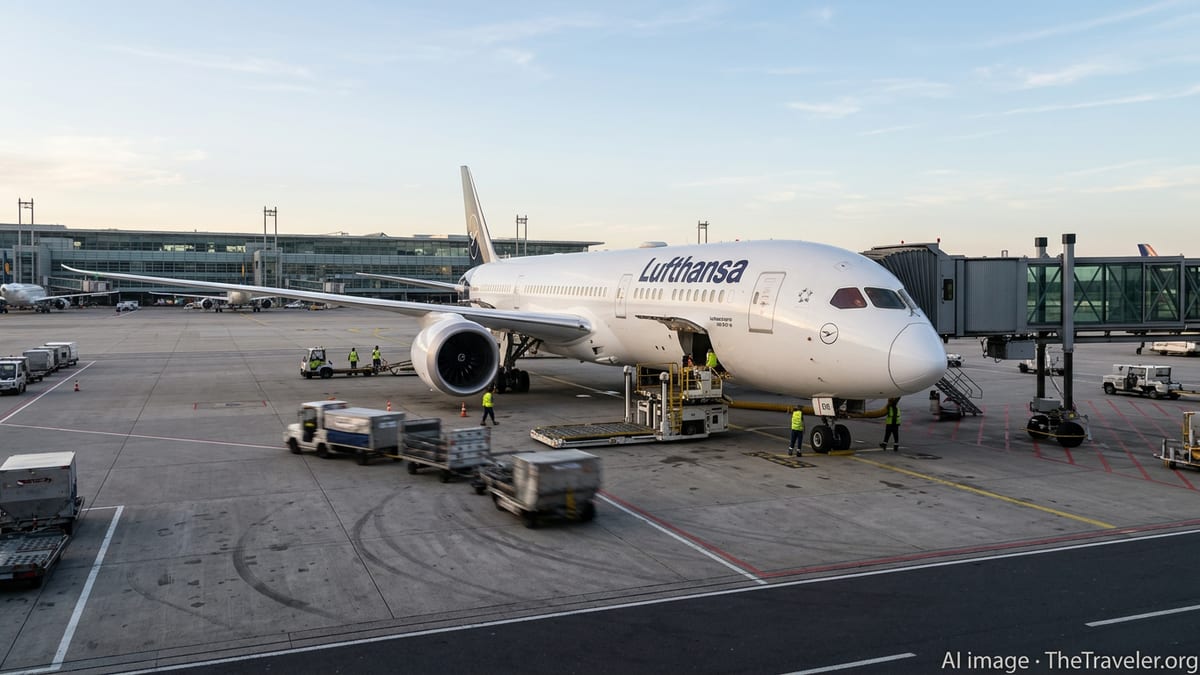
The route will be operated by Lufthansa’s Boeing 787-9 aircraft equipped with the carrier’s new Allegris long-haul cabin, which offers redesigned Business, Premium Economy and Economy sections. The aircraft is billed as one of the most fuel-efficient in Lufthansa’s widebody fleet, a factor the airline highlights as it seeks to expand while meeting stricter sustainability targets.
Strengthening Bilateral Aviation and Trade Relations
The decision to restart direct flights is being framed by officials and industry groups as a broader step in reinforcing German-Malaysian relations. Germany is Malaysia’s largest trading partner within the European Union, with more than 700 German companies present in the Southeast Asian nation, spanning sectors from automotive and chemicals to machinery and advanced manufacturing.
Aviation links have been a recurring focus of bilateral engagement, with German delegations in recent years exploring aerospace and airport-related investment opportunities in Malaysia. The new Frankfurt–Kuala Lumpur service is expected to support these efforts by giving executives and technical teams a faster, more predictable travel option between key industrial regions in Germany and production hubs around the Klang Valley and beyond.
For Germany, the route further cements Frankfurt’s role as a primary European gateway to Southeast Asia at a time when trade and supply chains in the region are diversifying. For Malaysia, it is another step toward consolidating Kuala Lumpur International Airport’s position as a regional hub and preferred entry point for European travelers heading to the wider ASEAN market.
Industry observers note that the announcement aligns with Malaysia’s push to attract more high-value investment and to leverage its role as an ASEAN member in negotiations with European partners. Direct air services are seen as a crucial component in making these ties more resilient, particularly for industries that depend on face-to-face collaboration and just-in-time logistics.
Tourism Boost for a Record-Setting Destination
The launch of the new service also targets strong tourism flows. Malaysia has recently emerged as the most visited country in Southeast Asia, welcoming more than 40 million international visitors in 2025 according to official figures cited by Lufthansa. The airline is betting that easier access from continental Europe will help sustain this momentum.
Nonstop flights from Frankfurt are expected to appeal to German and European leisure travelers drawn to Malaysia’s mix of urban attractions in Kuala Lumpur, beaches in Langkawi and the east coast, and nature-focused experiences in Borneo. Travel agents anticipate that the direct route will make combined itineraries to Malaysia and neighboring countries more attractive, with Kuala Lumpur acting as a starting point for multi-country tours.
On the inbound side, Malaysian travelers will gain new one-stop access, via Frankfurt, to more than 150 onward destinations across Europe and beyond on Lufthansa and its partners. That could spur demand for city breaks, cultural tourism and sports travel, including trips to major football hubs such as Munich, Dortmund and London via connections.
Tourism stakeholders in Malaysia are expected to court joint marketing campaigns with Lufthansa and German partners, promoting the new route as part of broader efforts to move visitors beyond traditional hotspots and to lengthen average stays. The restoration of a direct link is seen as an important signal of confidence in Malaysia’s tourism potential following several years of rapid post-pandemic recovery.
Competitive Dynamics on the Europe–Southeast Asia Corridor
Lufthansa’s move places fresh competitive pressure on airlines that have dominated Europe–Malaysia traffic with one-stop services. Carriers such as Qatar Airways, Emirates, Etihad Airways and Turkish Airlines, along with regional hubs in Singapore and Bangkok, have long captured passengers traveling between Germany, the wider EU and Malaysia through their own connection-heavy networks.
By reinstating a nonstop option, Lufthansa is seeking to recapture some of that traffic, especially among time-sensitive business and premium leisure travelers. The evening departures in both directions are designed to align with common work schedules and allow for full days on the ground before flying overnight.
The choice of the Boeing 787-9 fitted with the Allegris cabin also reflects a bid to compete not only on schedule but on product quality. The refreshed Business Class with direct aisle access, enhanced Premium Economy seating and updated Economy features are intended to narrow the comfort gap with leading Gulf and Asian competitors that have set high benchmarks on long-haul service.
Analysts suggest the route could also stimulate fare competition on certain dates, particularly during peak holiday periods when demand from Germany to Southeast Asia is strong. While one-stop itineraries are likely to remain price-sensitive options, the presence of a nonstop service adds a new dimension to how travelers and corporate buyers weigh cost against convenience and total journey time.
Long-Term Network Strategy in Southeast Asia
The Frankfurt–Kuala Lumpur launch forms part of a broader Southeast Asia strategy for Lufthansa Group, which has been gradually rebuilding and recalibrating its presence in the region. With Kuala Lumpur added to an existing network that includes Bangkok, Singapore and Phuket, the airline is moving toward a more diversified portfolio of leisure and business destinations.
Positioning Kuala Lumpur as the group’s third main Southeast Asian gateway gives Lufthansa the flexibility to serve both point-to-point demand and flows connecting through Frankfurt to North America and other parts of Europe. The schedule is crafted to plug into key bank structures at Frankfurt, optimizing aircraft utilization while providing short connecting times.
The timing of the launch at the start of the Winter 2026/27 season underscores Lufthansa’s confidence in sustained demand rather than just seasonal peaks. If the route performs strongly, industry experts say additional frequencies or capacity upgrades could follow in subsequent seasons, further anchoring the link between Germany and Malaysia.
For policymakers and industry players on both sides, the new service is being viewed as more than just another long-haul route. It is a tangible symbol of deepening ties between Europe’s largest economy and a rapidly expanding Southeast Asian nation, with aviation once again at the forefront of trade, investment and people-to-people exchange.