

More news on this day
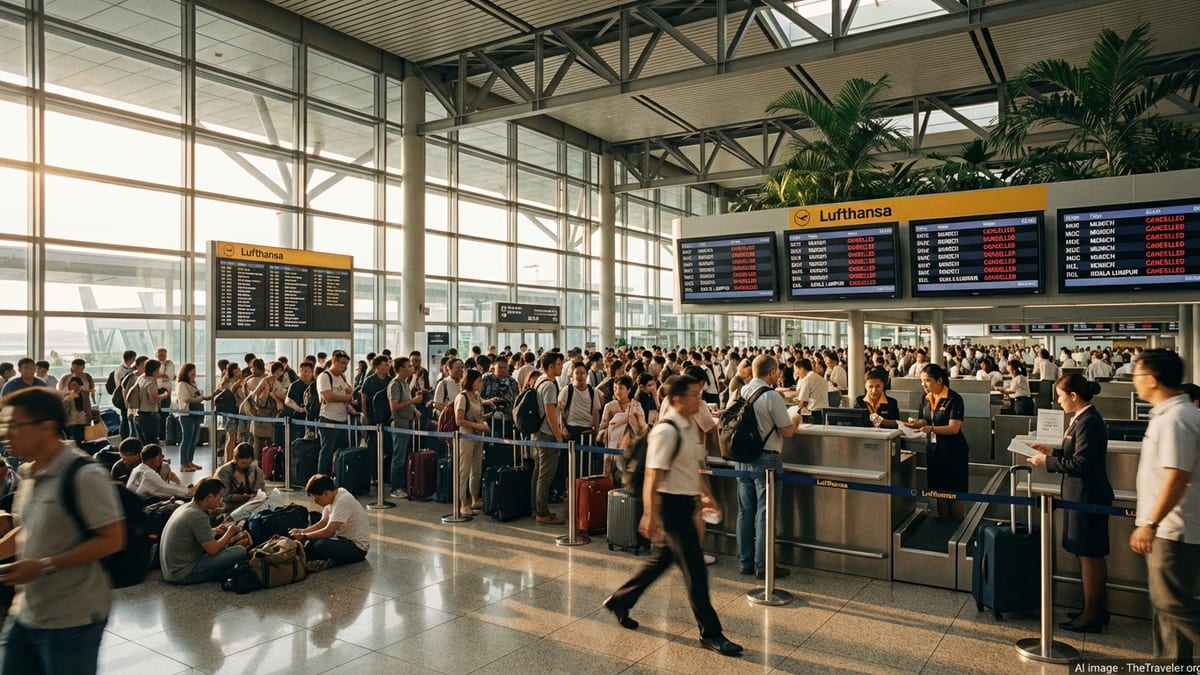
Two Lufthansa-operated flights departing Singapore for Munich and Kuala Lumpur were cancelled this week, disrupting travel plans for hundreds of passengers and adding fresh strain to already fragile airline networks across Asia.
Sudden Cancellations Hit Key Regional and Long Haul Links
The cancellations affected one long haul service between Singapore and Munich and a regional connection involving Kuala Lumpur, according to airport schedule data and passenger reports from Singapore Changi Airport. Both services were removed from departure boards within hours of their scheduled pushback, triggering queues at transfer desks and a spike in rebooking requests on already busy alternative routes.
Lufthansa did not immediately publish a detailed public explanation for the short notice changes, but operational data from recent days points to a convergence of challenges, including tight aircraft utilisation, congested European hubs and weather-related disruption on earlier rotations. Industry observers note that when a carrier is running a high load factor on long haul services, even a minor upstream disruption can cascade, making cancellations more likely when there is no spare aircraft or crew available.
The long haul Singapore to Munich route is a critical link for both business and leisure travellers, connecting Southeast Asia’s busiest hub with one of Europe’s key aviation gateways. The Kuala Lumpur sector, although shorter, acts as a feeder for regional passengers joining onward intercontinental flights. The removal of both flights on the same day therefore had an outsized impact on travel itineraries across multiple time zones.
Passengers at Changi described scenes of confusion as departure boards refreshed and check in agents began rebooking affected travellers onto later flights operated by partner airlines and competitors. Several travellers reported being offered overnight accommodation and meal vouchers, while others opted for refunds and began searching for alternative routings through Bangkok, Dubai or Hong Kong.
Knock On Effects Across European and Southeast Asian Hubs
The disruption in Singapore quickly fed into broader pressure on Munich Airport, which serves as a major hub for Lufthansa’s European and transatlantic services. With one fewer inbound long haul arrival from Asia, the airline faced an additional challenge in balancing aircraft rotations and ensuring adequate capacity for outbound connections to other European cities and North America.
At the same time, Kuala Lumpur International Airport saw a flurry of schedule adjustments as passengers who had planned to connect via Singapore were rebooked onto direct and one stop alternatives. Regional carriers serving the so called Golden Triangle of Singapore, Kuala Lumpur and Bangkok reported higher than usual loads on short notice bookings, as affected travellers tried to salvage business meetings, holiday start dates and family visits.
Analysts say the episode underscores how tightly interconnected Southeast Asia’s aviation network has become. Singapore operates as a super hub, funnelling traffic from around the region through to Europe and beyond. When a major long haul service drops out of the schedule, its absence ripples across multiple airports, affecting not only origin and destination passengers but also those using Singapore as a transfer point.
With airlines across Asia still rebuilding capacity and crews after the pandemic era downturn and subsequent surges in demand, there is limited slack in the system. That lack of buffer means that any individual cancellation can trigger a web of delays, missed connections and last minute rerouting that stretches from regional secondary cities to Europe’s biggest airports.
Aviation Strains Mount Amid Recent Waves of Disruption
The Lufthansa cancellations come against a backdrop of mounting operational strain across Asia’s skies. In recent weeks, thousands of flights across the region have been delayed or cancelled as carriers grapple with congested airspace, weather systems and ongoing staffing and fleet constraints. Singapore, Indonesia and the Philippines have been among the hardest hit, with several days registering more than a thousand delayed services in a 24 hour period.
At Singapore Changi, record passenger volumes and tight turnaround windows have left airlines with little room for error. Even modest schedule disruptions elsewhere in the network, such as storms over Europe or technical issues with individual aircraft, can cascade into missed slots and cancellations further down the line. When a long haul aircraft due to operate out of Singapore is delayed or diverted on an earlier leg, the options for substitution are limited.
Meanwhile, European hubs such as Munich have faced their own bouts of disruption driven by storms, air traffic control restrictions and high seasonal demand. Flights bound for or departing from Munich have in recent months been diverted or rescheduled due to severe weather over central Europe, complicating crew duty schedules and forcing airlines to juggle aircraft assignments at short notice.
Industry experts argue that the Lufthansa cancellations from Singapore are symptomatic of a wider fragility in global aviation networks. Airlines have rebuilt schedules to chase resurgent demand, but many are still operating with lean spare capacity. When things go wrong, the margin between a manageable delay and a full cancellation can be very thin, especially on long haul routes that depend on specific aircraft types and qualified crews.
How Lufthansa and Partner Airlines Responded on the Ground
In the immediate aftermath of the cancellations, Lufthansa and its partner airlines moved to rebook affected passengers and minimise onward disruption. Travellers holding tickets between Singapore, Munich and Kuala Lumpur were offered a mix of options, including rerouting via other hubs, travel on later departures, or refunds where alternative arrangements were not practical within a reasonable timeframe.
Ground staff at Changi coordinated with airline operations teams in Europe to identify spare seats on upcoming flights, prioritising passengers with tight onward connections and those travelling for urgent reasons. Some customers to Germany and other European destinations were shifted to services via Zurich, Frankfurt or Istanbul, while others accepted rebookings a day or more later on the same route.
Airlines in the Star Alliance network, which includes Lufthansa and Singapore Airlines, played an important role in absorbing displaced passengers. Codeshare agreements and joint ventures between carriers allowed ticketed travellers to be reaccommodated on partner flights without the need to issue entirely new tickets, reducing processing time at airport counters.
Nonetheless, not every passenger was able to secure a convenient alternative. Reports from the terminal described long waits at customer service desks and a scramble for remaining hotel rooms around the airport as travellers faced unexpected overnight stays. Social media posts highlighted the stress for families with children and for those whose visas or onward travel commitments left them with little flexibility to extend their journeys.
What Travellers Need to Know if Their Flight Is Cancelled
The latest disruption has once again raised questions among travellers about their rights when flights are suddenly cancelled and about the practical steps they should take at the airport. Consumer advocates emphasise that passengers should first seek official confirmation of the cancellation from the airline or the departure board, then approach the carrier’s service counters or digital channels to understand their rebooking and refund options.
For itineraries involving the European Union, including flights operated by or arriving on an EU based carrier such as Lufthansa, travellers may be covered by passenger protection rules that set out rights to rerouting, care and, in certain circumstances, financial compensation. Eligibility, however, depends on the precise cause of the disruption, the timing of the cancellation and whether extraordinary circumstances such as severe weather were involved.
In practice, passengers at airports like Singapore Changi are often focused on immediate necessities such as securing a confirmed seat on a later flight, arranging accommodation if an overnight stay is required and contacting employers or family to inform them of the delay. Travel insurers advise keeping all receipts for food, transport and hotel costs incurred as a direct result of a cancellation, as these may be partially recoverable under comprehensive policies.
Experts also encourage travellers on complex itineraries to monitor their flights proactively using airline apps or airport information services, especially during periods of widespread disruption. Early awareness of a deteriorating situation can make it easier to request alternative routings before remaining seats on other flights disappear.
Singapore’s Role as a Super Hub Under the Spotlight
The Lufthansa cancellations have put a fresh spotlight on Singapore’s role as Southeast Asia’s leading aviation hub and on the challenges that come with that status. Changi handled close to 70 million passengers last year, surpassing pre pandemic traffic and underscoring its importance as a transfer point between Asia, Europe and the rest of the world.
As volumes have risen, Singapore has pushed forward with infrastructure expansion and operational innovations, from the ongoing development of an additional terminal to investments in air traffic management. Yet, even with these upgrades, the system remains vulnerable to shocks that originate far beyond its borders, such as disruptions at European hubs or geopolitical tensions that close airspace along key routes.
Local aviation experts say the latest cancellations highlight the need for continued coordination between airlines, airport operators and regulators to ensure that capacity, staffing and contingency planning keep pace with demand. They note that while Singapore has generally maintained a reputation for reliability and efficiency, the complexity of modern airline networks means some degree of disruption is inevitable.
For travellers, the incident serves as a reminder that flying via a major hub can bring both benefits and risks. On the one hand, hubs like Singapore offer abundant connection options and frequent services; on the other, the concentration of traffic means that when problems arise, the impact can be magnified across many routes at once.
Outlook for Routes Between Singapore, Munich and Kuala Lumpur
Looking ahead, industry analysts expect Lufthansa and its partners to maintain strong capacity between Singapore and Munich, given the importance of the route for corporate travel, tourism and cargo. While the cancellations were disruptive, they are not seen as a signal that the airline is retreating from the market, but rather as an operational setback in an otherwise robust schedule.
On the regional front, links between Singapore and Kuala Lumpur remain among Southeast Asia’s busiest corridors, served by a mix of full service and low cost carriers. Any temporary reduction in capacity from one airline is usually absorbed quickly by rivals and alliance partners, though often at higher fares for last minute travellers.
Both European and Southeast Asian carriers are expected to continue fine tuning their schedules in the months ahead to accommodate evolving demand, seasonal peaks and operational realities such as airspace constraints and maintenance requirements. For passengers, that means the overall choice of flights should remain broad, even if occasional disruptions like those seen this week continue to crop up.
For now, the priority for Lufthansa and other airlines involved is clearing the immediate backlog of disrupted journeys and restoring confidence among passengers. How swiftly and transparently carriers handle the aftermath of cancellations from key hubs like Singapore will play a significant role in shaping traveller sentiment during what is shaping up to be another intensely busy year for global aviation.