

More news on this day
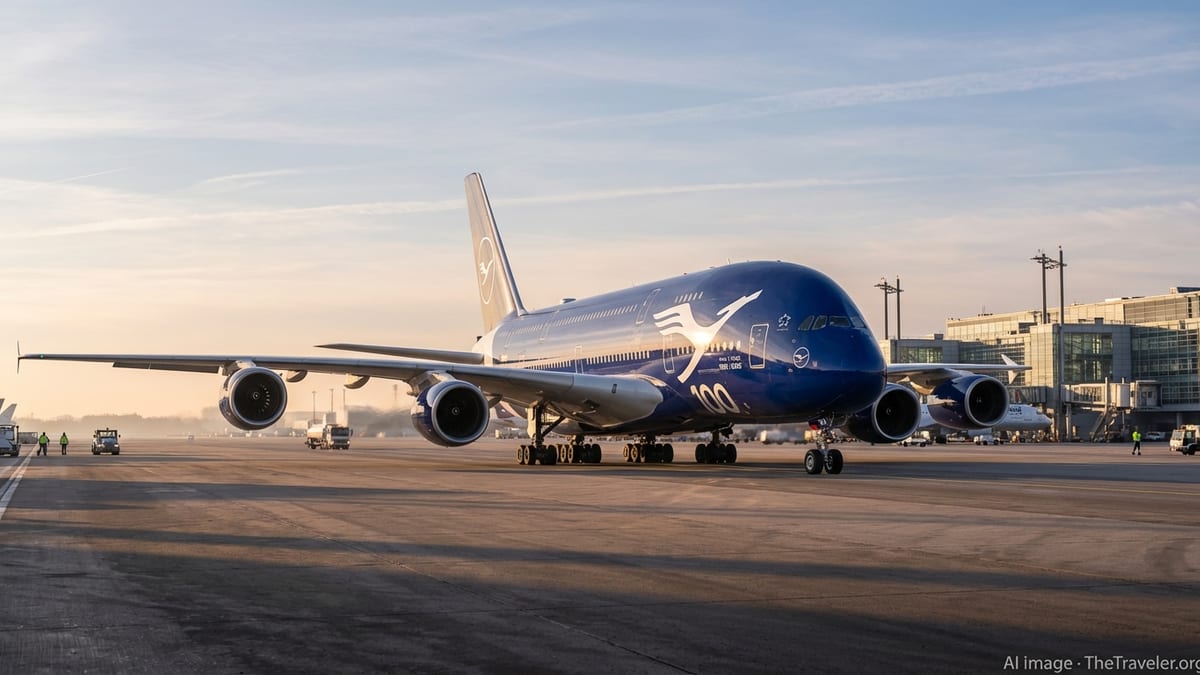
Lufthansa’s Airbus A380 has become the latest and largest aircraft to wear the German carrier’s special 100th anniversary livery, touching down in Munich this week in a dramatic deep blue paint scheme that marks a key milestone in the airline’s centennial celebrations.
A Jumbo Canvas for a Centennial Story
The freshly repainted Airbus A380, registered D-AIMH, arrived at Munich Airport from Shannon, Ireland, after spending more than a month in the paint hangar. Operating as flight LH9901, the superjumbo landed on the evening of February 25, drawing the attention of aviation enthusiasts who have been tracking Lufthansa’s evolving centennial fleet.
The aircraft is now predominantly clad in dark blue, carrying a supersized white crane motif that stretches along the fuselage. The design integrates the number “100” on the left side and underside of the aircraft, while the right side bears the inscription “1926 | 2026,” a nod to the founding of the original Deutsche Luft Hansa in 1926 and the airline’s journey over the past century.
For Lufthansa, putting the special livery on the A380 is both symbolic and practical. The double decker remains the largest passenger aircraft in the airline’s fleet and a flagship on high-density, long haul routes. Giving the superjumbo the anniversary colors visually anchors the centennial theme at major international hubs where the type regularly operates.
The A380 is scheduled to re enter scheduled service from Munich in March, positioning the aircraft to showcase the centennial design across key intercontinental markets during the peak of the anniversary year.
Inside the XXL Crane Makeover
Lufthansa says the repainting of D-AIMH was a detailed and labor intensive project. A team of 35 technicians worked for exactly 34 days to complete the transformation of the superjumbo from its standard livery into the bold centennial scheme.
The white crane, the central element of the design, measures around 47 meters in length and extends into the aircraft’s wings, creating a continuous visual line across the A380’s vast surface. In total, more than 4,000 square meters of exterior skin were repainted, an area Lufthansa likens to roughly 16 tennis courts.
To minimize operational disruption and costs, the work was carried out during an already scheduled repainting cycle at Shannon, a long standing heavy maintenance and painting location for European carriers. This approach allowed Lufthansa to introduce the striking new look with only marginal additional expense compared with a regular overhaul.
The result is a high impact visual that is immediately distinguishable on the apron and in the air, giving airport spotters and travelers an unmistakable symbol of the airline’s centennial year whenever the A380 appears at the gate or on approach.
The Growing 100th Anniversary Fleet
The A380 is the fourth aircraft to join Lufthansa’s anniversary lineup, a special fleet created to fly in dedicated centennial colors throughout 2026. The program began late last year when a Boeing 787 9 in the commemorative scheme arrived in Frankfurt as the campaign’s lead aircraft.
Since then, an Airbus A320neo and an Airbus A350 900 have also entered service in the same deep blue livery, operating out of Frankfurt and Munich respectively. Another A320neo in centennial colors is due to join the fleet shortly, adding more opportunities for passengers on European routes to encounter the design in daily service.
According to the airline’s previously announced plans, two more long haul flagships are scheduled to follow. In the coming weeks, a Boeing 747 8 and an Airbus A350 1000 will receive the anniversary paint scheme, bringing the total number of specially liveried aircraft to seven across six different types.
By distributing the centennial design across both widebody and narrowbody aircraft and basing them at different hubs, Lufthansa aims to ensure that frequent flyers, casual travelers, and aviation fans alike have a good chance of seeing at least one member of the anniversary fleet during the course of the year.
Symbolism, Strategy and Passenger Appeal
Beyond its visual impact, the centennial livery is designed to underline the airline’s message of continuity between its historic roots and its modern, global network. The use of the crane, a long standing emblem of Lufthansa, in an oversized, stylized form across a contemporary blue fuselage is intended to connect tradition with a forward looking image.
The anniversary fleet also supports a broader brand and commercial strategy. Special liveries tend to attract outsized attention on social media and among aviation enthusiasts, generating organic publicity for the carrier. At the same time, they serve as a visible talking point for crew and passengers, especially as the airline highlights its 100 year story in in flight magazines, lounges, and marketing campaigns.
For Lufthansa’s most loyal customers, the centennial aircraft offer a new collectible element to their travels. Many frequent flyers track and log the registration numbers of the aircraft they fly, and the presence of a small group of unique liveries encourages itinerary planning that favors flights operated by these special jets.
As the A380 in its new colors prepares to enter service from Munich, it will join a rolling sequence of centennial aircraft deliveries and repaints that will continue into the second half of 2026, keeping the anniversary narrative active each time one of the distinctive blue aircraft takes to the skies.
What Travelers Can Expect to See
Passengers encountering the A380 and its sister centennial aircraft will find that the changes are largely skin deep. The anniversary branding is focused on the exterior, leaving Lufthansa’s current onboard product unchanged on the A380 and on the other types that wear the special colors.
From the terminal and the jet bridge, however, the difference is impossible to miss. The deep blue fuselage, contrasted with the bright crane and bold anniversary numerals, creates a markedly different ramp presence from the airline’s standard white and blue livery. The large “100” on the underside is particularly visible during takeoff and landing for spotters watching from outside the airport perimeter.
As the aircraft returns to regular long haul rotations from Munich in March, travelers can expect to see the centennial A380 on some of Lufthansa’s busiest intercontinental routes, depending on seasonal scheduling and demand. The airline has not formally dedicated the aircraft to specific city pairs, giving operations teams flexibility while still ensuring the special livery makes frequent appearances at major global gateways.
For now, aviation photographers and enthusiasts are closely tracking the superjumbo’s movements as it completes final preparations and crew training flights. Once in full revenue service, D-AIMH will become one of the most photographed aircraft in Lufthansa’s modern history, serving as a flying tribute to one hundred years of German commercial aviation.