

More news on this day
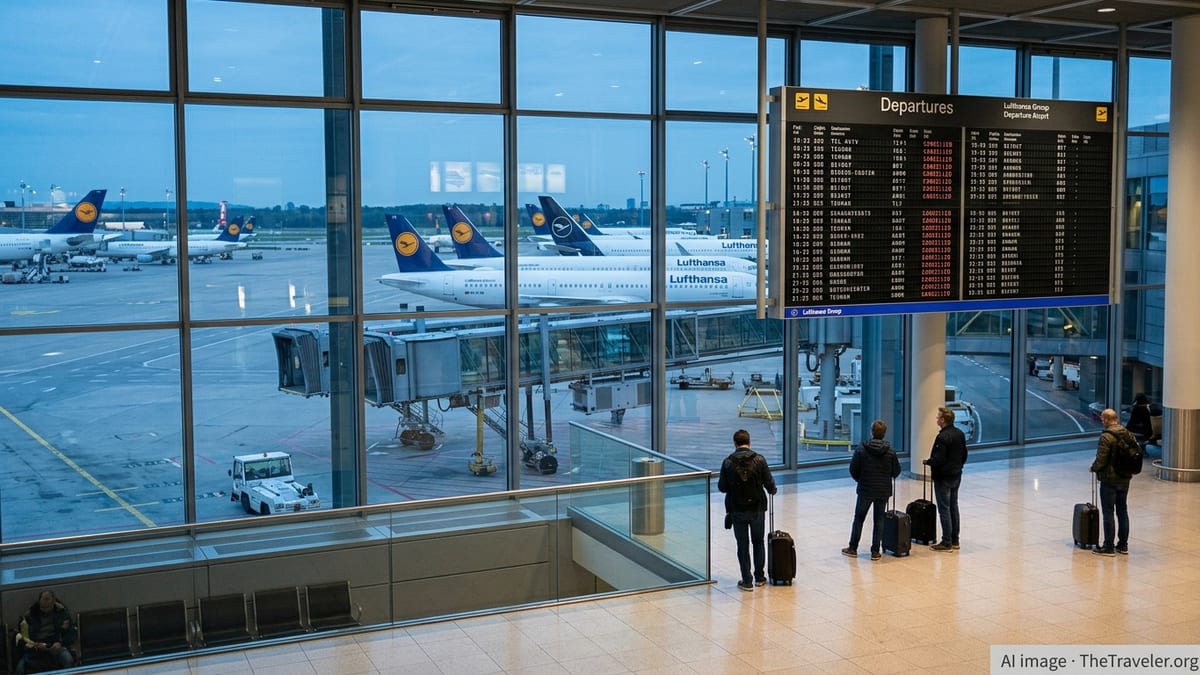
Lufthansa Group airlines are suspending most of their passenger services to the Middle East until October 24, 2026, as the carrier family recalibrates its network in response to heightened regional conflict, airspace restrictions and elevated operational risk across multiple countries.
Get the latest news straight to your inbox!
Scope of the Suspension Across Lufthansa Group Carriers
Publicly available booking data and network information indicate that Lufthansa, SWISS, Austrian Airlines and Brussels Airlines have removed the bulk of their Middle East destinations from sale through October 24, 2026. In many cases only limited inventory or placeholder schedules appear in reservation systems, signalling a prolonged reduction rather than a short-term schedule tweak.
The suspensions primarily affect routes linking key European hubs such as Frankfurt, Munich, Zurich, Vienna and Brussels with cities including Tel Aviv, Tehran, Beirut, Amman and major Gulf gateways. Some flights show as unavailable or restricted to higher booking classes only, while others no longer appear at all for travel before the late-October cutoff.
Network planning material for the 2025 to 2026 winter season already highlighted a reduced presence in parts of the region, and the latest schedule moves now extend that retrenchment into the following summer and early autumn. The October 24 date aligns broadly with the close of the northern summer timetable period, suggesting that a more fundamental review of Middle East operations is underway before the 2026 to 2027 winter schedule.
Although details vary by airline and destination, the pattern across the group points to a coordinated response. The four carriers share joint network planning and are adjusting capacity in tandem, with traffic partly redirected via alternative hubs and overflight corridors outside the most volatile airspace.
Security and Airspace Risk Driving Network Decisions
The decision to extend the halt on most Middle East services into late 2026 is rooted in a complex security environment spanning multiple conflict zones. Since 2023, commercial aviation in the wider region has been repeatedly disrupted by the Israel–Hamas conflict, attacks affecting airspace around Israel, escalations involving Iran and cross-border tensions that have triggered precautionary airspace warnings.
Destination reports and risk assessments circulated to corporate travel managers and universities have for some time flagged elevated security risks at airports such as Beirut and Tehran, as well as the potential for rapid changes in operating restrictions. In Iran, the suspension of international flights at key gateways and the impact of the ongoing Iran war have sharply limited the viability of scheduled European services.
Flight-tracking data and news coverage show large detours around Iranian and Iraqi airspace for long-haul routes between Europe and Asia, adding cost and complexity for airlines that continue to serve the broader region. For Lufthansa Group, these indirect routings reduce the efficiency of using traditional Middle East stopovers and make point-to-point flights into high-risk areas less commercially and operationally attractive.
Insurers and aviation safety agencies have also maintained heightened scrutiny of operations in and near conflict zones. Rising war-risk insurance premiums, coupled with guidance to avoid certain flight information regions, weigh heavily on airline risk calculations and help explain why carriers may prefer to withdraw entirely from certain markets rather than maintain a minimal presence.
Impact on Travelers and Corporate Travel Programs
The prolonged suspension through October 24, 2026 creates significant uncertainty for leisure travelers, expatriates and business passengers who have long relied on Lufthansa Group’s network to connect Europe with the Middle East. It affects not only point-to-point itineraries but also complex multi-leg journeys that link regional cities to North America, Africa and Asia via the group’s hubs.
Travel forums and passenger reports reference cancelled or altered itineraries, with some travelers finding flights to cities such as Tel Aviv or Amman either unavailable or open only in premium cabins months in advance. In some cases, flights remain visible in timetables but cannot be booked in most fare classes, a practice that often precedes formal cancellation once operational decisions are finalized.
Corporate travel managers and institutional coordinators are responding by shifting bookings to other European or Gulf carriers that still operate into selected Middle East airports, though these airlines are themselves navigating an unstable environment. Many organizations are updating travel advisories, tightening approval processes for trips into higher-risk countries and encouraging the use of virtual meetings where possible.
For passengers already ticketed on affected Lufthansa Group services, standard rebooking and refund policies apply, but options can be limited during peak travel periods. With capacity constrained across the region, re-routing via alternate hubs such as Istanbul or select European gateways can involve longer journey times and higher fares, particularly on short notice.
Operational and Financial Considerations for Lufthansa Group
Strategically, withdrawing most Middle East capacity until late 2026 allows the group to redeploy aircraft and crews to more stable and profitable markets, including transatlantic and intra-European routes where demand remains strong. Industry commentary suggests that this kind of capacity shift may help offset the financial drag of flying around closed airspace and absorbing higher fuel and insurance costs on remaining long-haul services.
Schedule data show that Lufthansa and its sister airlines continue to adjust European feeder traffic in response to these network changes, trimming certain short-haul frequencies that were heavily reliant on onward Middle East connections. This can have knock-on effects for secondary European cities that previously enjoyed multiple daily links to Frankfurt, Munich, Zurich or Vienna primarily to support connecting flows.
At the fleet level, prolonged suspensions can simplify maintenance planning and crew rostering, as aircraft are based closer to home and less exposed to unscheduled disruptions. However, the flip side is a potential loss of market share in key Middle Eastern gateways where local and regional competitors may fill the gap, capturing both origin-and-destination traffic and premium connecting passengers.
Analysts following European aviation note that once airlines withdraw from politically sensitive markets for an extended period, returning can be challenging. Rebuilding sales channels, regaining corporate contracts and negotiating fresh airport and handling arrangements all take time, and depend on sustained improvements in security assessments and demand.
What Travelers Should Watch in the Coming Months
Although October 24, 2026 is the key date currently reflected in schedules, industry observers caution that it should be seen as a planning horizon rather than a firm commitment to resume all suspended routes. Timetables are typically adjusted several months in advance, and any meaningful change in the regional risk profile could lead to either an earlier partial return or further extensions.
Travelers with long-range plans involving affected destinations are advised by travel risk consultancies and corporate guidance documents to monitor airline announcements closely and to avoid relying on speculative schedules that appear beyond the published suspension window. In many cases, alternative routings via more stable hubs or different carriers may offer greater certainty, even if they are less convenient.
Airspace restrictions will remain a critical factor to watch. As long as large sections of Middle Eastern skies are subject to warnings, diversions or outright closures, European airlines are likely to prioritise overland and polar routings that limit exposure to the region. This dynamic shapes not only where Lufthansa Group flies, but also how it serves long-haul markets in Asia and Africa.
For now, the removal of most Lufthansa Group services to the Middle East until October 24, 2026 underscores how deeply aviation is intertwined with geopolitical developments. The eventual timing and scale of any return to the region will depend less on commercial appetite and more on the evolution of conflicts, diplomatic efforts and the overall risk landscape that airlines must navigate.