

More news on this day
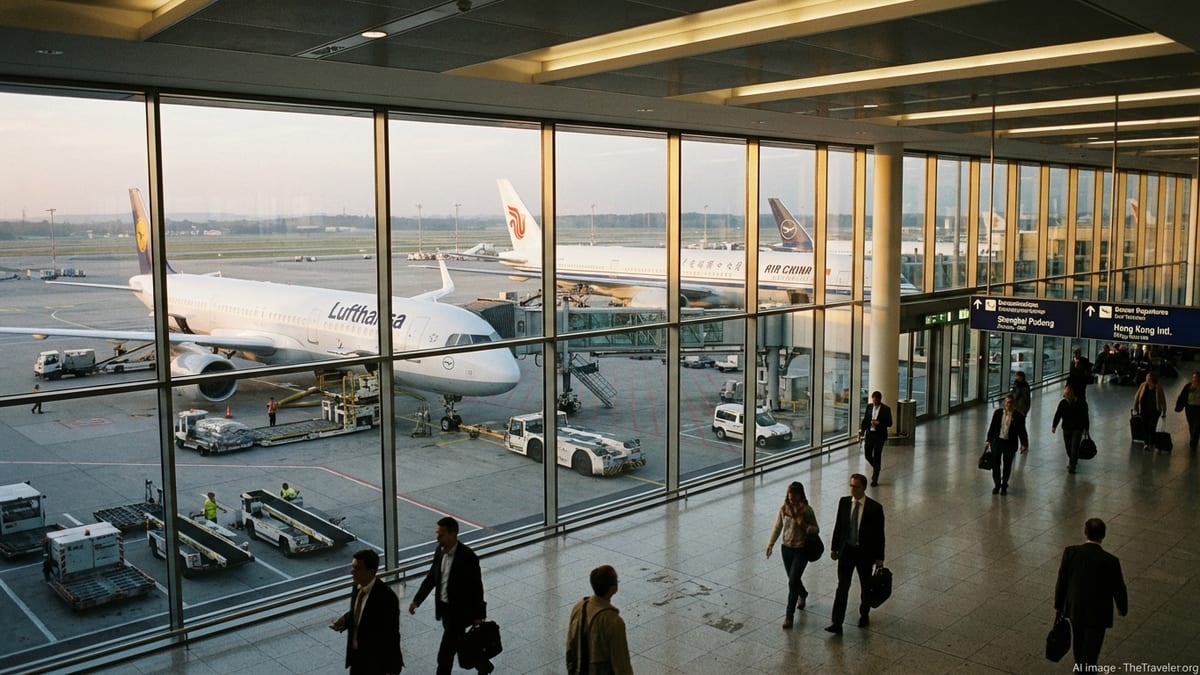
Lufthansa is executing one of its most significant overhauls of China services in years, reinforcing its presence in Shanghai and Hong Kong while reworking how travelers reach Beijing and deepening its joint venture with Air China. For European and North American passengers eyeing Asia’s biggest market, the reshuffle marks a structural shift in how, and where, they will connect.
Frankfurt to Beijing Pullback Signals Strategic Reset
The clearest sign of change is on the historic Frankfurt–Beijing corridor. After months of weak profitability and higher operating costs, Lufthansa has paused nonstop Frankfurt–Beijing flights for the current winter–spring season, shifting its own Beijing focus to Munich while relying more heavily on joint venture partner Air China to cover capacity between the Chinese and German capitals. Industry reports indicate that the Frankfurt–Beijing suspension follows a gradual downgrade of aircraft on the route, from flagship Airbus A380 and Boeing 747-8 services to smaller Airbus A340s, before operations were halted.
The decision places Lufthansa at odds with its pre-pandemic strategy, when Frankfurt served as the group’s primary Chinese gateway and Beijing one of its crown jewels in Asia. Now, Lufthansa is prioritizing yield and network profitability over sheer capacity, even if it means ceding some nonstop market share to Chinese carriers and concentrating its own metal where demand patterns and aircraft economics align better.
For travelers, the practical effect is that the classic Frankfurt–Beijing nonstops are increasingly replaced by routings via Munich or through codeshare flights operated by Air China. The airline insists that overall connectivity remains strong, but the symbolic retreat from Frankfurt–Beijing underscores both the cost pressures on European airlines flying long detours around Russian airspace and the growing competitive strength of Chinese carriers on trunk routes.
Shanghai Emerges as Lufthansa’s Flagship China Gateway
Against this backdrop, Shanghai is becoming the centerpiece of Lufthansa’s mainland strategy. The carrier has restored and then expanded its schedule from Germany to Shanghai, with daily nonstops from Munich to both Shanghai and Beijing in its 2024 summer program and further frequency growth since then. Group executives have highlighted Shanghai as Lufthansa’s first Asian destination to feature the new Allegris long-haul cabin on the Airbus A350-900, underscoring the commercial importance of the city for premium corporate and high-yield leisure traffic.
The choice of Shanghai for Lufthansa’s newest onboard product is not accidental. The city sits at the heart of Europe–China trade and German industrial investment, and traffic has rebounded faster here than on some other Chinese routes. Local airport authorities report a double-digit increase in daily scheduled flights across Shanghai’s two airports in the current summer seasons, with Frankfurt singled out among key intercontinental connections, helping support robust two-way flows of business travelers and increasingly, long-haul tourists.
By leading with its latest cabin and routing additional widebody capacity into Shanghai, Lufthansa is sending a clear signal: for European travelers heading to eastern China or transiting deeper into the domestic network, Shanghai is now the preferred entry point. As more connecting banks are built around these flights in Munich and Frankfurt, Shanghai’s role as Lufthansa’s anchor in mainland China is likely to grow.
Hong Kong Capacity Returns as a Premium Asia Hub
Hong Kong, once a victim of prolonged travel restrictions and shifting demand, is re-emerging as a key spoke in Lufthansa’s Asia network. The German carrier has steadily restored frequencies to the territory, aligning schedules to capture premium traffic between Europe and southern China as well as long-haul connections toward Australia and Southeast Asia on partner airlines. While Lufthansa no longer deploys its largest aircraft here, it is leaning on efficient twin-engine widebodies with upgraded cabins, reflecting a focus on yield over volume.
The broader market context is crucial. Several European competitors have trimmed or reconfigured their presence in Greater China, reducing flights into secondary Chinese cities or pulling widebody capacity from Hong Kong. Lufthansa’s strategy instead positions the city as a high-value, though more focused, hub: fewer but better-timed flights dovetail with alliance and interline partners to extend reach into the Pearl River Delta and beyond.
For travelers, that means Hong Kong is regaining its appeal as a flexible, premium gateway between Europe and Asia, even as some non-European airlines add competing services. With a stable schedule and modern cabins, Lufthansa appears intent on using Hong Kong to complement, rather than compete with, its strengthened Shanghai offering.
Air China Alliance Deepens to Keep Europe–China Flows Intact
Underpinning these visible route changes is an increasingly important commercial reality: Lufthansa’s joint venture with Air China is doing more of the heavy lifting. The Europe–China partnership, which already coordinates schedules and revenue sharing across multiple hubs and participating airlines, has become central to preserving connectivity on routes where European carriers alone struggle to make the numbers work.
As Lufthansa scales back direct Frankfurt–Beijing flying, Air China’s own services between the two capitals pick up a larger share of demand, marketed in Europe under Lufthansa code and integrated into its distribution systems. This allows Lufthansa to maintain a competitive one-stop proposition from dozens of European cities into Beijing and onward into Air China’s domestic network, while redirecting its own aircraft to stronger or higher-margin markets such as Shanghai and selected North American and Middle Eastern destinations.
The joint venture also helps smooth irregularities caused by aircraft delivery delays and shifting fleet plans. With first deliveries of new long-haul types like the Boeing 777-9 pushed further into the future, Lufthansa is juggling Airbus A350 deployments and even reactivating older A340s at its hubs. The ability to lean on Air China’s capacity in key Chinese markets buys flexibility at a time of constrained widebody supply and structurally higher costs on long Asia sectors.
What Travelers Should Watch in the New Europe–China Landscape
For passengers, the changes amount to more than a behind-the-scenes network tweak. It is becoming increasingly likely that itineraries between Europe and northern or central China will route via Munich or Shanghai rather than the traditional Frankfurt–Beijing pairing, and that at least one leg may be operated by Air China under a Lufthansa flight number. At the same time, Hong Kong is regaining prominence as a premium corridor into southern China and onward to the wider Asia-Pacific region.
Fares and schedules will reflect this new geometry. With capacity on some classic trunk routes still below pre-pandemic levels and operating costs elevated, travelers can expect continued pressure on prices during peak seasons, especially in premium cabins. However, the introduction of Lufthansa’s newest onboard products on the Munich–Shanghai route and selective use of modern twin-engine jets elsewhere will improve the experience for those willing to plan around the new hubs and banks.
Perhaps the most important takeaway is that Europe–China travel is not reverting to its pre-2020 map. As geopolitical tensions, airspace detours, and competitive dynamics reshape long-haul aviation, Lufthansa’s pivot toward Shanghai and Hong Kong, combined with a more alliance-driven approach to Beijing, suggests that passengers will increasingly navigate a joint, multi-hub ecosystem rather than a single dominant gateway. For frequent flyers and corporate travel planners alike, understanding this shift will be essential to securing the best routings, products, and value in the years ahead.