

More news on this day
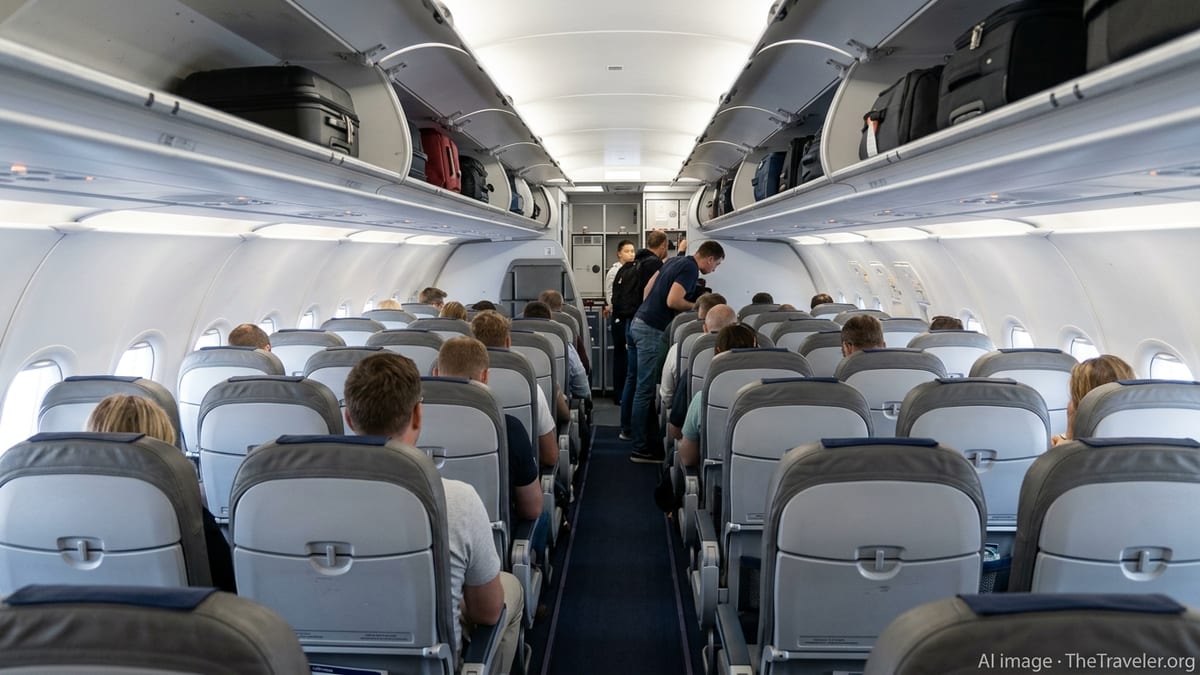
Lufthansa is accelerating a quiet but consequential reshaping of its European short-haul cabins, testing denser layouts and slimmer seats that highlight a strategic turn toward cost efficiency and away from traditional notions of spaciousness in economy class.
Get the latest news straight to your inbox!
A Retrofit Program That Adds Seats and Shifts Space
Lufthansa’s latest short and medium haul cabin initiative centers on refitting existing Airbus A320 family aircraft with a more compact interior, bringing them into line with its newer A320neo layout. Publicly available fleet information shows that the A320neo already carries 180 passengers, adding roughly a dozen extra seats over previous A320 configurations without changing the aircraft’s external dimensions. The retrofit program now aims to extend that denser blueprint across parts of the older narrowbody fleet from 2025 onward.
Group communications describe the new cabins as “innovative” and emphasize larger overhead bins and refreshed materials, but the overall design logic is centered on higher seat density. Reports and seat maps indicate that Space-Flex style rear galleys and lavatory modules, along with slimmer Recaro-style seats, allow airlines to free up sufficient space in the cabin for additional rows. In practice, this means redistributing square footage from crew work areas and lavatories into revenue-generating seats.
Industry and passenger commentary on Lufthansa’s A320neo layout over recent years has consistently highlighted tighter legroom and more constrained personal space, especially toward the rear of the aircraft where the cabin tapers and lavatories are clustered. With the retrofit program explicitly referencing the neo-style cabin as a template, many travelers expect a similar, more compressed experience to spread across the continental fleet.
Cost Pressures Drive a Group-Wide Narrowbody Strategy
The push to standardize denser cabins is unfolding alongside a broader restructuring of the Lufthansa Group’s short-haul network. The launch of Lufthansa City Airlines in 2024, operating Airbus A320 family aircraft as a dedicated feeder carrier, was framed in public documents as a way to secure a more competitive cost structure on intra-European routes. The group has also been shifting capacity among Eurowings and Discover Airlines, positioning them to serve price-sensitive leisure traffic with lower unit costs.
Annual reports and capital markets presentations portray this as a portfolio approach: Lufthansa mainline focusing on primary business markets and connectivity, while affiliated brands and feeder airlines absorb much of the volume on thinner or leisure-heavy routes. In all cases, however, the narrowbody workhorse remains the A320 family, and the trend toward harmonized, high-density interiors ties directly into the group’s efforts to improve per-seat economics.
Seat densification has become a common lever for European airlines under pressure from low-cost competitors. By adding rows without significantly increasing crew numbers or operational complexity, carriers can lower cost per available seat kilometer. Lufthansa’s retrofit program reflects that same calculus. Even incremental changes such as lighter slimline seats and compact galley-lavatory blocks can yield measurable gains in fuel burn per passenger and overall margins on shorter sectors.
Passenger Backlash Over Comfort and Cabin Layout
While the financial rationale is clear, passenger reaction to Lufthansa’s newer short-haul cabins has often been critical. Aviation-focused publications and traveler forums have for years documented complaints about reduced pitch, firmer slimline seats and the feeling of crowding around the aft lavatories on A320neo aircraft. Early coverage of the Space-Flex based layout described the response as notably negative, with some travelers citing long queues for smaller toilets and a loss of traditional standing space in the rear galley.
Seat maps and user reports suggest that particular rows, especially near the rear exits and lavatories, are perceived as significantly less comfortable due to limited recline, constant foot traffic and reduced space to stretch. For passengers accustomed to the more generous layouts found on older A320s or larger widebody aircraft, the transition to a denser narrowbody can be jarring, even on flights of only two or three hours.
The decision to prioritize additional capacity can also blur the perceived distinction between Lufthansa and its lower cost rivals. Although the airline continues to promote premium touches such as free middle seats in European business class and larger cabin baggage allowances than ultra-low-cost carriers, critics argue that seat comfort and personal space in economy have converged toward the broader industry minimum. The retrofit initiative risks reinforcing that perception if travelers experience visibly smaller lavatories and noticeably tighter rows on previously roomier aircraft.
Short-Haul Trade-Offs for Business and Leisure Travelers
For frequent business travelers, the short-haul cabins serve as the first and last impression of a trip that may otherwise feature a long haul connection on a more spacious aircraft. Denser seating, limited recline and increased congestion during boarding and disembarkation can erode the sense of seamless premium travel, even when service levels and loyalty benefits remain intact. Reports from route launches and schedule announcements show that Lufthansa is increasingly relying on narrowbodies to feed long haul banks at Frankfurt and Munich, making the short European segment an integral part of the overall product.
Leisure travelers, meanwhile, may be more price sensitive but are not immune to the impact of cabin changes. Families and groups often find themselves competing for overhead bin space, despite Lufthansa’s emphasis on larger compartments in the new cabins, simply because more passengers are now sharing the same area. On busy holiday departures, a fully densified A320 can feel more like a low-cost carrier experience, albeit with additional services layered on top.
At the same time, some passengers accept the trade-off as an inevitable aspect of modern short-haul flying. Public discussion frequently highlights that many European airlines have already embraced non-reclining slimline seats and high-density layouts as standard, making Lufthansa’s shift appear more evolutionary than radical in the wider market context. For travelers focused mainly on schedule, reliability and price, modest reductions in legroom may be tolerable, particularly on flights under two hours.
What the Experiment Signals for Future Cabins
Lufthansa’s short-haul retrofit program is still at a relatively early stage, but the direction is clear. By projecting the A320neo style interior across a larger portion of its continental fleet, the group is signaling that seat density and unit costs take precedence over incremental gains in personal space. The move aligns with a wider industry narrative in which cabin innovation on shorter routes is more about optimizing revenue per square meter than expanding comfort margins.
Reports from within the Lufthansa Group also indicate that lessons learned from trials at Eurowings and other subsidiaries may influence future cabin decisions at the mainline brand. Test configurations that prove particularly efficient could be adopted more widely, while layouts that generate strong customer pushback may be adjusted or limited to specific markets. The current “pinch-to-polish” phase, in which square centimeters are shaved in one area and subtly upgraded in another, appears to be part of a broader cycle of experimentation.
Looking ahead, travelers on Lufthansa’s European network are likely to encounter a more standardized but leaner cabin experience, with visual refinements and improved storage partially offsetting the reality of added seats and tighter spaces. For the airline, the challenge will be to maintain its reputation as a full service carrier while pursuing cost disciplines that increasingly resemble those of its low-cost competitors. The outcome of this short-haul experiment may help define what passengers come to expect from European premium brands in the narrowbody era.