

More news on this day
Thailand’s tourism industry has been jolted by an unexpectedly strong rebound from China this Lunar New Year, with officials now projecting around 241,000 Chinese visitors between February 13 and 22, far above initial expectations and adding fresh momentum to the country’s post-pandemic recovery.
Forecasts Smashed as Chinese Arrivals Rebound
The Tourism Authority of Thailand, which had cautiously projected a steady but moderate rise in visitors from China this year, is now recalibrating its expectations after updated Lunar New Year figures. Tourism planners initially expected a solid holiday period but not a dramatic surge, given lingering safety concerns and competition from other regional destinations. Instead, bookings and on-the-ground arrivals have pointed to a sharp uptick, with around 241,000 Chinese tourists now anticipated over the ten-day festival window.
The revised outlook reflects a broader shift in sentiment among Chinese travelers. Just a year ago, Thailand’s appeal was dented by high-profile security incidents and social media debate about safety standards. This season’s performance suggests that aggressive marketing, improved security messaging and visa facilitation are starting to pay off. The Lunar New Year holiday, traditionally one of the most important travel periods for Chinese outbound tourism, has become a critical barometer of whether Thailand can win back its pre-pandemic share of this key market.
The new numbers fold into a wider recovery story. Between January 1 and early February, nearly half a million Chinese visitors had already arrived, signaling that demand was building well before the New Year break officially began. As the holiday approached, daily arrivals from China climbed toward roughly 20,000 a day, pushing the final Lunar New Year tally far beyond what most analysts had predicted at the start of 2026.
For Thailand, the 241,000-strong wave of Chinese holidaymakers is more than a headline figure. It is a symbolic milestone that reinforces the country’s status as one of Asia’s most resilient tourism economies, even as regional rivals compete fiercely for the same market.
Nationwide Celebrations Designed to Anchor Spending
This year’s Lunar New Year strategy in Thailand goes beyond simply counting arrivals. Tourism authorities have focused heavily on converting visitor numbers into longer stays and higher per capita spending by organizing coordinated celebrations in multiple regions. Rather than concentrating all festivities in Bangkok, planners have rolled out a countrywide calendar of events timed specifically to the February 13 to 22 travel window.
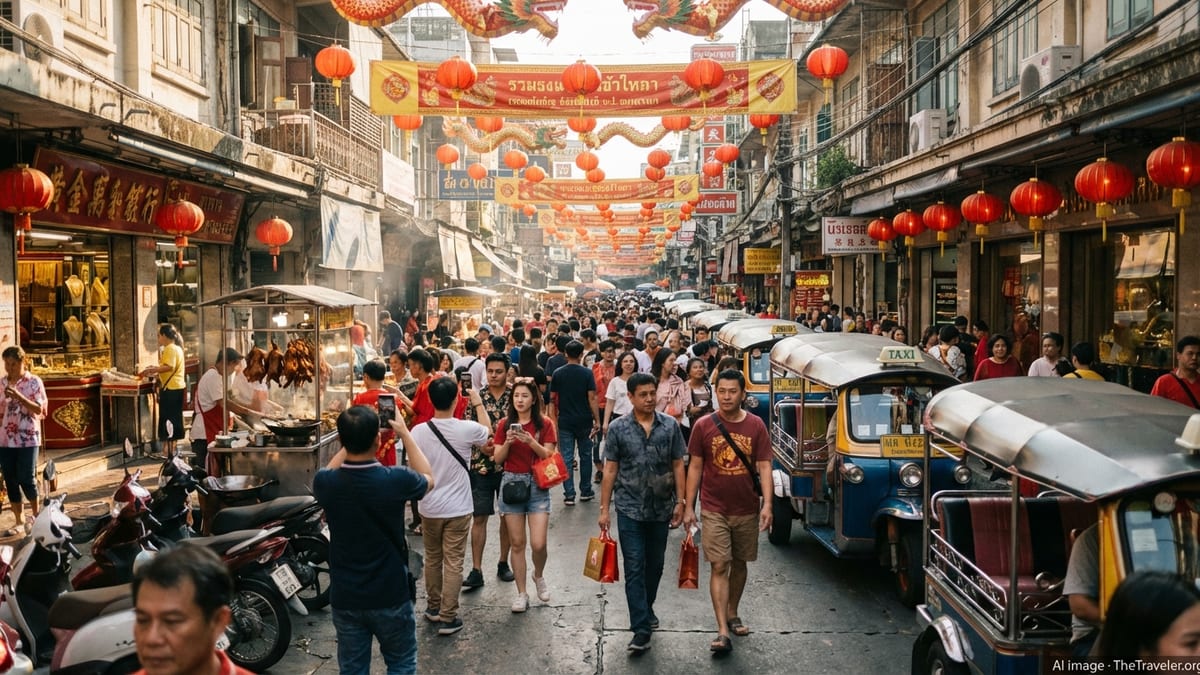
In the capital, Bangkok’s Chinatown along Yaowarat Road has been transformed with extensive decorative lighting, red lanterns and themed installations stretching from the iconic gateway at Odeon Circle down to Chaloem Buri Junction. Light shows, cultural performances and evening markets are designed to keep tourists in the district after dark, encouraging additional spending at restaurants, street food stalls and gold shops that traditionally see brisk business during the festival.
High-end retail and urban leisure are also part of the plan. Central shopping hubs such as Siam Paragon are staging large-scale Chinese New Year festivals featuring dragon and lion dances, acrobatic troupes from China, and interactive activities that blend Thai and Chinese traditions. These events are being promoted heavily to Chinese visitors through online travel agencies and social media campaigns, with the aim of driving traffic to Bangkok’s luxury malls and surrounding hotels.
Beyond the capital, regional destinations like Hat Yai in the south, Nakhon Sawan in the lower north and Suphan Buri in central Thailand are hosting their own signature celebrations. Hat Yai is highlighting cultural exchanges with China’s Fujian Province, while Nakhon Sawan’s long-running Chinese New Year procession and Suphan Buri’s dragon-themed festivities are being positioned as must-see attractions for both domestic and foreign visitors. Collectively, these events are expected to support more than 3.5 million trips nationwide during the period, combining international arrivals with increased domestic travel.
Airport Capacity and Safety Put to the Test
The Chinese New Year influx is also a test of Thailand’s aviation and border infrastructure. Airports of Thailand and the Department of Airports have been preparing for weeks to handle a surge in passenger volumes at the country’s six main international gateways, including Bangkok’s Suvarnabhumi and Don Mueang, as well as Chiang Mai, Chiang Rai, Phuket and Hat Yai. Authorities have deployed additional staff to immigration counters, baggage halls and security checkpoints in an effort to minimize queuing times during peak arrival hours.
Capacity management is not simply an operational issue. After previous holiday spikes led to complaints about long lines and missed connections, the government has been under pressure to show that it can accommodate higher traffic without sacrificing service quality. This year, airport operators are leaning more heavily on digital systems for passenger flow monitoring and are extending shifts for frontline staff. Travelers have been advised to arrive at least two to three hours before departure for international flights, underscoring how closely authorities are watching the strain on facilities.
Safety, both in the air and on the ground, has been elevated as a central theme in communications with the Chinese market. Aviation authorities have reiterated compliance with international standards covering runway inspections, wildlife management and aircraft operations, highlighting enhanced monitoring to reduce the risk of incidents such as bird strikes. At the same time, police and tourism security units have stepped up visible patrols in high-traffic tourism zones, from Chinatown and riverside piers in Bangkok to popular resort districts in Phuket and Chiang Mai.
The messaging is targeted squarely at restoring confidence. Following widely publicized criminal cases involving Chinese nationals in the region, Thai officials know that perceptions of safety can shift quickly on social media platforms. The ability to accommodate a sudden jump in Chinese arrivals over the Lunar New Year holiday, without major disruptions or high-profile security incidents, is viewed as essential to rebuilding Thailand’s reputation as a safe and welcoming destination.
Economic Stakes: Billions of Baht Riding on the Holiday
The financial implications of the Lunar New Year surge are substantial. Chinese visitors have long been among Thailand’s highest-spending tourists, and even a relatively short holiday can generate a disproportionate share of annual tourism revenues. For this year’s festival period, authorities expect tens of billions of baht in direct spending on hotels, flights, food, shopping and excursions, feeding into broader economic recovery targets.
Thailand’s tourism planners are tracking not only raw arrival numbers but also patterns of expenditure. Early data suggest that a significant share of Chinese holidaymakers are returning to pre-pandemic behavior, favoring centrally located three- and four-star hotels, group excursions and organized shopping tours. At the same time, a growing segment of younger, independent travelers is gravitating toward boutique accommodations, café culture and social media-friendly experiences, distributing spending more widely across local businesses.
For small and medium-sized enterprises, particularly in city-center neighborhoods and secondary destinations, the holiday influx can be decisive. Street food vendors and family-run restaurants in Chinatown, guesthouses in heritage quarters and souvenir shops near temples all see Lunar New Year as a critical opportunity to rebuild savings depleted during the pandemic downturn. The anticipated wave of 241,000 Chinese visitors is expected to provide an important cushion ahead of quieter travel months later in the year.
Macroeconomically, the festival fits into a broader push by the government to restore tourism receipts to 2019 levels, when international arrivals generated trillions of baht in revenue. Meeting that goal will depend heavily on how quickly Chinese demand can be rebuilt and sustained beyond peak holiday periods. The better-than-expected New Year performance offers encouraging signals, but policymakers are aware that a single successful holiday season cannot, on its own, guarantee long-term stability.
Marketing Blitz in China: From Online Agencies to Influencers
The stronger-than-forecast Lunar New Year turnout has not happened by accident. Thailand’s tourism authorities have mounted an intensive marketing campaign in mainland China, working closely with major online travel agencies and airlines to push discounted packages, bundled promotions and special event tie-ins. Partnerships with prominent Chinese platforms have enabled Thailand to showcase curated itineraries focused on culture, wellness, gastronomy and shopping, all framed around the convenience of visa-friendly entry and frequent flight connections.
Digital storytelling has been central to this effort. Chinese influencers and key opinion leaders have been invited to experience Thai destinations ahead of the holiday, producing videos and posts that highlight safer travel options, family-friendly activities and new attractions. Content ranges from late-night food tours in Bangkok’s Chinatown to sunrise temple visits in Chiang Mai and beach escapes in the south, all designed to reinforce images of Thailand as both familiar and fresh to repeat visitors.
The messaging has also been carefully calibrated to address concerns that previously dampened demand. Official campaigns emphasize enhanced policing in tourist zones, clear channels for reporting incidents, and coordination between Thai and Chinese authorities to protect travelers. By balancing reassurance with aspirational imagery, tourism officials hope to encourage hesitant travelers to return while persuading first-time visitors to choose Thailand over competing destinations such as Japan, Vietnam and Malaysia.
Crucially, the latest Lunar New Year performance is feeding directly back into these campaigns. Stronger-than-expected arrivals during the festival provide fresh material for success stories, allowing marketers to present Thailand as a destination where Chinese tourists are already returning in significant numbers and enjoying smooth, incident-free trips.
Shifting Travel Patterns and Destination Hotspots
This year’s Lunar New Year has also revealed subtle shifts in how Chinese visitors are experiencing Thailand. While classic destinations such as Bangkok, Phuket and Chiang Mai remain dominant, tourism operators report increased interest in secondary cities and emerging cultural hubs. Some Chinese travelers, particularly repeat visitors, are seeking out less crowded neighborhoods, riverside communities and smaller provincial towns that offer a different perspective on Thai life.
In Bangkok, Yaowarat and nearby Old Town districts are seeing a mix of traditional group tours and independent travelers exploring temples, markets and heritage shophouses at their own pace. Canal-side communities and newly revitalized warehouse districts are drawing younger Chinese tourists interested in photography and local street culture. These dispersal patterns are easing some pressure on saturated attractions while spreading tourism income more broadly across the capital.
In the south, coastal provinces beyond Phuket, including parts of Phang Nga, Krabi and the Gulf of Thailand, are capturing more Chinese holidaymakers during the New Year break. Island-hopping excursions, snorkeling trips and wellness retreats are proving popular among families and younger couples alike. Meanwhile, in the north, Chiang Mai and nearby mountain towns are leveraging cooler weather, coffee culture and craft markets to appeal to visitors looking for a slower-paced holiday.
Tour operators say these evolving preferences could shape product development throughout 2026. Packages that combine headline destinations with lesser-known stops are gaining traction, as travelers look for a balance between iconic sights and more intimate, local experiences. The Lunar New Year wave has offered a live test of which itineraries resonate most strongly with the returning Chinese market.
Balancing Booming Demand with Long-Term Sustainability
As Thailand celebrates the unexpected strength of Chinese arrivals this Lunar New Year, officials and industry leaders are increasingly focused on how to manage future growth sustainably. The pandemic pause, followed by a gradual recovery, highlighted longstanding concerns about overcrowding in popular areas, environmental stress in fragile marine ecosystems and the uneven distribution of tourism benefits.
In response, authorities are using this year’s festival period as an opportunity to trial measures aimed at smoothing out visitor flows and promoting more responsible travel behavior. These include encouraging off-peak visits to heavily trafficked sites, promoting lesser-known attractions, and working with local communities to set guidelines on everything from waste management to respectful conduct at temples and shrines.
For now, the priority is to ensure that the current wave of 241,000 Chinese New Year visitors leaves positive memories rather than logistical frustrations. That means keeping transport links running smoothly, ensuring sufficient capacity in accommodation and attractions, and maintaining clear communication in multiple languages. But beyond the immediate season, the lessons from this year’s holiday will influence how Thailand shapes its tourism model in the years ahead.
If the country can translate this Lunar New Year surge into stable, well-managed growth, it will not only bolster economic recovery but also strengthen Thailand’s position as a destination where high volumes of visitors coexist with cultural authenticity and environmental stewardship. The surprise strength of Chinese arrivals this year suggests that, handled carefully, Thailand’s long courtship of the Chinese travel market may be entering a new, more balanced phase.