

More news on this day
Luton’s main railway station is set for a long-awaited accessibility overhaul as work begins on a multi-million-pound project to deliver step-free access to all platforms by spring 2027, marking a major milestone for inclusive rail travel on one of Britain’s busiest commuter corridors.
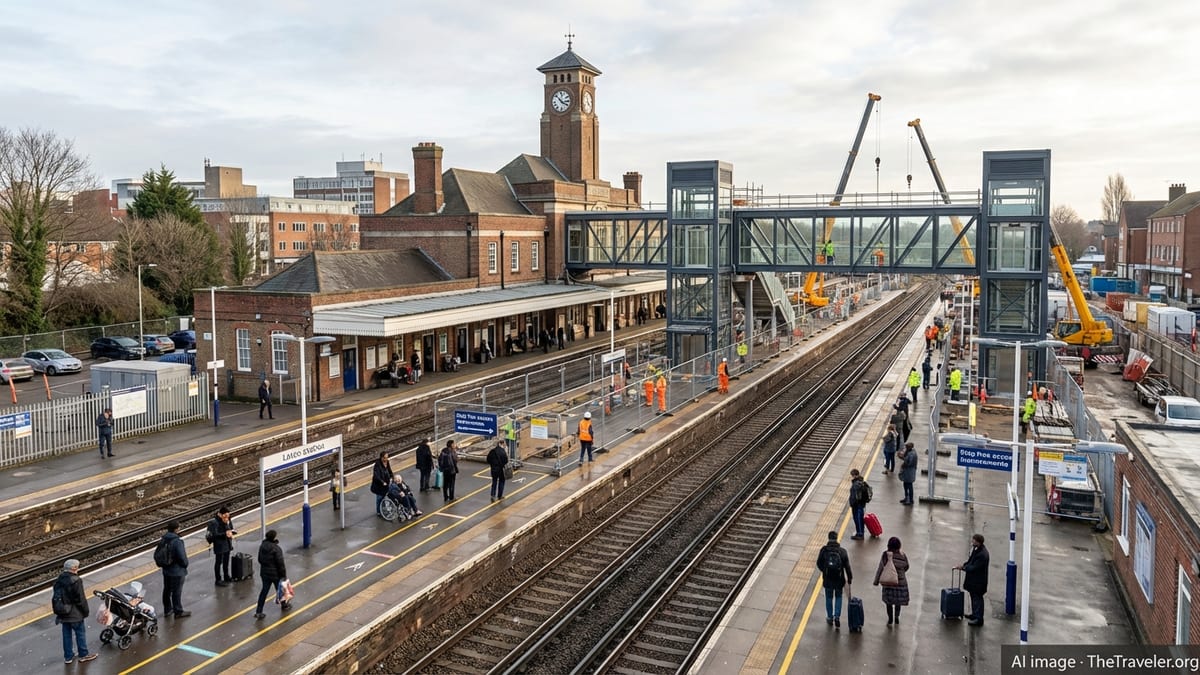
Long-Delayed Accessibility Promise Finally Moves On-Site
Construction teams have started work at Luton station on a transformative upgrade that will, for the first time, provide step-free access to every platform. The scheme, funded through the government’s Access for All programme and delivered by Network Rail in partnership with Govia Thameslink Railway, comes nearly two decades after improvements were first pledged in 2006.
At present, only platform 5 at Luton offers step-free access, leaving passengers who use wheelchairs or have reduced mobility facing significant barriers to reaching other services. Many have relied on staff assistance, circuitous routes, or journeys via other stations to complete trips that should be straightforward.
The new project will see a fully accessible footbridge installed across the station, served by three lifts that will link the main entrance and drop-off points with all platforms. Once complete, passengers will be able to move between trains without using stairs, narrowing the gap between Luton and newer, purpose-built hubs such as nearby Luton Airport Parkway, which already offers level access to platforms.
Network Rail engineers say the main bridge span is scheduled to be lifted into place in June, a key moment that will visibly reshape the station skyline. Fit-out and lift installation will follow through late 2026, ahead of an expected completion in spring 2027.
What the Step-Free Upgrade Will Change for Passengers
The upgrade is expected to transform daily journeys for thousands of people who currently find Luton station difficult or impossible to use independently. For wheelchair users, older travellers, people with hidden disabilities, and those carrying heavy luggage or pushing buggies, the new lifts will turn formerly off-limits platforms into realistic options.
The work will redefine Luton’s classification within the national station accessibility framework. Today it is effectively limited to step-free access on a single platform, but the new bridge and lifts will create a continuous, unobstructed route from street to platform across the site. That shift aligns Luton with the standards achieved recently at other Access for All-funded schemes across the network, where new footbridges, ramps and lifts have opened up stations to a broader range of users.
Accessibility campaigners argue that such projects do more than meet legal obligations. By normalising step-free travel, they say, they encourage more people to swap car journeys for public transport, reducing congestion and pollution in busy urban centres like Luton. For rail operators, better access can also translate into increased ridership, particularly for off-peak leisure travel where families and older passengers make up a large share of demand.
Rail industry figures have repeatedly described station accessibility upgrades as “life-changing” for some customers, pointing to examples where improved access has allowed people to return to work, education or social activities that depended on reliable rail connections.
Managing Disruption During a Complex Station Rebuild
Delivering a major infrastructure project at a live station on a heavily used main line presents significant logistical challenges. Network Rail has confirmed that Luton will remain open throughout the works, with construction carefully staged to keep trains running and core passenger facilities available.
During key phases, including the installation of the new bridge structure, passengers can expect temporary changes to walking routes, platform access points and waiting areas. Periodic closures of sections of the concourse or existing footbridge are likely while heavy lifting operations take place, and some services may be adjusted during overnight or weekend possessions.
Rail operators are advising passengers, particularly those who require assistance, to check station information before travelling and allow extra time to navigate temporary layouts. Staff will be on hand to guide customers through any diversions and to ensure that current step-free routes, limited though they are, remain usable throughout construction.
Local businesses and residents have been warned to expect periods of increased noise and construction traffic around the station. However, the bulk of the most disruptive activities, such as bridge lifts, are expected to be timed to minimise impact on both rail operations and the surrounding town centre.
A Cornerstone of Wider Town Centre Regeneration
The accessibility overhaul at Luton station is a central element of a broader regeneration vision for the town centre. Luton Borough Council has set out plans for a revitalised gateway around the station, including a redesigned entrance, modern ticketing facilities and improved public spaces, alongside new homes, commercial units, a performance venue and an expanded food and leisure offer.
By making the station easier to use for everyone, planners hope to strengthen Luton's role as a rail-connected hub for Bedfordshire and the wider region. Better access is expected to support local employment by widening the catchment area for commuters and making it easier for visitors to reach the town’s shops, venues and events.
The upgrade also complements recent investments in connectivity to Luton Airport, where the dedicated DART shuttle from Luton Airport Parkway already offers step-free links between main line trains and the terminal. Together, the projects form a corridor of more accessible rail travel from the town centre to the airport and beyond, reinforcing Luton's position on key north-south routes between the Midlands, London and the south coast.
Local leaders have welcomed the start of works as a long overdue step that brings the town’s main station closer to the standards increasingly expected at major interchanges elsewhere in the country. They argue that as rail travel modernises, stations that remain partially inaccessible risk deterring visitors and undermining wider regeneration goals.
Luton in the Context of a National Accessibility Push
The Luton scheme is one of a series of major accessibility projects across Britain’s rail network, funded largely through the Department for Transport’s Access for All programme. In recent years, stations from Biggleswade in Bedfordshire to Hither Green in south-east London have received new lifts, bridges and step-free routes as part of a long-term drive to remove barriers for disabled passengers.
Despite this progress, campaigners note that a significant proportion of UK stations still lack full step-free access, particularly on older lines where constrained sites and historic structures make upgrades technically complex and expensive. Projects like Luton’s, they say, demonstrate that even busy, space-limited stations can be transformed with sustained investment and careful engineering.
For operators on the Midland Main Line and the wider Thameslink network, completing the Luton upgrade will close a prominent accessibility gap on a corridor that already includes several modern, fully step-free stations. As the industry looks to rebuild passenger numbers and confidence, especially in the wake of shifting post-pandemic travel patterns, visible commitments to inclusive design are increasingly seen as a core part of the railway’s future.
With the bridge lift scheduled for this summer and completion targeted for 2027, passengers will not see the full benefits overnight. But the first construction work on site is a tangible indication that, after years of delay, Luton is finally on track to become a station that all passengers can use with confidence.