

More news on this day
Luxembourg’s new tram connection to Findel Airport is already transporting more than seventy thousand passengers a month, rapidly transforming how travelers, airport staff, and commuters move between the country’s main air gateway and the capital’s business districts.
Get the latest news straight to your inbox!
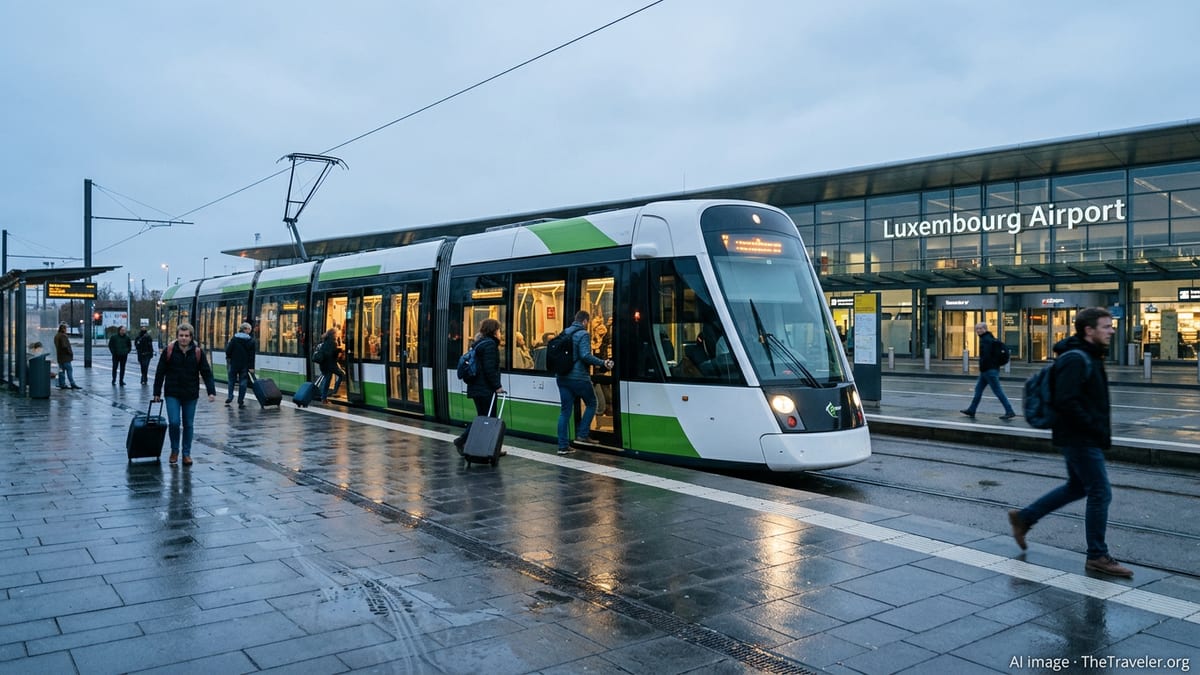
A Fast Start for Luxembourg’s Airport Tram Link
Opened to passengers on 2 March 2025, the extension of Luxembourg’s T1 tram line from Luxexpo to Findel Airport marked the final phase of a long-planned light rail corridor stretching from the city’s south to its eastern gateway. The 3.9 kilometer section crosses the A1 motorway and terminates directly in front of the terminal, placing the airport squarely on the country’s high-capacity urban rail spine.
Luxtram and national mobility planners initially projected about 10,000 additional riders a day once the airport link was fully integrated into the timetable. In its first sustained months of operation, averaged recent counts indicate that more than seventy thousand passengers now use the tram to reach or leave the airport every month, a figure authorities say is broadly in line with expectations and still growing as awareness spreads.
The ridership is being driven by a mix of groups. Daily airport workers, business travelers bound for Kirchberg’s financial district, cross-border commuters connecting to buses and trains, and tourists making their way into the compact city center are all helping to fill the trams that arrive at the terminal roughly every eight minutes during the day.
For Luxembourg, where public transport has been free of charge nationwide since 2020, the data provides a clear signal that convenient, high-frequency rail access can quickly shift behavior away from private cars and taxis, particularly for short trips to and from the airport.
Transforming Airport Access and Ground Traffic
Before the tram reached Findel, access to Luxembourg Airport relied heavily on road traffic, with taxis, private cars, and a handful of bus routes competing for limited curb space at the terminal. Congestion at peak periods, especially on the approaches from Kirchberg and the A1 motorway, was a routine concern for both local authorities and the airport operator.
The new tram link has already altered this balance. Transport officials report noticeable reductions in car volumes on key access roads during morning and evening peaks, attributing part of that decline to travelers who now opt to roll luggage straight from the arrivals hall to the tram platform instead of queueing for cabs or parking shuttles. The airport’s adjacent park and ride facility is also drawing drivers who prefer to leave their vehicles on the outskirts and continue into the city by tram.
At the same time, the airport itself is experiencing record traffic. Luxembourg Airport handled approximately 5.3 million passengers in 2025 and is forecast to climb further in 2026, helped in part by stronger demand from neighboring regions. The tram has become a selling point in that growth story, positioning Findel as a more attractive option for travelers from Germany, France, and Belgium who can combine regional rail or coach services with a seamless tram ride to the terminal.
Airport executives say the new link strengthens Luxembourg’s pitch as a convenient, low-stress gateway in the heart of Europe, complementing runway and terminal upgrades with a modern, high-capacity public transport connection that removes one of the key friction points in the passenger journey.
How the Tram Extension Rewires the City’s Mobility Network
The airport terminus completes a 17 kilometer tram corridor with 24 stations, knitting together major employment zones, residential districts, and interchanges with national rail. From Findel, passengers can remain on the same tram through Kirchberg, past the central station, and toward the south of the capital without changing vehicles, drastically simplifying door to door planning for many trips.
Planners describe the airport branch as more than a point-to-point shuttle. By feeding riders into multiple transfer hubs, the extension boosts overall network efficiency, spreading patronage across buses and trains that intersect with the line. The seventy thousand monthly airport tram passengers represent not only direct journeys to the terminal but also onward trips that ripple through the broader public transport system.
The infrastructure itself has been designed with long-term capacity in mind. The double track layout and high platforms can support a throughput of up to 10,000 passengers per hour in each direction, giving Luxtram room to increase frequency as airport traffic grows. New rolling stock ordered in recent years allows the operator to run more services at peak times while maintaining regular intervals across the line.
Urban planners point out that the airport tram is also reshaping land use along its route. The Héienhaff park and ride stop, for example, is planned as a multimodal node capable of absorbing commuter car traffic from the motorway corridor, while new office and service developments around Luxexpo and Kirchberg are being marketed with direct, car free access to the terminal as a central amenity.
Passenger Experience: From Free Fares to Luggage-Friendly Trams
For travelers, the most visible impact is the simplicity of the journey. The tram platform at Findel is a short walk from arrivals and departures, with clear wayfinding and level access for wheeled suitcases, strollers, and reduced mobility passengers. Services run from early morning until late evening, and travel time between the airport and the central station typically falls under 25 minutes.
Because all public transport in Luxembourg operates without fares for passengers, the airport tram eliminates ticketing as a potential barrier for visitors unfamiliar with the system. Tourists stepping off a flight need only follow the tram signs and board, without worrying about vending machines, local currency, or smartphone apps to pay for the ride.
Luxtram has been gradually adapting its fleet to better accommodate airport traffic. Interior layouts prioritize generous standing areas near doors and flexible spaces where luggage can be stowed without blocking aisles. Passenger information screens display clear interchange options for mainline trains, regional buses, and key destinations in the city, helping first time visitors navigate onward legs of their trips.
Regular users have noted that the tram offers a more predictable alternative to road based transfers, particularly in peak hours when congestion or roadworks can delay buses and taxis. With dedicated tracks and signal priority at many junctions, the line has so far demonstrated reliable punctuality, an attribute that is especially valued by passengers rushing to make flights.
What Comes Next for Luxembourg’s Light Rail Ambitions
The strong start of the airport connection is feeding directly into Luxembourg’s broader mobility strategy, which includes ambitious targets to raise public transport’s share of overall trips and reduce congestion on the road network by 2035. Policymakers view the tram’s airport performance as evidence that major infrastructure investments can quickly yield measurable behavioral change when designed around everyday needs rather than symbolic projects.
Further extensions of the tram network are already under study, including new segments toward Hollerich and additional links better connecting the southern suburbs and cross border commuters to the T1 corridor. The airport experience, where early projections of tens of thousands of riders per month are being met or exceeded, is expected to strengthen the case for these next phases when funding decisions are debated.
Transport officials also see the tram as a tool for managing future growth at Findel. With passenger volumes at the airport on a steady upward trajectory, the ability to absorb more trips by rail rather than road is increasingly viewed as a prerequisite for sustainable expansion. Additional park and ride capacity, improved pedestrian connections around the terminal, and potential service increases at the busiest times of day are all under consideration.
For now, the practical outcome is already visible. Trams slipping quietly in and out of the terminal forecourt, filled with a steady flow of residents and visitors, have become part of the daily rhythm of Luxembourg Airport, signaling a decisive shift toward rail based access at one of Europe’s fastest evolving small hubs.