

More news on this day
Thousands of motorists faced severe disruption on one of southern England’s busiest routes after a major police incident forced the closure of the M3 motorway eastbound in Surrey for several hours during the morning peak, leaving commuters stuck in tailbacks, buses diverted and regional journeys in chaos.
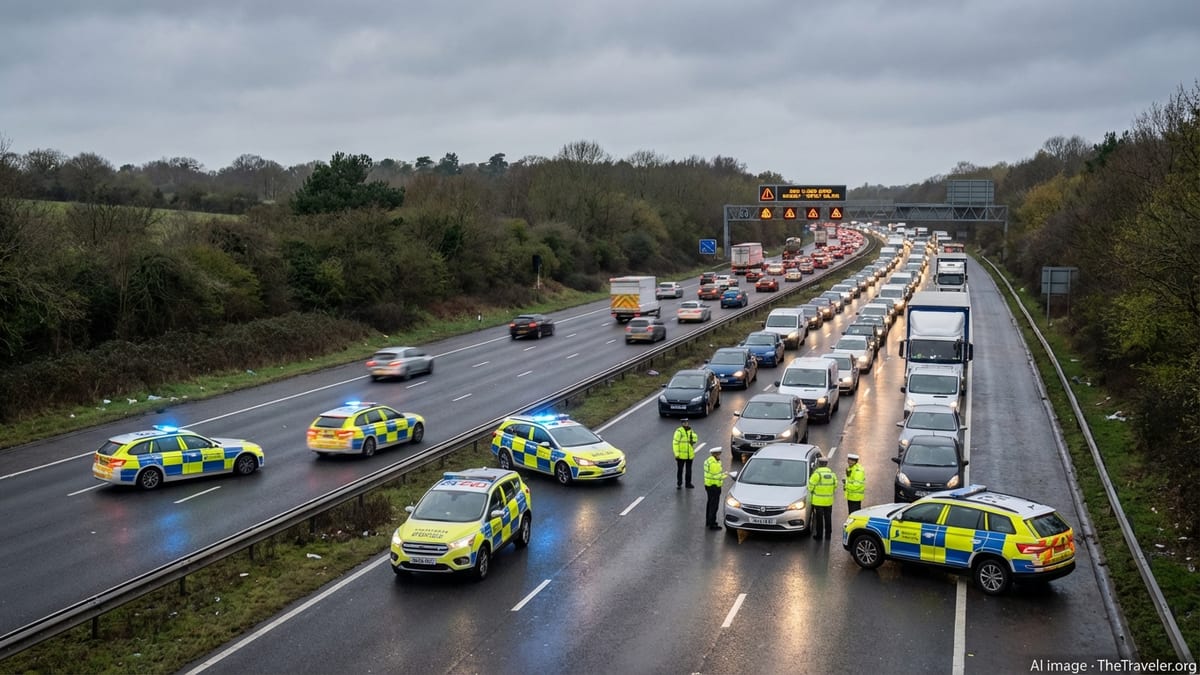
Police Incident Shuts Key Stretch of M3 in Morning Rush
The M3 eastbound in Surrey was closed for hours between Junction 4, near Farnborough, and Junction 3, near Bracknell, after what authorities described as a serious, police-led incident on the carriageway. The closure, which began in the early morning peak, also affected the entry slip road at Junction 4, preventing traffic from joining the motorway and forcing vehicles already on the route to a standstill.
National Highways traffic officers, working alongside Surrey Police and ambulance crews, implemented a full closure of the affected stretch while emergency services responded at the scene. Motorway cameras showed long lines of stationary traffic stretching back towards Hampshire, as drivers waited for updates and attempted to reroute via local roads.
Police have not yet released full details of the incident, which is being treated as serious, but confirmed that the road needed to remain shut for an extended period to allow specialist officers to work safely. Early indications suggested that the motorway would not fully reopen until late morning, leaving travel plans across the wider region in disarray.
Commuters Face Hours of Delays and Gridlocked Diversions
The timing of the closure, coinciding with the height of the weekday commute, meant that thousands of motorists were caught in the disruption. Tailbacks on the M3 built rapidly, with congestion reported for several miles approaching Junction 4 as vehicles were brought to a halt behind police cordons.
Drivers attempting to avoid the closure quickly overwhelmed local diversion routes through Farnborough, Frimley and Camberley, creating extended queues on secondary roads not designed for such heavy volumes of traffic. Residents reported nose-to-tail traffic on normally quiet residential streets as satnav systems recalculated and pushed long-distance traffic into suburban areas.
Many commuters travelling towards London, Reading and the M25 corridor were forced to abandon their usual motorway route and instead funnel onto already busy alternatives such as the A30 and A331. Rail services saw a knock-on effect too, as some drivers opted to leave their cars and switch to trains at nearby stations, adding further strain to the morning peak on key commuter lines.
National Highways and Police Coordinate Major Response
National Highways activated a major incident response, deploying traffic officers to assist with managing the closure, setting up diversions and helping stranded motorists. Electronic signs on the wider strategic road network, including the M27, M25 and A3, were updated to warn drivers to avoid the M3 eastbound between Junctions 4 and 3 and to expect long delays.
At the scene, Surrey Police officers sealed off the carriageway while colleagues worked with the South East Coast Ambulance Service and other emergency responders. Specialist units were called in as part of standard protocol for serious motorway incidents, and recovery contractors were placed on standby pending clearance to enter the closure area.
Traffic control centres monitored conditions via CCTV and data feeds, extending the estimated time for normal traffic conditions several times as the morning progressed. Officials urged drivers to delay journeys where possible, follow official diversion symbols rather than ad-hoc shortcuts, and avoid using hard shoulders or reversing on slip roads, both of which pose significant safety risks.
Impact on Regional Travel, Business and Tourism
The M3 is a critical artery linking the south coast with the M25 and London, carrying commuters, freight, and leisure traffic between Hampshire, Surrey and the capital. A prolonged closure in either direction can quickly ripple across the wider transport network, and Friday’s incident was no exception.
Business travellers heading to early meetings in London, Reading and the Thames Valley technology corridor reported missing appointments or being forced to join remotely from stationary cars. Delivery firms warned of delayed consignments into distribution hubs along the M3 and M4, while coach operators rerouted services at short notice, extending journey times for passengers travelling to Heathrow and central London.
For leisure travellers and tourists, particularly those heading from the south coast and airport catchment areas towards the capital or onward rail connections, the closure created uncertainty and stress. Some motorists facing standstill delays opted to divert via the A3 or even the M4 corridor, but with limited advance warning many had little choice but to wait until the motorway gradually began to reopen.
Motorists’ Experiences: From Standstill Tailbacks to Last-Minute Reroutes
Drivers caught up in the incident described a morning of uncertainty as updates filtered through from radio bulletins, overhead gantries and traffic apps. Many reported being stationary for long periods with engines switched off, while others found themselves inching along diversion routes that quickly became overwhelmed by the surge in displaced motorway traffic.
For those travelling with children or vulnerable passengers, the delays proved particularly challenging. Some motorists moved between vehicles to share information and offer water or assistance, while others used in-car navigation to share live conditions with friends and colleagues still planning their morning journeys.
On public transport, passengers reported bus routes running significantly behind schedule as vehicles diverted away from the motorway and battled congested town centres. Park-and-ride and rail station car parks closer to London filled earlier than usual as drivers abandoned efforts to rejoin the motorway and looked for alternative ways to complete their journeys.
Traffic Management, Diversions and Safety Advice
Throughout the closure, National Highways advised drivers to allow extra time, check live traffic information before setting off and consider postponing non-essential journeys. Official diversions directed long-distance traffic onto parallel strategic routes where possible, but many drivers also chose to use local knowledge or satnav guidance to find their own way around the incident.
Road safety campaigners reiterated warnings about the dangers of making risky manoeuvres in congested conditions, including using hard shoulders, turning in live lanes or attempting to force through emergency access points. With emergency vehicles needing clear routes to the scene, any additional obstruction or erratic driving behaviour can delay critical response times.
Motorists were also reminded to keep fuel tanks adequately topped up for long motorway journeys and to carry basic supplies such as water, snacks and phone chargers, particularly during periods of unsettled weather or heightened incident risk. While full closures of key motorways remain comparatively rare, when they do occur they can quickly turn routine commutes into multi-hour ordeals.
Calls for Resilience and Clear Communication on Strategic Routes
The incident has prompted renewed discussion about travel resilience on some of the UK’s busiest corridors, where a single closure can have widespread repercussions. Transport analysts point out that while police and highway authorities must prioritise safety and thorough investigation, the growing dependence on a limited number of key routes leaves commuters and businesses exposed to sudden disruption.
There were calls for continued investment in intelligent transport systems, including more granular real-time information for motorists, better integration between motorway control centres and rail operators, and clearer advance signage on approach routes when major closures are in place. Some industry voices also urged employers to maintain flexible working arrangements where possible, allowing staff to work remotely when severe disruption is expected.
Local authorities along the M3 corridor, already managing ongoing development and increasing traffic volumes, face the added challenge of accommodating sudden surges of diversion traffic. Ensuring that residential streets do not become unsafe rat-runs during major motorway incidents remains a key focus for transport planners and community representatives alike.
What Drivers Should Do if Caught in Similar Closures
In the wake of the M3 eastbound shutdown, travel experts have reiterated practical guidance for motorists who find themselves unexpectedly trapped behind a motorway closure. The first principle is to remain patient and follow the instructions of police officers, traffic officers and signage, rather than attempting independent manoeuvres that could compromise safety.
Drivers are advised to stay in their vehicles unless directed otherwise, keep the hard shoulder clear for emergency access, and use hazard lights if traffic comes to an abrupt stop. Keeping the in-car heating or air conditioning at a moderate level, rather than running it at full power for long periods, can help conserve fuel during extended delays.
Before setting out, checking multiple sources of live information, including national traffic services and local media, can significantly reduce the risk of being caught at the back of a closure. For regular commuters on corridors such as the M3, having pre-planned alternative routes, knowing nearby railway stations and maintaining flexibility in start times can all help limit the impact when serious incidents occur.