

More news on this day
A major collision on the M6 has closed part of the motorway for several hours, causing extensive delays, long tailbacks and significant disruption for drivers travelling through one of the United Kingdom’s busiest north–south routes.
Get the latest news straight to your inbox!
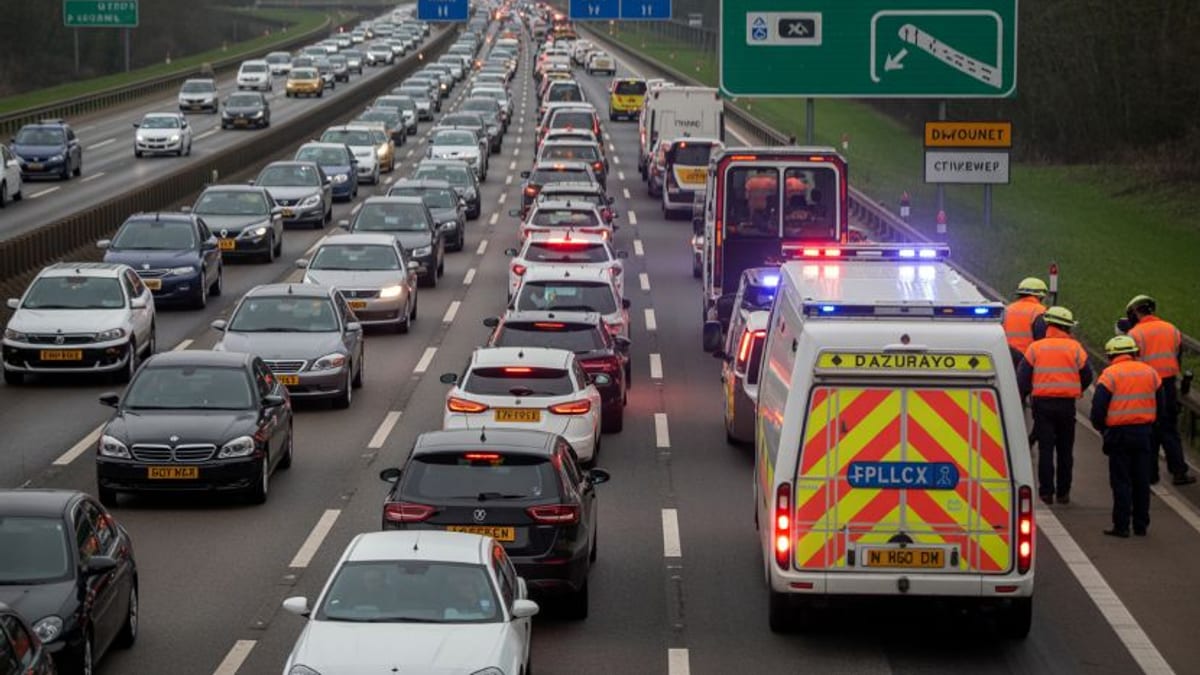
Image by Travel And Tour World
What Happened on the M6 and Where Traffic Is Affected
Published coverage from national and regional outlets indicates that a serious multi vehicle collision led to a full closure of a key section of the M6 in both directions for several hours. Initial reports describe a complex scene involving multiple cars and at least one heavy goods vehicle, with debris and damaged vehicles blocking several lanes. Emergency response teams and recovery crews required an extended period on scene, which contributed to the lengthy closure period.
The crash occurred on a busy stretch of the motorway used heavily by long distance traffic as well as local commuters. Publicly available traffic camera images and live congestion maps show queues building quickly in both directions, with stationary or very slow moving traffic extending for several miles on approach to the closure point. The impact has been particularly acute where local junctions feed directly onto the motorway, creating knock on congestion on surrounding A roads.
Travel reports suggest that lane closures are expected to remain in place even after the motorway fully reopens, as recovery teams remove vehicles and highway inspectors assess damage to barriers and the road surface. Drivers are being advised to expect residual delays on the M6 and connecting routes for several hours after the initial incident has been cleared.
For many drivers, the continuing disruption will affect journeys between major cities as well as access to regional airports, freight hubs and popular leisure destinations that rely on this corridor.
Current Delays and How Long Disruption May Last
Live traffic data and broadcast travel bulletins describe severe delays in both directions approaching the affected section of the M6. In some areas, average speeds dropped to walking pace, with estimated journey times more than doubling for long distance trips. Congestion has also spread onto parallel A roads and local routes as drivers attempt to avoid the closure.
Several factors are likely to keep disruption in place beyond the initial incident response. Recovery of heavy goods vehicles and damaged cars typically requires specialist equipment, which must be positioned safely on a busy motorway. Once vehicles are removed, highway engineers often inspect central reservations, safety barriers and overhead infrastructure. If barrier sections are damaged or fuel and oil have contaminated the carriageway, additional time is needed for repairs and resurfacing.
Based on similar incidents documented in previous years, major motorway crashes that completely block carriageways can lead to full closures lasting from three to six hours, with associated congestion persisting long after lanes have reopened. In this case, reports indicate that the M6 was shut for several hours during the peak of the response, and drivers are being warned that knock on delays could continue into the evening travel period.
Motorists planning time sensitive journeys, including airport transfers and long distance coach trips, are being urged by travel reporters and motoring organisations to allow substantial extra time and to check for updates before setting off.
Best Alternative Routes for North–South Travel
With a key section of the M6 heavily disrupted, many drivers are looking for practical alternatives. According to publicly available mapping and routing data, one of the main north–south options is to divert to nearby motorways such as the M1 or M61, depending on the exact location of the closure and the origin and destination of the journey. These routes can provide a longer but often more reliable path around a major incident, particularly for long haul traffic.
For regional journeys, parallel A roads that broadly follow the motorway corridor may offer an escape route, but these roads often run through towns and villages and can become quickly congested when large volumes of diverted motorway traffic arrive. Travel coverage typically advises that drivers only use these routes if they are familiar with the area or have up to date navigation guidance, as some sections include narrow carriageways, weight limits or low bridges that may not be suitable for heavy vehicles.
Coaches and freight operators commonly consider rerouting via alternate motorway links that avoid the affected section entirely, even at the cost of adding considerable mileage. Experience from previous closures suggests that a longer but free flowing motorway route can sometimes be faster overall than attempting short local detours through gridlocked urban roads.
For drivers with flexibility, altering departure times to travel outside peak congestion or postponing non essential journeys until the motorway network stabilises can significantly reduce stress and travel time.
Advice for Drivers Already Caught in Tailbacks
For those already on the M6 when the crash occurred, published travel advice highlights the importance of staying with vehicles unless directed otherwise, keeping lanes clear for emergency services and following instructions displayed on overhead signs. Remaining in marked lanes and avoiding unnecessary lane changes helps keep traffic flowing as recovery work progresses.
Drivers who are stationary or moving very slowly for an extended period are encouraged to manage fuel carefully by turning engines off when safe to do so, particularly for vehicles low on fuel. Keeping mobile phones charged, monitoring traffic bulletins on car radios and checking official traffic information services can provide early warning of when diversions become available.
Travel experts also stress the need for patience and consideration in long queues, especially where emergency vehicles need access along hard shoulders or between lanes. Blocking these access routes can delay the clearance of the incident and extend closure times for everyone.
Where safe opportunities to leave the motorway via a nearby junction present themselves, drivers may wish to consider exiting and using signed diversion routes rather than attempting unofficial shortcuts on minor roads that may not be suitable for large volumes of traffic.
What Travelers Should Check Before Setting Off
For motorists yet to begin their journeys, travel and motoring organisations consistently recommend checking live traffic services, radio travel bulletins and national traffic control updates for the latest picture on the M6. These sources can show whether closures remain in place, which junctions are affected and how severe the current delays are in real time.
Passengers booked on coaches that normally use the M6 are advised to review operator updates, as some services may be delayed, rerouted or in certain cases start and finish at alternative locations while congestion is at its peak. Rail services on parallel routes may also experience crowding from travelers switching modes, so advance planning is advisable where possible.
Those heading to airports, ferry terminals or time critical events are being urged by travel commentators to allow significantly longer than usual for road travel and consider earlier departures or alternative routes. Where public transport provides a viable option, combining rail and local bus connections may prove more reliable than remaining dependent on a heavily disrupted motorway corridor.
With the M6 forming such a crucial part of the United Kingdom’s long distance road network, even a single major incident can have knock on effects across a wide area. Continued monitoring of official traffic information and flexibility in route choice and timing remain the most effective tools for travelers trying to minimise disruption.