

Maastricht’s old town is one of the Netherlands’ most atmospheric historic centers, a compact maze of cobbled streets, Romanesque and Gothic towers, and leafy squares that feel more Belgian than Dutch. At its heart lies Vrijthof, a grand stage for centuries of religious processions and, today, bustling café culture and open-air concerts.
Around it, the twin basilicas of Saint Servatius and Our Lady, the intimate streets of the Stokstraat quarter, and the riverside avenues of Wyck invite slow exploration. This guide focuses on the old town’s most evocative corners, with practical context to help you understand what you are seeing and how best to experience it.
Understanding Maastricht’s Old Town
Maastricht’s old town grew from a Roman military settlement on the River Meuse into one of the Low Countries’ most important religious and trading centers. The Romans built a bridge and road here, seeing the strategic value of a crossing point between northern Europe and the Rhineland. Those early roads and defenses still determine the city’s layout, and in places the Roman and medieval layers are literally only a few meters apart. When you stand in todays central squares, you are walking over almost two millennia of continuous urban life.
The old town is compact and easy to explore on foot. It spans the area west of the Meuse, curling around Vrijthof and the Markt, then tapering towards the remaining sections of medieval walls and city gates. Stone churches rise above brick townhouses, while narrow alleys slice between larger shopping streets. It is an urban fabric best appreciated slowly, at ground level, where small details such as carved lintels, tiny chapels set into walls, and 18th century door knockers begin to show themselves.
Religion has shaped much of what you see. Maastricht once had multiple powerful collegiate churches, each with its own chapter of clergy, lands, and treasuries. The Basilica of Saint Servatius and the Basilica of Our Lady were the most influential, drawing pilgrims from across Europe. Their wealth financed ambitious architecture, art, and public works, which in turn attracted merchants and craftsmen. The result is a cityscape where ecclesiastical power and commercial energy sit side by side.
Today, Maastricht balances its past with a confident present. The old town is home to the university, independent boutiques, contemporary galleries, and design-forward cafés. Annual events and festivals animate its squares, and locals make full use of the public spaces that visitors come to photograph. When you plan your visit, remember that this is a living neighborhood, not an open-air museum. The best experiences often come from lingering, listening, and watching daily life unfold around you.
Vrijthof: The Beating Heart of the Old Town
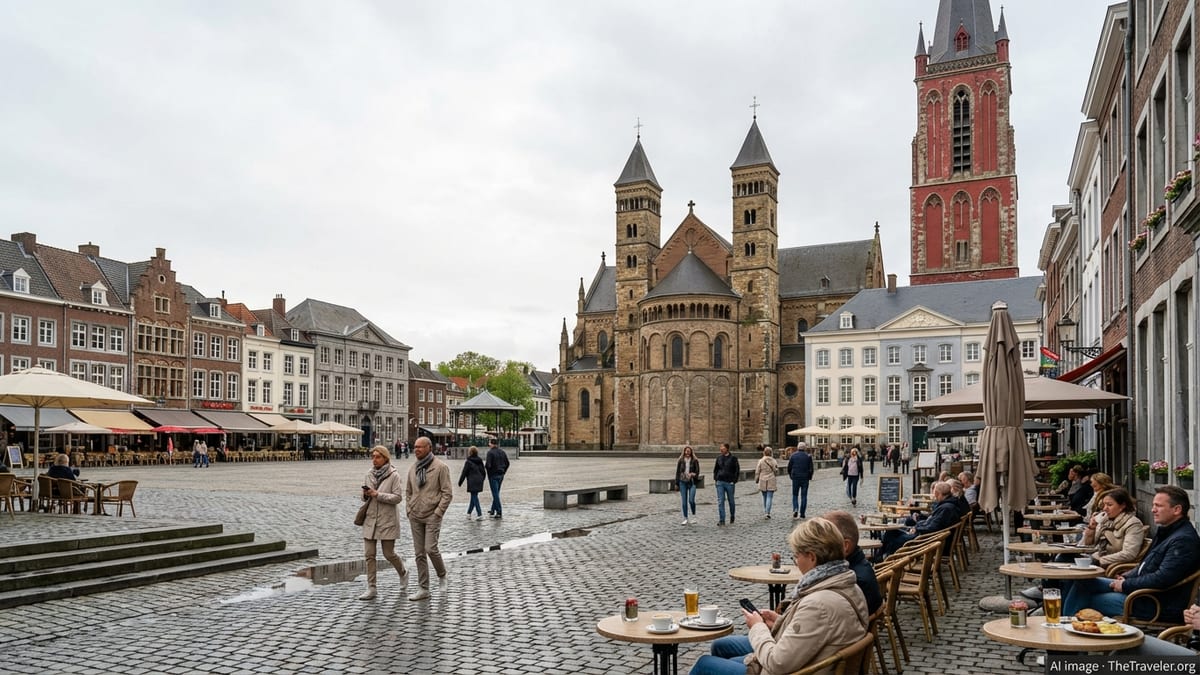
Vrijthof is Maastricht’s signature square, a large rectangular plaza edged with pavement cafés, monumental façades, and the twin silhouettes of Saint Servatius and Saint John’s Church. Its name hints at its early function as a “free court” and, before that, a burial ground connected to the shrine of Saint Servatius. Excavations have revealed that this space was used as a cemetery as far back as late Roman times. Over centuries, it evolved from sacred ground into the city’s civic living room.
The square is visually dominated by the Romanesque mass of the Basilica of Saint Servatius and the slender, red-painted tower of Saint John’s, creating a striking skyline that changes with the light. Along the other sides, you will see a mix of 16th century houses and later additions, including the former Spanish Government building and the neoclassical General’s House, now used for cultural functions. At ground level, terraces spill out every sunny day, filled with locals and visitors over coffees, beers, and plates of regional food.
Vrijthof is also Maastricht’s main events space. Concerts, fairs, and seasonal celebrations regularly transform the square. Summer evenings are often marked by open-air performances, while winter brings festive markets and illuminated decorations. When planning your trip, it is worth checking whether major events coincide with your dates. On busy nights, the mood is celebratory and musical, but if you prefer a quieter atmosphere, early mornings and shoulder seasons offer a different, more contemplative experience of the square.
To get a feel for Vrijthof beyond its postcard views, take time to walk its full perimeter. Notice the bandstand and the slight slope towards the basilicas, a reminder of its earlier use as a processional space. Step into one or two of the traditional “brown cafés” along the eastern side and you will find interiors little changed over decades, with wood paneling, old photographs, and a relaxed, conversational rhythm that contrasts with the bustle outside.
Basilica of Saint Servatius: Pilgrimage and Power
On the western edge of Vrijthof, the Basilica of Saint Servatius rises as a fortresslike presence in stone. Widely regarded as the oldest surviving church in the Netherlands, it stands over the tomb of Saint Servatius, a 4th century bishop whose grave became the focus of early pilgrimage. The present church is largely Romanesque in form, built in coal sandstone and marl, with a heavy westwork, twin towers, and rounded arches that recall the great pilgrimage churches further south in Europe.
Stepping inside, you enter a cool, dim interior where centuries of devotion and patronage are visible in capitals, sculptures, and side chapels. The plan follows a cruciform basilica, with a long nave, transepts, and an elevated choir. In the crypt lies the tomb of Saint Servatius, a place where pilgrims have knelt for more than a thousand years. Nearby, the shrine of the saint, an elaborately crafted reliquary, glows with metalwork and gemstones, emphasizing the basilica’s historic role as a religious magnet for the region.
The basilica’s treasury is one of the richest in Europe, containing reliquaries, liturgical objects, textiles, and artworks assembled over many centuries. Among the most famous objects are the Key of Saint Servatius and other items associated with the saint’s cult. The treasury is typically accessible for a fee and operates slightly different hours from the main church, so it is sensible to verify current opening times before you visit. Allow at least an hour to explore if you are interested in medieval craftsmanship, goldsmithing, and religious art.
Outside, make time to walk around the basilica’s exterior and cloisters. The cloister walk, with its pointed arches and view over a small garden, is one of the old town’s most atmospheric corners, especially in quiet moments between tour groups. From certain angles you can see how the church has grown organically, with later Gothic additions layered onto a robust Romanesque core. It is here that Maastricht’s role as a crossroads between northern and southern Europe, Roman roots and medieval piety becomes most tangible.
Basilica of Our Lady: Mystery, Stone, and Star of the Sea
A short walk from Vrijthof along winding streets brings you to the Basilica of Our Lady, one of Maastricht’s most evocative sacred spaces. Set on a small square near the old riverfront, this Romanesque church initially served as a powerful collegiate church with its own lands and chapter. Together with Saint Servatius, it formed a kind of spiritual axis for the city, and at times the two institutions were rivals as much as partners.
The approach to the basilica is almost theatrical. You enter from a relatively enclosed square, then step through heavy stone into a markedly darker, more introspective interior. Restorations in the late 19th and early 20th centuries emphasized the Romanesque character, with small windows and thick walls that create a hushed, almost mystical atmosphere. Murals, sculpted capitals, and later stained glass offer glimpses into the church’s layered history, from medieval frescoes to neo-Romanesque ceiling paintings.
The basilica is especially renowned for the statue of Our Lady, Star of the Sea, a 15th century wooden figure venerated by locals and pilgrims alike. The statue occupies a side chapel near the entrance, where candles burn throughout the day and visitors pause for prayer or quiet reflection. For many, this chapel is the emotional heart of the building, and spending a few minutes here gives a sense of the living devotion that still infuses the old town’s monuments.
Like Saint Servatius, the Basilica of Our Lady has a significant treasury of relics, textiles, and liturgical objects, reflecting its medieval importance. If opening hours align with your visit, it is worth exploring to gain a deeper understanding of how wealth, faith, and political influence were intertwined in historic Maastricht. Even if the treasury is closed, the cloisters and small surrounding streets, with glimpses of stone buttresses and secluded corners, reward slow wandering with a camera or notebook.
Historic Streets and Squares: Stokstraat, Markt, and Wyck
Beyond the basilicas and Vrijthof, Maastricht’s old town reveals its character in the streets that connect its main landmarks. The Stokstraat quarter, just north of Onze Lieve Vrouweplein, was once a working class area but has been carefully restored. Today its narrow lanes are lined with upscale boutiques and galleries housed in 17th and 18th century townhouses. Look up as you walk and you will see stepped gables, carved stone plaques, and former warehouse doors that hint at the area’s mercantile past.
Further north, the Markt square opens out in front of Maastricht’s stately City Hall, an elegant 17th century building that anchors the space. The square has hosted markets for centuries and continues to do so today, with weekly stalls selling produce, flowers, textiles, and household goods. On non-market days, terraces and cafés spill into the open, creating a more relaxed atmosphere. The contrast between Markt and Vrijthof is instructive: the latter is dominated by ecclesiastical buildings, while Markt is all about trade, civic administration, and everyday life.
To understand Maastricht’s relationship with the river, cross the Meuse via the Stone Bridge, a structure with Roman origins in its location and medieval roots in its present form. On the east bank lies Wyck, a district that feels like an extension of the old town, with cobbled streets, independent shops, and a slightly quieter pace. While not strictly part of the core historic center around Vrijthof, Wyck adds an important layer to your experience, showing how the city developed on both sides of the river to control this strategic crossing point.
As you move between these areas, do not rush. The pleasure of Maastricht’s streetscape is in juxtapositions: a medieval wall segment abutting a 19th century townhouse, a tiny chapel tucked beside a modern store, or a secluded courtyard glimpsed through a half-open gate. Many visitors find it helpful to plan a loose circuit that links Vrijthof, Saint Servatius, the Basilica of Our Lady, Stokstraat, Markt, and the river, then allows room for spontaneous detours whenever a side street looks appealing.
City Walls, Gates, and Fortifications
Maastricht’s long history as a fortified city is still visible around the edges of the old town. Sections of medieval city walls and a number of surviving gates, towers, and defensive works offer a more martial counterpoint to the churches and squares. Although much of the fortification system was dismantled in the 19th century, what remains gives a sense of the pressures the city faced as a frontier stronghold.
Walking south and west from the core old town, you will encounter stretches of stone wall interspersed with towers and bastions. These remains show how the city once bristled with defenses, designed to withstand sieges and control access. Some parts have been incorporated into parks and walking paths, making them pleasant routes for an afternoon stroll. Interpretive signs in various languages often explain the structures’ original purposes and the conflicts they witnessed.
Further afield, but still easily combined with an old town visit, are more extensive fortifications such as Fort Sint Pieter and underground casemates. These speak to Maastricht’s later role in European military history and offer vantage points over the city and surrounding landscape. While the fort lies outside the immediate Vrijthof area, visiting it can enrich your understanding of why Maastricht’s old town took the form it did and how its residents experienced war and peace over the centuries.
Back within the core, look for smaller defensive traces in unexpected places: thick cellar walls beneath townhouses, arrow slits re-used as window openings, or oddly angled property lines that follow the course of vanished ramparts. Learning to read these signs turns a simple walk into an informal urban archaeology exercise and deepens your appreciation for how layered Maastricht’s built environment truly is.
Experiencing Local Life: Cafés, Culture, and Seasonal Events
The charm of Maastricht’s old town lies not just in its architecture, but in the way people inhabit its spaces. Café terraces on Vrijthof, Markt, and smaller squares are a defining feature of daily life, especially in milder months. Locals linger over coffee, regional beers, and simple dishes, using the squares as extended living rooms. Joining them, even briefly, is one of the most effective ways to feel part of the city rather than a spectator passing through.
Cultural life is dense for a city of this size. Around Vrijthof you will find museums, galleries, and the main city theatre, which share the square’s historic buildings. Exhibitions and performances often lean into the city’s cross-border character, drawing influences from Belgium and Germany as much as from the rest of the Netherlands. Smaller venues tucked into side streets host concerts, talks, and community events, many of which welcome visitors without pretense.
Seasonal events leave a strong imprint on the old town. Carnival, with its colorful parades and festivities, transforms the streets in late winter, while summer brings concerts, outdoor cinema, and cultural festivals that draw audiences into the squares. In December, lights and decorations frame the historic façades, and temporary markets add a festive layer to already atmospheric urban spaces. Checking an up-to-date city calendar before your trip will help you decide whether to time your visit with these events or seek quieter periods.
Even outside formal events, daily rhythms are worth observing. Mornings can be surprisingly tranquil, with delivery vans and commuters sharing streets with early rising tourists. Lunchtime fills terraces and bakeries, while late afternoons see a gentle shift into after-work gatherings. By evening, the old town glows with warm interior light spilling onto cobbles, and the basilica towers become landmarks guiding you back to your starting point. Experienced slowly, these rhythms are as memorable as any single sight.
Practical Tips for Exploring Maastricht’s Old Town
Maastricht’s old town is best navigated on foot, and comfortable shoes are essential. Many streets are cobbled or paved with uneven stones, which add charm but can be tiring over a long day. Plan for a relaxed pace, building in café stops and short breaks on benches around the squares. If you are arriving by train, the walk from the main station across the Meuse into the old town is straightforward and gives an appealing first glimpse of the city’s riverfront.
Weather can shift quickly, so layered clothing is helpful, especially in shoulder seasons. Rain showers are common, but the city is well equipped with covered terraces, arcades, and interiors where you can wait out a brief downpour. Because many churches and historic interiors can be cool even in summer, carrying a light extra layer is sensible if you plan to spend time exploring crypts, treasuries, and cloisters.
Opening hours for churches, treasuries, and museums can vary by season and day of the week, and special services or events occasionally restrict access. It is wise to check current information shortly before your visit and to be flexible with your schedule. If you find a basilica closed when you arrive, use the time to explore nearby streets or enjoy a coffee and return later in the day. Patience is often rewarded with quieter interiors and more space to appreciate details.
Respectful behavior in religious spaces is important. Dress modestly, keep voices low, and avoid using flash photography unless clearly permitted. When services are in progress, it is courteous either to wait until they have finished or to sit quietly at the back rather than moving around to take photographs. Remember that for many residents, these are active places of worship and community life as well as historic monuments.
The Takeaway
Maastricht’s old town rewards those who arrive with curiosity and time. Centered on Vrijthof, framed by the basilicas of Saint Servatius and Our Lady, and woven together by intimate streets and river views, it offers a concentrated experience of European urban history. Roman roots, medieval pilgrimage, fortification, commerce, and contemporary cultural life all coexist within walking distance of one another.
To make the most of your visit, think of the old town not as a checklist of sights, but as a series of overlapping stories. One thread might follow Saint Servatius from his tomb to the gleaming objects in the treasury. Another might trace the path from the quiet mystery of Our Lady’s interior to the open conviviality of Vrijthof’s terraces. A third might lead you out along surviving walls, then back in via the markets and bridges that have sustained the city for centuries.
Ultimately, what stays with many visitors is a sense of atmosphere: the way bells echo across rooftops, how candlelight glows against ancient stone, or how voices rise and fall around café tables as day turns to night. These impressions resist strict planning and emerge instead from unhurried moments. Walk slowly, look closely, and leave space in your itinerary for the city to surprise you. Maastricht’s old town will meet you halfway.
FAQ
Q1: How much time should I plan to explore Maastricht’s old town and Vrijthof area?
Most visitors find that a full day is enough to see the main highlights at a relaxed pace, but two days allow you to visit both basilicas thoroughly, explore the treasuries, wander the smaller streets, and enjoy the café culture without rushing.
Q2: Is Maastricht’s old town easy to navigate without a guided tour?
Yes, the old town is compact and walkable, with clear signage and landmarks like Vrijthof and the basilica towers to orient you. Maps from the tourist office are helpful, but many travelers simply follow a loose circuit and rely on the visually distinctive squares as reference points.
Q3: Can I visit the Basilica of Saint Servatius and its treasury on the same ticket?
The basilica and treasury typically have separate or combined ticket arrangements depending on current policy, with the church itself sometimes accessible for a small fee or donation and the treasury requiring a paid ticket. It is best to confirm details on the spot, as prices and formats can change.
Q4: Are photography and video allowed inside the basilicas?
Photography is often permitted without flash in many areas, but restrictions may apply in specific chapels, treasuries, or during services. Always check posted signs and follow staff guidance, and avoid photographing people at prayer to maintain a respectful atmosphere.
Q5: What is the best season to experience Vrijthof and the historic streets?
Late spring and early autumn offer comfortable temperatures, active café terraces, and generally pleasant walking conditions. Summer brings outdoor concerts and a lively mood but can be busier, while winter offers atmospheric lights and markets, with a quieter feel on non-event days.
Q6: Is Maastricht’s old town suitable for travelers with limited mobility?
Many main streets and squares are accessible, but older cobblestones, steps into churches, and uneven surfaces can pose challenges. Some interiors have ramps or lifts, while others retain historic access only. If mobility is a concern, it helps to plan routes in advance and allow extra time.
Q7: Are there guided tours focusing on the religious history of Maastricht?
Yes, guided walks that highlight the city’s religious heritage, including Saint Servatius, the Basilica of Our Lady, and related sites, are regularly offered by local organizations and independent guides. They provide context on pilgrimage traditions, architecture, and the rivalry and cooperation between the city’s major churches.
Q8: Do I need to book tickets in advance for major sights in the old town?
For most churches and smaller museums, advance booking is not required outside of very busy periods. However, certain special exhibitions, combined tours, or fortification visits may require or recommend reservations, especially in peak season or on weekends.
Q9: Is English widely spoken in Maastricht’s old town?
Yes, English is widely spoken in cafés, hotels, museums, and at main attractions. Signage at major sights is often bilingual or multilingual, and staff are used to assisting international visitors, making it straightforward to ask questions or request information.
Q10: Can I easily combine a visit to Maastricht’s old town with other nearby destinations?
Maastricht is well connected by train and bus to other Dutch, Belgian, and German cities, so it is easy to pair a stay here with side trips to places such as Valkenburg, Liège, or Aachen. Many travelers base themselves in Maastricht’s old town for a few days and explore the region from there.