

More news on this day
Macau is powering through a new tourism milestone in 2026, racing past 10 million visitor arrivals on the back of surging demand from mainland Chinese travelers and record-breaking holiday peaks, even as questions grow over whether the compact city’s infrastructure can keep pace.
Get the latest news straight to your inbox!
Mainland-Driven Boom Pushes Visitor Numbers Higher
Macau entered 2026 on the momentum of a record 40.06 million visitor arrivals in 2025, the highest annual tally ever recorded for the city, according to publicly available government statistics. That figure was already above the pre-pandemic benchmark of 39.4 million set in 2019, underscoring how quickly demand has rebounded and then exceeded previous highs.
Early 2026 data suggests the curve is steepening. Statistics compiled by local authorities show more than 3.6 million arrivals in January 2026, a total broadly in line with the strong finish to 2025 but achieved outside any major holiday period. During the nine-day Spring Festival Golden Week that followed in February, tourism office figures cited in industry coverage report 1.55 million arrivals, with several single days surpassing previous records.
Aggregated across January and the extended Lunar New Year period, analysts following the sector estimate that cumulative arrivals have already topped the 10 million mark by late February, putting Macau on track for another record year if current trends hold. Mainland Chinese visitors continue to account for roughly 70 percent or more of total arrivals, mirroring the pattern seen in 2025.
Industry reports indicate that visa facilitation measures, improved high-speed rail connectivity on the mainland side and growing confidence in cross-border travel are all feeding the surge. At the same time, the city is working to attract more international visitors, particularly from Southeast Asia, although these markets still represent a much smaller share of total arrivals than mainland China and neighboring Hong Kong.
Holiday Peaks Test Transport and Border Capacity
The surge has been most visible during peak holiday periods, when images of dense crowds at border checkpoints and on key tourist streets have circulated widely in regional media. During the 2026 Lunar New Year Golden Week, local police and tourism authorities reported daily arrival figures that broke multiple post-pandemic records, with one day exceeding 210,000 visitors according to data cited in Chinese and Macao-based outlets.
Border Gate and the Hengqin Port, the two main land checkpoints connecting Macau with Zhuhai, have carried much of this load. Official statistics for 2025 showed that land crossings accounted for more than 80 percent of all visitor arrivals, and that traffic through both Border Gate and Hengqin grew sharply year on year. With the surge continuing into 2026, these nodes remain critical pressure points in the city’s tourism infrastructure.
Operators of the Macau Light Rapid Transit system and cross-border bus networks have expanded frequencies around peak periods, while additional e-channels and queuing areas have been introduced at some checkpoints. However, reports from regional travel media and social platforms during recent holidays describe crowded terminals, long waits for taxis and shuttle buses, and congested pedestrian corridors, particularly in areas linking border points to the main hotel and casino zones.
These strains are reminiscent of the National Day Golden Week patterns observed in 2024 and 2025, when Macao also broke single-day arrival records. For 2026, forecasts by gaming and hospitality analysts suggest that each major holiday period, from May Day to National Day, is likely to generate new peaks as long as mainland demand holds and capacity constraints do not meaningfully deter travelers.
Hotels, Neighborhoods and Public Spaces Under Pressure
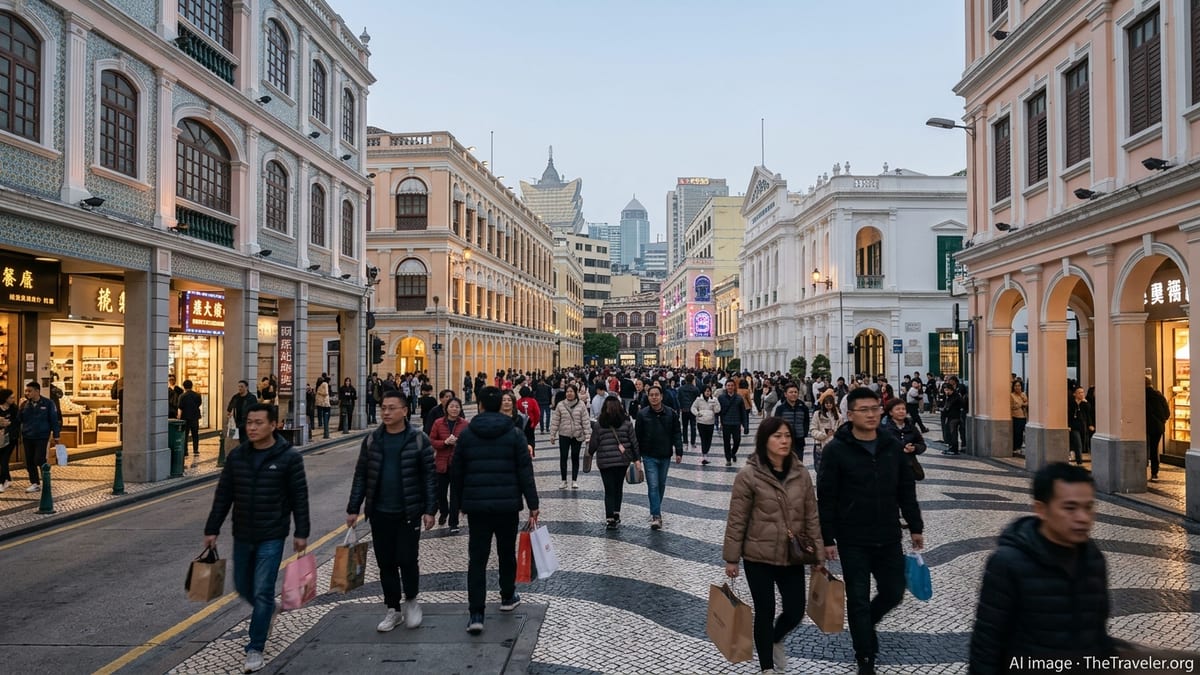
Beyond border control and transport, the rapid influx is reshaping life at street level. With more than 40 million visitors passing through in 2025 and early 2026 pointing to an even higher tally, the city’s dense urban fabric is under persistent pressure on weekends and holidays. Travel publications and local commentary highlight extremely crowded conditions in the historic center, from Senado Square to the Ruins of St Paul’s, during peak periods.
Hotel supply has expanded in recent years, especially on the Cotai Strip, where large integrated resorts continue to add rooms and attractions. Sector briefings note that average occupancy in major properties has pushed back toward the mid-90 percent range during festival periods, with some hotels imposing minimum-stay requirements. Budget and mid-range options on the peninsula report being fully booked well in advance of peak travel dates.
Residents and small businesses in older neighborhoods report mixed impacts. Some local commentary points to higher retail and restaurant takings, while others highlight noise, crowding and pressure on public transport during weekends. Urban planners have long warned that Macau’s limited land area and intricate street network limit how much visitor volume the traditional core can comfortably absorb without eroding quality of life for residents and the visitor experience itself.
Municipal departments have responded with stepped-up crowd management, temporary traffic diversions and more intensive cleaning and maintenance of public spaces during busy periods. Observers note that these measures help smooth the sharpest edges of overcrowding but do not fundamentally resolve the tension between rising visitor numbers and finite urban space.
Infrastructure Upgrades Aim to Keep Pace
Macau has been investing heavily in connectivity and tourism infrastructure in an effort to support higher volumes while nudging visitors toward new districts. The opening of the Hengqin Light Rapid Transit extension at the end of 2024 created a direct rail link from Cotai to the Hengqin Port, offering an alternative to road-based cross-border travel and easing pressure on some arterial routes.
In parallel, incremental improvements to road networks on reclaimed land in Cotai and Taipa, upgrades to bus routes, and continued optimization of taxi and ride-hailing regulations are intended to move visitors more efficiently between ports, hotels and attractions. Planning documents also envisage additional public spaces and waterfront promenades designed to spread foot traffic beyond a handful of saturated sightseeing areas.
Regional integration projects within the Guangdong–Hong Kong–Macau Greater Bay Area are another factor. More frequent intercity rail links, ferry services and cross-border coach routes are expanding the catchment area from which day-trippers and short-stay visitors can reach Macau. Analysts suggest that this connectivity, while supporting tourism growth, also risks concentrating even more demand into short, intense peaks around weekends and holidays.
Observers of the city’s long-term development note that large-scale land reclamation has historically outpaced the adaptation of the road grid and public transport, leaving some new districts better built for cars and resort complexes than for pedestrians. The current tourism boom is testing how quickly those areas can evolve into more balanced urban spaces that accommodate residents, workers and visitors alike.
Balancing Growth With Sustainability
For policymakers and industry stakeholders, the key question is whether Macau can channel the post-pandemic boom into a more diversified and sustainable tourism model. Official messaging in recent years has emphasized non-gaming attractions, cultural tourism and family-friendly offerings, a shift that is visible in the growing number of large-scale shows, exhibitions and sporting events hosted in Cotai.
At the same time, gaming revenue remains the backbone of the local economy, and reports from financial analysts covering Macau’s casino operators link the surge in visitor numbers with a strong rebound in mass-market gaming volumes during the 2026 Lunar New Year period. This dual focus on volume-driven gaming and higher-spending leisure visitors presents both opportunities and risks.
Travel industry commentators note that if congestion, booking difficulties and long waits become normalized, some potential visitors may opt for alternative regional destinations such as Hong Kong, Hainan or other parts of the Greater Bay Area. Surveys referenced in tourism research suggest that comfort, ease of movement and access to non-gaming experiences are increasingly important factors for repeat visitors and younger travelers.
How Macau manages the next phase of infrastructure investment, crowd management and product diversification will therefore be crucial. With visitor numbers already smashing records in 2026 and likely to climb further, the balance between maximizing arrivals and maintaining a livable, attractive city is emerging as one of the territory’s defining challenges for the decade ahead.