

More news on this day
Madagascar Airlines is accelerating its regional expansion with a wave of new and codeshared routes across the Indian Ocean, promising tourists quicker access to some of the island nation’s most remote beaches, wildlife reserves and coastal towns.
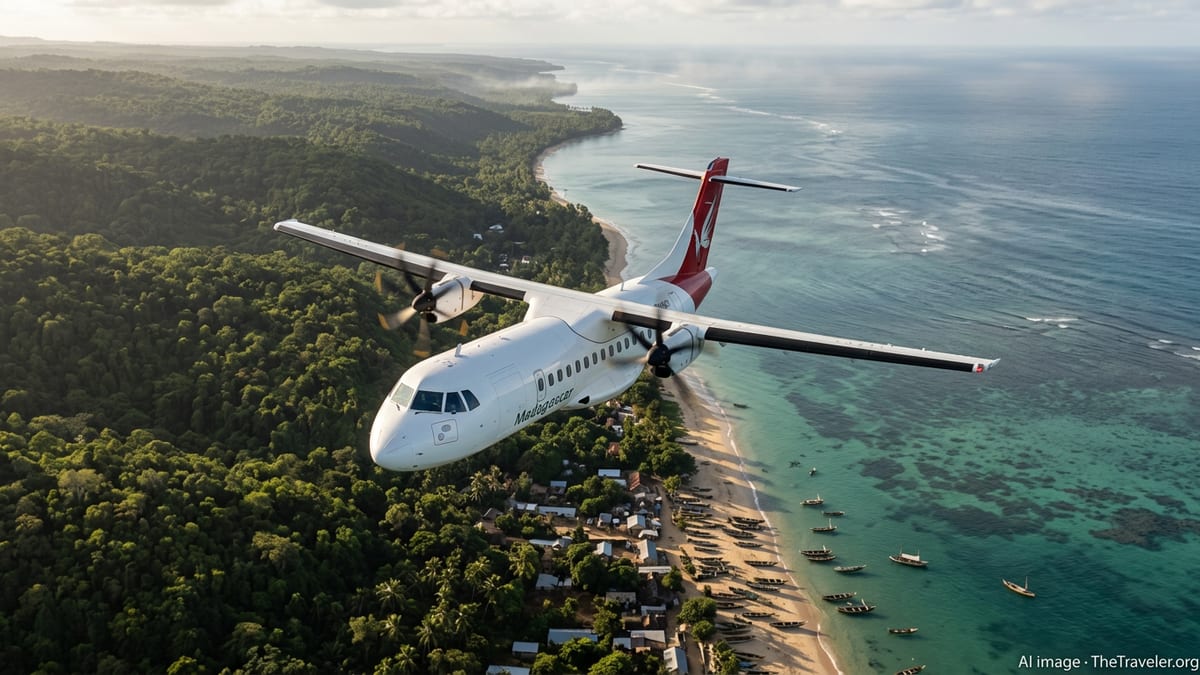
New Regional Links Put Remote Islands Within Easy Reach
Central to the latest expansion is a new inter-island route linking La Réunion with the Malagasy ports of Toamasina and the island of Sainte-Marie, operated in partnership with Air Austral under a codeshare and special prorate agreement. Marketed under Madagascar Airlines flight numbers, the routing is designed to turn what was once a multi-stop journey into a same-day hop for visitors arriving from Europe or beyond via La Réunion.
The corridor opens up Sainte-Marie, long considered one of Madagascar’s most evocative “hidden gems,” to travelers who previously had to connect through Antananarivo and overnight on the mainland. With the new schedule, beach-focused itineraries that combine Réunion’s volcanic landscapes with Sainte-Marie’s whale-watching bays and palm-fringed beaches can now be completed with minimal backtracking.
Toamasina, an important port city on Madagascar’s east coast, also stands to benefit from the new routing. The city’s colonial-era streets, lagoon-backed beaches and proximity to lesser-known reserves such as Ivoloina make it a natural stop for adventurous travelers seeking an alternative to more established circuits around Antananarivo and Nosy Be.
By tying these destinations more tightly into the regional network, Madagascar Airlines is positioning the Indian Ocean as a multi-stop playground, where travelers can string together islands and coastlines that were once difficult to reach within a single holiday.
Upgraded Fleet Drives Faster Domestic Connections
The regional push is underpinned by an overhaul of Madagascar Airlines’ short-haul fleet, including the arrival of additional ATR 72 aircraft that are optimized for quick hops between provincial cities and resort areas. These turboprops, configured for regional operations, allow the carrier to add frequencies and open thinner routes that would not be viable with larger jets.
New and reinforced services from Antananarivo to coastal hubs such as Nosy Be and Toamasina, scheduled with the upgraded ATR fleet, are intended to reduce connection times for international passengers and simplify multi-stop itineraries within Madagascar. Rather than doubling back through the capital for every leg, tourists increasingly have the option to fly point-to-point between key regions.
In recent months, Madagascar Airlines has also restructured its domestic network to connect provincial cities directly. Routes that enable travelers to combine Nosy Be in the northwest, Toliara in the southwest and Sainte-Marie off the east coast in a single itinerary are being prioritized, turning what used to be complex overland journeys into a series of short flights.
For local communities, these changes bring more than tourism. Faster domestic links improve access to medical services, education and trade, while the additional traffic helps sustain year-round schedules to destinations that once relied on highly seasonal demand.
Partnerships Expand Access From Europe, Africa and Beyond
Alongside new regional routes, Madagascar Airlines has leaned heavily on partnerships with larger carriers to feed passengers into its growing network of hidden-gem destinations. Codeshare and interline agreements with Air Austral, Air France, Emirates and other international airlines give overseas travelers a wider choice of one-ticket itineraries that connect seamlessly onto Madagascar Airlines’ domestic and regional flights.
From Europe, direct services between Paris and Antananarivo under a codeshare arrangement channel visitors into the capital, where they can board onward flights to coastal and island destinations on the same booking. This reduces the risk and complexity of separate tickets, a key concern for travelers heading to more remote parts of the world.
In the Indian Ocean, the strategic tie-up with Air Austral based in La Réunion is particularly significant. Passengers arriving from France, Mayotte or other regional points can now connect under Madagascar Airlines flight numbers to cities such as Antananarivo, Antsiranana, Nosy Be and Toamasina, as well as the new La Réunion–Toamasina–Sainte-Marie link.
Further afield, increased capacity by partner airlines from hubs such as Dubai and Addis Ababa has made Madagascar more accessible to travelers from Asia, the Middle East and Eastern Europe. Once in Antananarivo, these passengers can transition quickly onto Madagascar Airlines’ ATR-operated network, reaching rainforests, highland plateaus and coral-fringed archipelagos that previously required days of overland travel.
Tourism Ambitions Tied to Lesser-Known Destinations
The expansion of regional routes is closely aligned with Madagascar’s national tourism goals, which target strong growth in international arrivals over the next several years. Authorities and industry stakeholders have repeatedly emphasized that achieving these targets will depend on moving visitors beyond a handful of well-known sites to a broader portfolio of destinations.
Madagascar Airlines has identified several such locations as priorities for improved air access. Nosy Be, already established as a beach favorite, is being positioned as a gateway to smaller surrounding islands and marine parks. On the east coast, Sainte-Marie’s whale migrations, historic pirate lore and low-key village life offer a quieter alternative to mass-tourism resorts elsewhere in the Indian Ocean.
On the mainland, cities such as Toliara in the southwest and Antsiranana in the north serve as jumping-off points for deserts, baobab forests, karst landscapes and marine reserves that rarely feature in first-time itineraries. By upgrading aircraft and partnering with regional airlines, Madagascar Airlines aims to place these areas on the same practical footing as more famous attractions like the Avenue of the Baobabs or the Tsingy de Bemaraha.
Industry observers note that this strategy could help distribute visitor spending more evenly, easing pressure on fragile ecosystems while creating jobs in communities that have historically seen little benefit from tourism. Better air links are also expected to encourage investment in small lodges, guesthouses and guiding services outside the traditional hotspots.
What Travelers Can Expect on the New Routes
For tourists planning trips in the coming seasons, the practical impact of Madagascar Airlines’ regional expansion will be most visible in shorter journey times and more varied routing options. Itineraries that once required backtracking through Antananarivo or overnight layovers in regional hubs are gradually being replaced by same-day connections and triangular routes linking multiple coastal cities.
Improved scheduling coordination with partner airlines means that international arrivals can increasingly connect directly onto domestic flights within a few hours of landing, minimizing airport waits and reducing the risk of missed connections. Travelers booking through major carriers or reputable tour operators are often able to secure through-checked baggage and protected connections on a single ticket.
On board, the upgraded ATR 72 fleet is configured for short-haul comfort, with a focus on reliability and consistency rather than luxury. For many visitors, the real upgrade lies outside the cabin windows: low cruising altitudes offer broad views of terraced highlands, river valleys and reefs as flights trace the contours of an island that remains largely undeveloped and sparsely populated.
As with any rapidly evolving network in an emerging destination, schedules can shift and travelers are advised to confirm flight times and routings close to departure. But for those prepared to navigate a dynamic environment, Madagascar Airlines’ new regional routes are opening a growing menu of hidden gems to explore in a single, tightly planned journey.