

More news on this day
Chennai’s Madhavaram Retteri Lake is fast evolving from a functional urban reservoir into a flagship eco-tourism draw, with new boating facilities, landscaped green spaces, and low-impact recreational attractions expected to significantly boost visitor footfall in North Chennai in the coming months.
Get the latest news straight to your inbox!
From Water Reservoir to Urban Eco-Tourism Destination
Madhavaram Retteri Lake, a key water body in the city’s northern corridor, has traditionally played an important role in Chennai’s water management network. In recent years, publicly available planning documents and media coverage indicate that the lake has been earmarked as one of several major water bodies selected for comprehensive revitalisation, with a focus on flood resilience, water storage, and public recreation.
Reports indicate that the Chennai Metropolitan Development Authority and allied civic agencies have been implementing a multi-phase upgrade programme around the lake, framed as part of a broader initiative to restore and activate at least a dozen major lakes across the metropolitan area by late 2025. The approach combines desilting and bank strengthening with measures intended to open the waterfront to residents through promenades, parkland, and eco-friendly amenities.
Retteri’s transformation is positioned alongside earlier lakefront redevelopments in and around Chennai that introduced walking tracks, bird islands, and boating decks. However, recent coverage suggests Madhavaram Retteri is being developed as a more ambitious showcase, explicitly marketed as an eco-tourism and leisure destination for both residents and domestic visitors.
As work advances, the lake is increasingly being discussed in local tourism and lifestyle features as a new counterpoint to Chennai’s traditional seaside attractions, signalling a shift toward inland blue-green public spaces as part of the city’s tourism mix.
Boating, Jet Skis, and New Water-Based Experiences
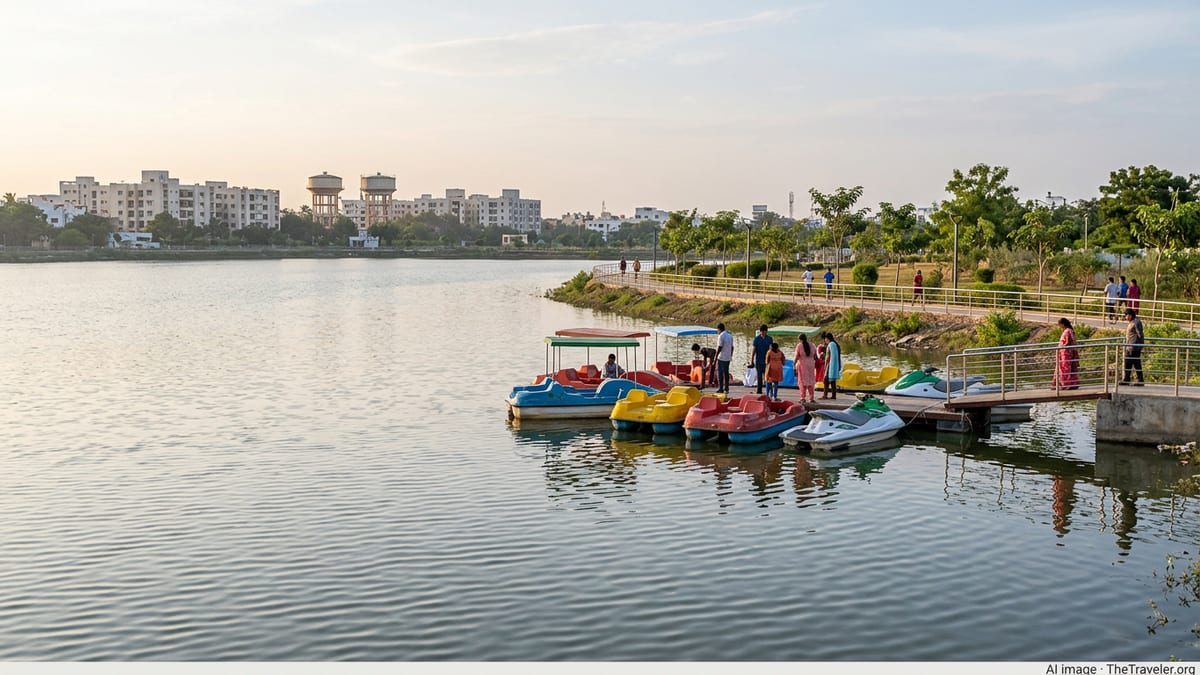
The most visible change at Madhavaram Retteri Lake is the rollout of organised boating activities. Coverage from Chennai-based outlets in early 2026 highlights that dedicated boat houses have begun operating at Madhavaram and nearby Manali, offering pedal boats and other craft on defined circuits, with standardised ticketing and safety norms.
Madhavaram’s 66-acre water spread gives it scope to host a range of non-motorised and controlled motorised activities. According to recent reports, the lake is being positioned as one of Chennai’s first restored urban lakes to feature jet ski rides in addition to regular boating, a move that aligns it with other regional leisure lakes that offer structured water sports while maintaining no-go zones for ecological protection.
Visitor reports and media descriptions suggest that the boating experience is currently centred on family-friendly pedal boats and small capacity craft, with time-bound slots and fixed tariffs. Weekends are already described as busy, particularly in the late afternoon and early evening, indicating early traction among city residents looking for an alternative to the usual beachside outings.
As infrastructure is upgraded, the lakefront is expected to host a more diverse mix of water-based recreation, with authorities stating in earlier policy documents that the water spread itself will remain largely free of heavy construction, in line with recent nature-based restoration practices adopted at other Chennai lakes.
Green Promenades, Play Areas, and Community Spaces
Alongside the boating facilities, the land around Madhavaram Retteri Lake is being reshaped into a network of green public spaces. Published planning overviews and real-estate focused coverage indicate that the project includes continuous walkways and jogging tracks around substantial stretches of the lake, landscaped gardens, shaded seating, and dedicated play zones for children.
This model echoes earlier eco-park style lakefronts elsewhere in Tamil Nadu, where tree-lined promenades, viewing decks, and open plazas have been added without encroaching on the main water spread. At Retteri, preliminary visuals shared in local media show newly laid paths tracing the shoreline, pockets of native planting, and stepped seating areas intended for viewing the water and migratory birds.
Parking bays, basic amenities blocks, and food kiosks are also being integrated into the design, according to publicly available descriptions, with an emphasis on clustering such infrastructure away from the most sensitive ecological zones. The intention is to create an all-day destination that supports walking, casual recreation, and family visits, while still functioning as a critical urban water storage asset.
For neighbourhoods in North Chennai, which have historically had fewer large-scale recreational parks than the city’s southern corridors, the redevelopment is being framed as a new “lung space” that could raise local liveability indicators and potentially influence residential and commercial development patterns in the surrounding area.
Eco-Friendly Design and Habitat Protection
A key plank of the Madhavaram Retteri Lake initiative is its positioning as an eco-friendly attraction rather than a conventional amusement zone. Recent coverage on Chennai’s broader lake restoration drive notes a shift towards nature-based solutions, which favour earth bunds, vegetated edges, and wetland buffers instead of extensive concrete embankments.
At Retteri, this approach is reflected in efforts to deepen and desilt sections of the lake to improve storage capacity, while simultaneously creating gently sloped, planted banks intended to support birdlife and aquatic vegetation. Earlier references to Retteri’s proposed eco-tourism role have mentioned ideas such as bird islands, viewing points for migratory species, and controlled access areas to minimise disturbance.
Environmental considerations are also shaping operational guidelines. Publicly available information suggests that high-speed or noisy activities are likely to be confined to specific zones and timings, with the remaining areas reserved for quieter boating or left undisturbed for habitat conservation. Lighting, waste management, and vendor operations around the lake are expected to be designed to limit pollution and protect water quality.
The project is being closely watched by urban planners and environmental advocates, as it serves as a test case for how Chennai can balance recreation, tourism, and climate resilience across its network of lakes and wetlands, particularly in flood-prone northern zones.
What Visitors Can Expect in the Coming Months
For visitors, Madhavaram Retteri Lake is emerging as a multi-layered destination that combines water-based fun with green open space. Boating is already operational through a formal ticketing counter, with options typically including four-seater pedal boats on a 20-minute circuit and other small craft. Jet ski rides, framed in earlier coverage as a key differentiator for the lake, are anticipated to draw adventure-seeking visitors as operational capacity scales up.
Around the lake, visitors can expect expanding stretches of walking and jogging tracks, landscaped gardens, and vantage points offering wide views of the water. Families are likely to find children’s play areas, informal seating, and limited but growing food options, with more amenities expected as the lakefront matures as a tourism node.
Travel reports suggest that late afternoons and early evenings on weekends are already peak times, with thousands of visitors on some days, while weekday mornings may offer a quieter experience suited to walkers, joggers, and birdwatchers. As with many new urban parks, ongoing fine-tuning of crowd management, parking, and maintenance practices will shape how comfortable the space feels at different times of day.
For travellers planning a Chennai itinerary, Madhavaram Retteri Lake is increasingly being listed alongside beaches, heritage precincts, and botanical gardens as a stop that showcases the city’s evolving relationship with its water bodies. With the broader lake revitalisation programme scheduled to continue through 2025, the site is set to play a prominent role in how Chennai presents itself as a greener, more water-sensitive urban destination.