

More news on this day
Madrid has secured what regional investment documents describe as Ryanair’s largest aircraft maintenance hub in Europe, an expensive, long-term move that is expected to concentrate high-skilled aviation jobs in the Spanish capital and reinforce Barajas Airport’s status as a strategic low-cost base.
Get the latest news straight to your inbox!
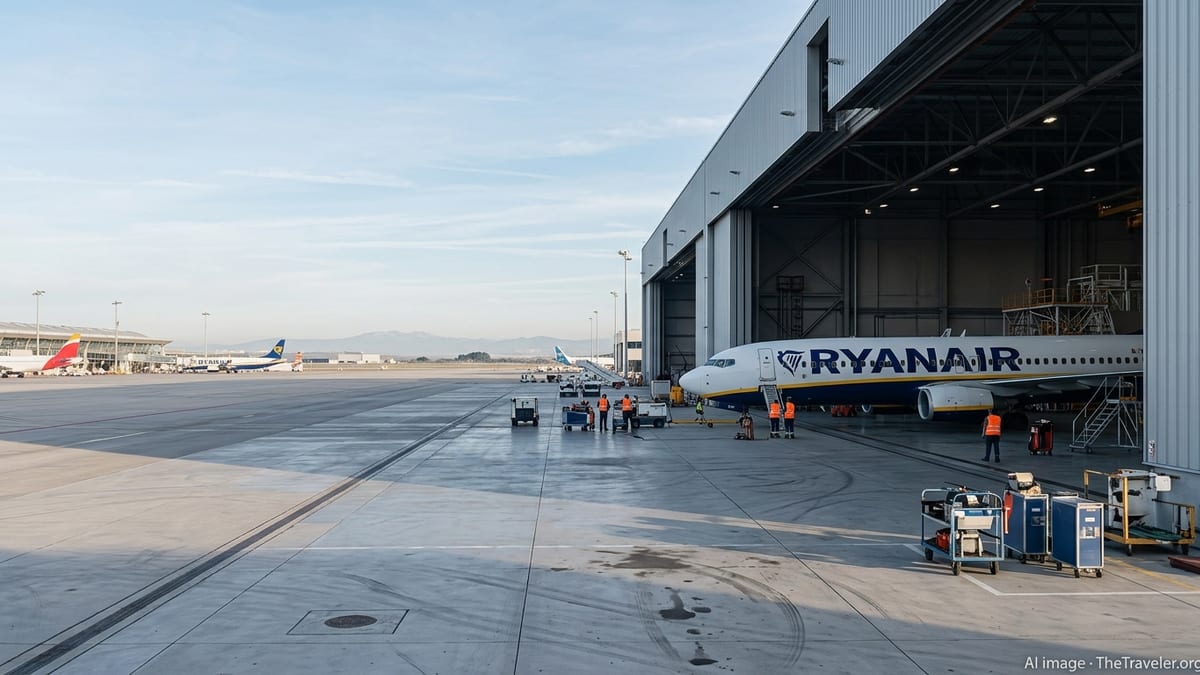
A Big Bet on Madrid at Barajas Airport
Publicly available investment material from the Madrid regional government highlights a 15-year lease granted to FR Hangars, the Ryanair-linked company that operates the carrier’s Spanish hangars, for a major new maintenance and painting facility at Adolfo Suárez Madrid Barajas Airport. The hangar, located in the industrial zone north of Terminals 1, 2 and 3, repurposes space historically used by Iberia and marks one of the most significant maintenance footprint shifts at Spain’s largest airport.
The project is described as the largest single hangar at Barajas, covering more than 22,600 square meters. Around 16,300 square meters will be dedicated to housing aircraft, with just over 6,200 square meters used for storage and office areas, allowing Ryanair to concentrate heavy technical activity on-site rather than relying solely on third-party providers across Europe.
Documents detailing the deal indicate an initial committed investment of 8 million euros in the first three years of the contract. While modest when set against Ryanair’s fleet growth plans, this outlay is part of a broader strategy that includes new aircraft, expanded routes and training infrastructure anchored in Spain, positioning Madrid as a long-term operational center rather than just another base on the network map.
Alongside the hangar, the Madrid region is also slated to host a new Ryanair pilot training center, with a dedicated complex featuring six full flight simulators near Barajas. This combination of maintenance facilities and training capacity suggests that the carrier intends to treat the Spanish capital as a core technical and human-capital hub for its European operations.
How the Hub Fits into Ryanair’s Wider Spanish Expansion
The Madrid maintenance hub forms part of a wider multibillion-euro investment program that Ryanair has earmarked for Spain. Regional promotional material notes that the airline plans to invest around 5 billion euros in the country over seven years, including basing 33 additional Boeing 737 MAX aircraft and opening five new operational bases across the Spanish market.
Traffic figures and corporate presentations show that Spain is already one of Ryanair’s largest markets, with hundreds of routes linking secondary and primary airports to the rest of Europe. The expansion plan envisions increasing the number of routes from roughly 730 to more than 1,000, deepening connectivity into both tourism-focused regions and key business destinations such as Madrid and Barcelona.
Within this context, the Barajas facility becomes less an isolated infrastructure project and more the technical backbone of Ryanair’s Spanish growth. Airline maintenance strategy briefings describe a mix of in-house and outsourced maintenance, with existing heavy maintenance bases in countries such as Lithuania, Poland and Scotland and a wide web of line maintenance stations at major airports including Madrid.
By scaling up at Barajas, Ryanair appears to be consolidating more of its engineering work directly under its control and closer to where its Spanish-based aircraft operate. The Madrid hub will complement existing hangars in other Spanish cities, particularly Seville, and could gradually shift the balance of complex maintenance tasks away from external partners toward company-managed facilities.
High-Skilled Jobs and a New Center of Gravity for Spanish Aviation Work
The size and complexity of the new hangar, combined with the pilot training center, point to a significant concentration of technical, engineering and simulator-instruction jobs in the Madrid region. Investment documentation and socio-economic impact studies published by the airline indicate that Ryanair directly employs thousands of people across Spain, and the new facility is expected to add a fresh layer of skilled maintenance and support roles.
Madrid already hosts one of Spain’s largest aerospace clusters, with major industrial sites to the south around Getafe and a dense ecosystem of aerospace services and suppliers near Barajas. The Ryanair hub is likely to draw on this talent pool, boosting demand for licensed aircraft engineers, mechanics, planners, quality assurance specialists and logistics staff, while also creating entry-level pathways for technicians and apprentices.
For Spain’s wider aviation labor market, the move could act as both a magnet and a disruptor. Regions that currently rely on smaller maintenance operations, or on line maintenance only, may see some skilled workers relocate to Madrid for more stable or specialized roles. At the same time, the creation of a large-scale, low-cost-focused maintenance and training complex in the capital may encourage other carriers and suppliers to expand there, intensifying competition for engineers and technicians.
Job quality and conditions will remain an important point of scrutiny for unions and professional associations, particularly in a sector where contracts, pay scales and shift patterns vary widely between airlines and maintenance providers. However, the net effect on employment is expected to be positive, with more long-term technical roles in Spain rather than maintenance work leaking to facilities outside the country.
What the Move Means for Barajas and Spain’s Airport Network
Adolfo Suárez Madrid Barajas is already one of Europe’s busiest airports and a primary gateway between Europe and Latin America. It serves as a hub for Spain’s flag carrier and several leisure and long-haul operators, while also acting as a major base for low-cost airlines. The installation of Ryanair’s largest European maintenance hangar at the airport strengthens its position as a multipolar hub that mixes legacy and budget operations on an unprecedented scale in Spain.
From an airport management perspective, hosting a large maintenance facility brings additional, less cyclical revenue streams and anchors long-term airline commitments. The new hangar occupies valuable industrial land adjacent to the runways, indicating a strategic choice to prioritize aviation services and high-value industrial activity alongside passenger growth and commercial development around the terminals.
For Spain’s broader airport network, the Madrid hub may accelerate a structural divide between high-density, full-service locations with integrated maintenance and training, and smaller regional airports more focused on point-to-point passenger traffic. Ryanair has been expanding bases in tourist regions and secondary cities, but the technical heart of its Spanish operation now appears clearly set to revolve around Madrid, with Seville and other locations playing complementary roles.
That shift could reshape where highly skilled aviation jobs are created, where young engineers choose to train and work, and how regional governments pitch their airports to airlines. Some regions may increasingly market themselves as operational bases and tourism gateways, while the capital consolidates its role as the country’s central hub for aircraft maintenance, pilot training and aviation services.
What Travelers and Aviation Workers Should Watch Next
For travelers, the immediate impact of the new Madrid maintenance hub will not be as visible as new routes or cheaper fares, but it may indirectly influence service reliability. Concentrating maintenance capacity near where many aircraft are based can reduce positioning flights for checks, potentially cutting disruptions, turnaround times and operational costs over the medium term.
Aviation professionals, especially engineers, technicians and pilots, are likely to feel the changes more directly. The arrival of a large-scale maintenance and training ecosystem in Madrid increases opportunities for career progression within Spain, from line maintenance into heavy checks or from flight school into simulator instruction and fleet training roles, without necessarily needing to relocate to other European aviation hubs.
Over the coming years, observers will be watching whether Ryanair expands the Barajas complex further, adds extra maintenance bays or extends the lease beyond the initial 15-year period. The scale of the airline’s planned aircraft deliveries and route growth in Spain suggests that the Madrid hub could evolve into one of the most important low-cost maintenance centers in Europe, with knock-on effects for suppliers, training schools and competing carriers.
As the project advances from lease agreement to full operation, it will serve as a high-profile test of how targeted aviation investment can reshape regional job markets, rebalance maintenance work within Europe and cement a city’s status as a central node in the fast-evolving low-cost airline network.