

More news on this day
Holiday travel to Spain’s Costa del Sol faces a major setback after the full reopening of the AVE high-speed rail line between Madrid and Malaga was postponed again to late April, leaving Easter travelers grappling with bus substitutions, longer journey times and reduced seat availability.
Get the latest news straight to your inbox!
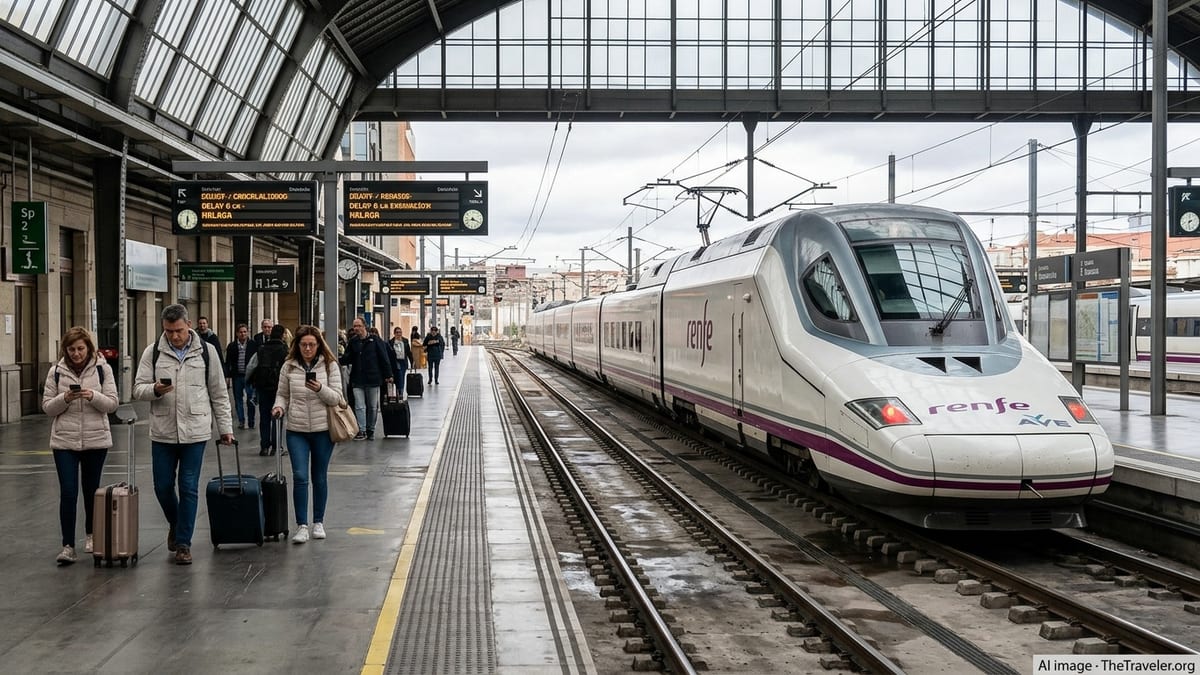
Reopening Pushed Beyond Easter Peak
Publicly available information from Spanish rail infrastructure updates indicates that the Madrid–Malaga high-speed corridor, already operating under significant restrictions since January, will not resume full AVE service before the end of April. Earlier expectations pointed to a reopening in time for Semana Santa, but the date has now slipped beyond the crucial Easter holiday window.
The disruption stems from ongoing works on the high-speed route in Andalusia following a serious accident near Adamuz in January and subsequent weather-related damage. Rail authorities have emphasized the need to complete safety checks and infrastructure repairs before restoring normal operations, even if that means missing one of the busiest travel periods of the year.
As a result, long-distance connections between Madrid and Malaga are currently operating on a mixed model that combines rail with road transfers. What was once a direct, sub-three-hour AVE journey has, for many departures, turned into a longer, multi-leg trip that can add significant uncertainty to tightly planned Easter itineraries.
Impact on Costa del Sol Tourism and Bookings
Tourism and hospitality associations on the Costa del Sol are warning of a sharp impact on Easter demand. According to regional industry coverage, local hoteliers had banked on a surge of high-speed rail arrivals from Madrid and other inland cities, counting on the AVE to fill rooms across Malaga, Marbella, Torremolinos and Nerja during Holy Week.
Those expectations have been rapidly downgraded. Reports from business groups point to a drop in last-minute reservations and a rise in cancellations directly linked to the uncertainty over rail connections. Some estimates circulating in the regional press suggest that lost revenue for Malaga and the wider Costa del Sol over the Easter period could range into the hundreds of millions of euros, once hotel stays, restaurant spending and ancillary services are taken into account.
Air travel data reinforces the shift in behavior. Recent figures highlighted in national media show a marked increase in passengers flying between Madrid and Malaga compared with the same period last year, as travelers abandon the disrupted rail corridor in favor of more predictable flight schedules, despite higher prices and airport transfer times.
What Travelers Can Expect on the Madrid–Malaga Route
For those still planning to use rail between Madrid and Malaga around Easter, journeys are likely to involve a combination of high-speed and conventional services, along with replacement buses on affected segments. Current timetables show trains terminating or starting at intermediate hubs such as Antequera, with passengers transferred by coach to complete the journey to Malaga.
This hybrid operation typically adds at least 45 minutes to an hour to the usual timetable, and sometimes more if connections are tight or traffic conditions are unfavorable. Travelers should expect fewer direct departures, occasional platform changes and potential crowding at transfer points, particularly on peak Easter travel days.
Seat availability is another concern. With the high-speed line partially closed, the overall number of rail seats into Malaga is lower than in a normal Easter season, even as demand for coastal destinations remains strong. Public transport forums and recent passenger accounts describe sell-outs on popular departure times and limited flexibility to switch trains on the day of travel.
Ticket conditions have also evolved. Earlier in the disruption, many passengers were offered compensations or alternative arrangements, but updated notices referenced in traveler reports indicate that tickets purchased more recently may carry more restrictive refund and delay conditions, especially where the altered timetable is already built into the schedule.
Alternatives: Flights, Regional Trains and Road Travel
With direct AVE services constrained, many Madrid-based travelers heading to the Costa del Sol are turning to domestic flights. Airlines have increased capacity on the Madrid–Malaga route compared with last year, and publicly available booking data shows strong load factors in the run-up to Easter. While flying restores travel times to around one hour in the air, passengers need to factor in airport transfers, security checks and possible holiday-season queues.
Other travelers are piecing together journeys using a mix of regional trains and intercity buses. Routes via Seville, Granada or Cordoba can work for flexible itineraries, though they generally take longer than the pre-disruption AVE connection. Online travel communities report that some itineraries require careful planning to match regional train arrivals with bus departures, especially in the evening.
Car rentals and rideshare platforms are also absorbing some of the displaced demand. Motorway links between Madrid and Malaga provide a straightforward, if lengthy, alternative of around five to six hours by road under normal traffic conditions. However, higher rental prices during Easter, fuel costs and possible congestion on key stretches may offset the convenience of door-to-door travel.
For visitors already based on the Costa del Sol who had planned day trips inland by high-speed rail, regional options remain available on certain corridors, but timetables may be thinner and journey times longer than advertised earlier in the year. Travelers are advised, based on recent timetable summaries, to check schedules close to departure and allow extra margins for connections.
Planning Strategies for Easter and Spring Trips
Given the continued uncertainty on the Madrid–Malaga AVE line through Easter, travel planners recommend building more flexibility into itineraries. That can mean avoiding tight same-day connections to flights or cruises, selecting refundable or changeable tickets where possible, and scheduling key transfers earlier in the day to reduce the risk of knock-on disruption.
Travelers who have not yet booked transport are increasingly advised by public travel guides and forums to compare total trip times and costs across modes rather than assuming rail will be the fastest or simplest option this season. In some cases, a direct flight from Madrid or another Spanish city to Malaga, or even to nearby airports such as Granada, may be more predictable than a multi-leg rail journey dependent on replacement buses.
For those who prefer to retain rail as part of their trip, one tactic emerging in recent traveler accounts is to treat the journey as a staged itinerary, adding an overnight stop in cities such as Cordoba or Seville. This can reduce the stress of delays while turning a disrupted through-journey into an opportunity to see more of Andalusia.
Looking beyond Easter, expectations are cautiously shifting toward a normalization of services later in spring, once safety works and infrastructure checks are completed. Until full AVE operations resume on the Madrid–Malaga line, however, anyone bound for the Costa del Sol should prepare for longer travel times, bus segments and a more complex booking landscape than in previous years.