

More news on this day
Travellers connecting through Singapore faced fresh disruption today as Jetstar, Qantas, Singapore Airlines and other major carriers cancelled eight key flights, disrupting busy routes linking the city state with Melbourne, Sydney, Dubai, Jeddah, Jakarta and other major hubs.
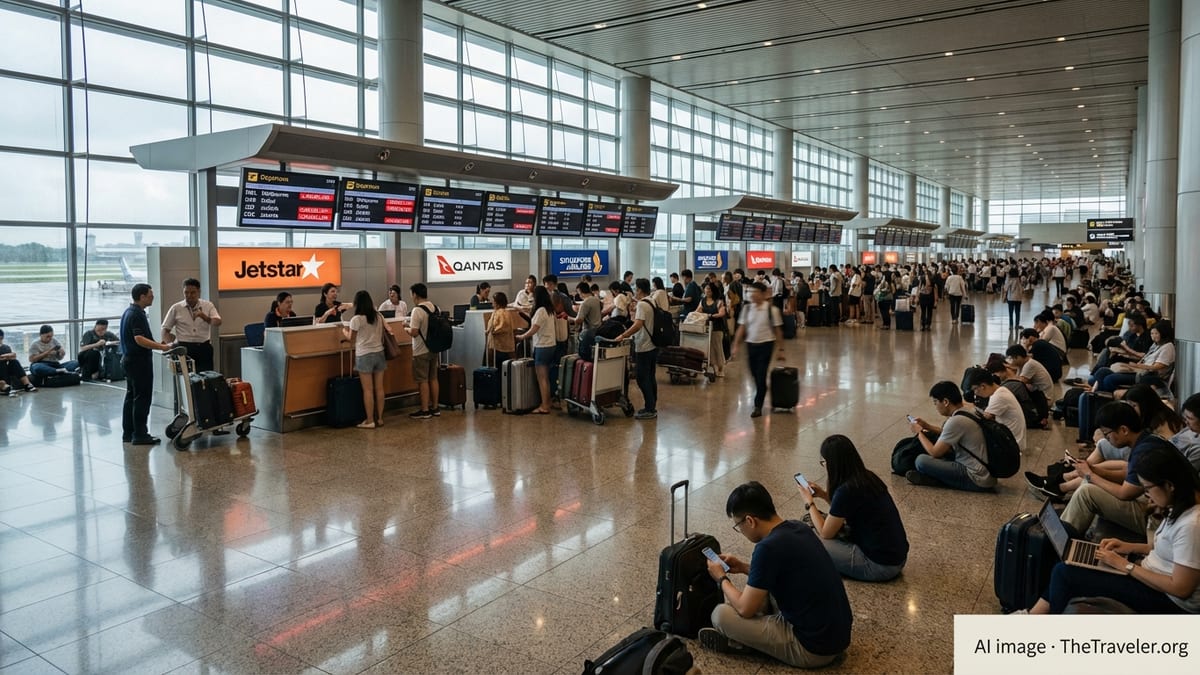
Multiple Airlines Pull Key Services on Busy Regional and Long Haul Links
The latest round of cancellations has hit a mix of short haul and long haul services that typically carry heavy leisure and business traffic into and out of Singapore. Jetstar and Qantas pulled services touching Melbourne and Sydney, while Singapore Airlines scrubbed departures tied to onward connections to the Middle East and Indonesia, according to operational data and airport schedules reviewed today.
Passengers reported receiving short notice messages advising them that their flights via Changi Airport had been removed from the schedule or converted to later departures. Some travellers on Australia routes found early morning flights between Sydney and Melbourne cancelled on the same day they were due to continue on to Singapore, forcing last minute rebookings onto later services or different airlines altogether.
Regional itineraries to Jakarta and long haul journeys connecting to Dubai and Jeddah were also affected, with some services withdrawn outright and others consolidated into a reduced number of departures. Airlines have been attempting to move disrupted travellers onto remaining flights, but high late February demand on major Asia Pacific and Middle East corridors has limited available seats, leading to extended delays for some passengers.
While eight flights may appear modest in isolation, aviation analysts note that on heavily booked routes a small cluster of cancellations can quickly ripple across the network as missed connections, crew displacement and aircraft rotations compound the disruption.
Operational Strain at Changi and Tight Capacity Across the Region
The disruption comes as Changi Airport continues to operate under intense pressure, with airlines adjusting schedules around terminal changes, aircraft redeployments and lingering capacity constraints on some regional routes. Jetstar’s gradual shift of its Singapore operations toward Terminal 2, and the earlier closure of its Singapore based affiliate Jetstar Asia in 2025, have already reduced the low cost capacity that once helped absorb peaks in demand between Southeast Asia and Australia.
At the same time, full service carriers such as Qantas and Singapore Airlines are still carefully balancing restored capacity against operating costs on long haul flights. Rising airport fees and supplier costs in Singapore were cited by Qantas when it shut down Jetstar Asia last year, and those pressures remain a factor as airlines decide which frequencies to prioritise and which lightly loaded or operationally complex flights to cut at short notice.
The immediate trigger for today’s cancellations appears to be a combination of aircraft availability and schedule recovery rather than a single dramatic incident. Recent weeks have seen isolated delays and technical issues on Australia to Singapore sectors, prompting carriers to reshuffle aircraft and crews in order to protect core trunk services while trimming marginal frequencies.
Changi’s role as a major connecting hub means such tactical schedule changes can quickly be felt far beyond Singapore itself, particularly on itineraries where travellers rely on tight connections between Australian cities and long haul flights to the Middle East and Europe.
Passengers Scramble for Alternatives on Melbourne, Sydney and Jakarta Routes
For travellers, the most immediate impact has been on early morning and late evening flights that are often used to maximise time at either end of a trip. In Australia, some Jetstar customers booked on the busy Sydney to Melbourne corridor found their departure cancelled outright, with options limited to later departures already heavily booked at the tail end of the Southern Hemisphere summer holiday period.
In Singapore, passengers heading for Jakarta reported being offered same day but significantly delayed alternatives, or rerouting through other Indonesian gateways with domestic connections added to complete their journey. Those bound for the Gulf and Saudi Arabia faced longer waits, as services to Dubai and Jeddah typically operate only a few times per day from Singapore and are constrained by slot and crew duty time limitations.
Airlines involved in the disruption have encouraged passengers to check their booking status frequently and to arrive at the airport earlier than usual if they have been rebooked, in case further schedule adjustments are required. Some travellers have opted to switch to other carriers at their own expense in order to keep time sensitive commitments, particularly those connecting from Australia to religious trips or business meetings in the Middle East.
Travel agents across the region reported a spike in calls as customers sought clarification on their options, including refunds, credits or alternative routings that avoid Singapore altogether in favour of other hubs such as Kuala Lumpur, Bangkok or Hong Kong.
Refunds, Rebookings and What Travellers Should Expect Next
With eight flights cancelled and knock on delays affecting other services, the main focus for affected airlines has been to move passengers onto the next available departures while honouring fare conditions and local consumer protection rules. In most cases, customers whose flights were cancelled have been offered a choice of free rebooking on the next available service in the same cabin, travel credit for future use, or refunds for unused sectors.
However, the level of compensation for additional costs such as hotels, meals and onward connections varies significantly between carriers and jurisdictions. Travellers on tickets originating in Europe may have stronger claims under European passenger rights rules than those whose journeys begin in Asia or Australia, where compensation frameworks differ and often do not mandate fixed cash payments for schedule changes caused by operational reasons.
Airline call centres and online chat channels have been under visible strain, with some passengers reporting long waits to speak to an agent as they attempted to salvage carefully planned itineraries. Industry observers say this underlines the value of booking complex trips through experienced travel advisers who can intervene quickly when cascading cancellations hit a connecting hub like Singapore.
Looking ahead to the coming days, carriers are expected to keep a tighter rein on capacity while they work schedules back into balance, which could mean further minor adjustments even after today’s high profile cancellations. Travellers with upcoming itineraries via Singapore are being urged to monitor flight status closely and to allow extra buffer time for connections where possible.
Changi’s Hub Role Underlines Fragility of International Networks
The episode is a reminder of how sensitive global air travel remains to localised operational issues, even in an era when traffic through Singapore is approaching or surpassing pre pandemic levels. As one of Asia’s pre eminent hubs, Changi knits together Australia, Southeast Asia, the Middle East and Europe with finely tuned schedules that often leave little room for error.
When several major airlines simultaneously withdraw or retime a handful of flights, the impact can cascade across multiple continents, particularly for travellers relying on single ticket itineraries that thread together low cost and full service segments. Analysts note that the withdrawal of Jetstar Asia last year reduced some of the redundancy in short haul capacity around Singapore, making it harder to recover quickly when disruptions occur.
For now, airport authorities and airlines are presenting today’s wave of cancellations as part of the normal ebb and flow of schedule management at a busy hub rather than a sign of deeper structural problems. Still, for the thousands of travellers whose plans were upended on routes linking Singapore with Melbourne, Sydney, Dubai, Jeddah, Jakarta and beyond, the disruption has been a stark reminder to build flexibility into international journeys.
With travel demand remaining strong across the Asia Pacific and Middle East corridors, any further cancellations or schedule reshuffles in the weeks ahead will be closely watched by passengers and the wider industry alike.