

More news on this day
Asia’s busiest air corridors are being quietly rewired as Japan Airlines, Cathay Pacific, Korean Air and United Airlines adjust Taiwan schedules and partnerships, just as a new AI-driven border control tool nicknamed “Mr. Cam” begins changing how travelers are processed at the island’s airports.
Airlines Reset Their Taiwan Strategies After a Rapid Rebound
With traffic between Taiwan and major Asian hubs rebounding to and in some cases surpassing pre-pandemic levels, leading carriers are rebalancing capacity and refining the way they connect passengers through Taipei. The Hong Kong–Taipei route alone returned to the top spot globally by seat volume in 2024, underlining how central Taiwan has become to regional air networks. Against that backdrop, Japan Airlines, Cathay Pacific, Korean Air and United Airlines are each making targeted but meaningful adjustments that will affect how and where travelers transit.
Most of the changes are not dramatic route launches or cancellations, but rather schedule fine-tuning, equipment swaps and deeper coordination with local partners in Taipei. For frequent flyers, these moves can translate into more daylight connections, shorter layovers, or a different mix of widebody and narrowbody aircraft on key city pairs. For Taiwan’s main gateway, Taoyuan International Airport, they signal a gradual shift toward higher-yield traffic and more seamless transfers rather than sheer volume alone.
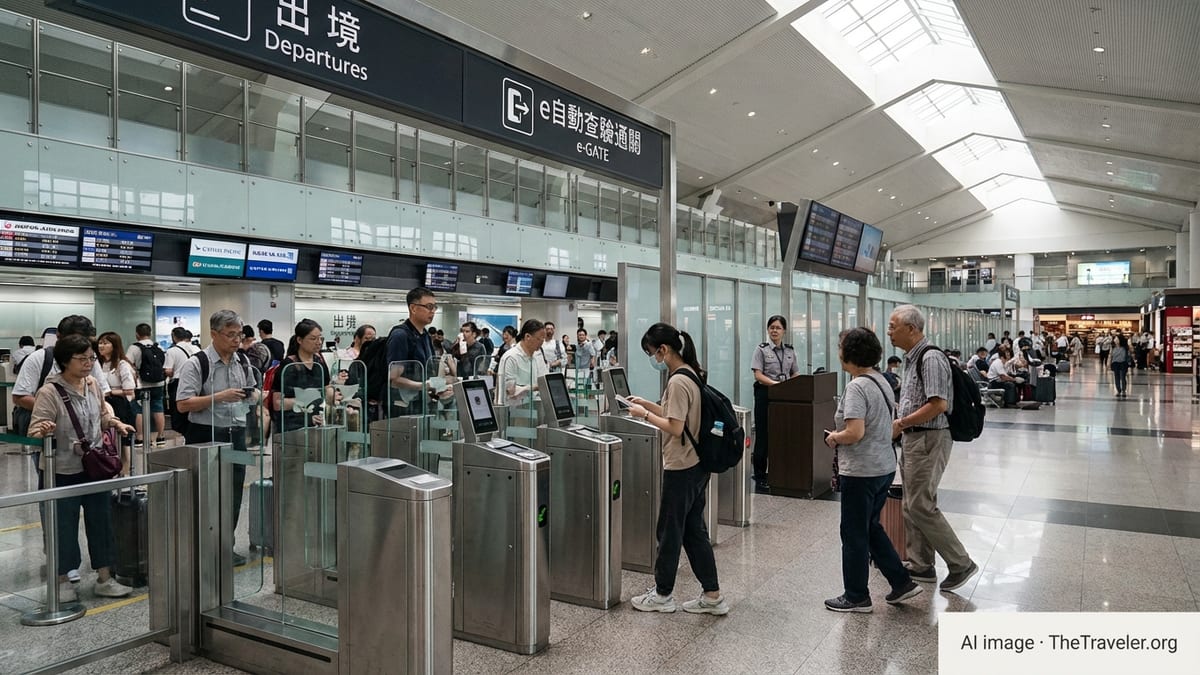
At the same time, Taiwan’s authorities are upgrading how passengers are processed at the border. The rollout of a new generation of automated e-Gates, built around dynamic facial recognition and expanded eligibility for foreign visitors, is being paired with an AI camera and analytics platform informally dubbed “Mr. Cam.” Together, these technologies aim to ease bottlenecks at peak times and give airlines more confidence that tight connections through Taipei can be met.
While details vary by carrier, the overarching trend is clear. Taiwan’s air links with Northeast Asia and North America are entering a more data-driven phase, where schedule planning by Japan Airlines, Cathay Pacific, Korean Air and United increasingly assumes a faster, more predictable ground experience powered by AI-led surveillance systems.
What Is AI-Powered “Mr. Cam” at Taiwan’s Airports
“Mr. Cam” is an unofficial nickname used by local staff and technology vendors for the camera-centered AI analytics now being layered on top of Taiwan’s fourth-generation automated immigration gates. The National Immigration Agency has progressively upgraded these e-Gates since 2020, completing a full replacement of the earliest generation units across major airports in 2024 and 2025. The newest hardware supports dynamic facial recognition, multi-angle image capture and the ability to process passengers as they walk up, rather than requiring them to stand still for long periods.
On paper, the e-Gate alone is simply a self-service passport control kiosk that uses biometrics to verify identity and grant clearance. What turns it into the so-called “Mr. Cam” system is an array of linked cameras and software that monitor passenger flows and behavior in real time. The AI engine looks for practical operational signals, such as queue length, processing speed at each lane, and the proportion of passengers being redirected to manual inspection. It can flag sudden surges when several widebody arrivals land at once and help border officers open or close gates dynamically.
The same backbone can also support security-oriented functions. The AI can highlight unusual movements, repeated failed verification attempts or people lingering near restricted areas of the immigration hall. Officials emphasize that biometric data are tied to immigration records and that the system is designed to work within Taiwan’s existing privacy and data protection framework, but rights groups are watching closely as more capabilities come online.
In practical terms, travelers will mainly notice that automated gates are more widely available and more responsive to peaks. The technology behind “Mr. Cam” is not presented to passengers as a consumer-facing product, yet it increasingly shapes the experience of entering and leaving Taiwan, particularly during banked arrival and departure waves that are built around the schedules of leading hub carriers.
Inside Taiwan’s New e-Gate Era and How It Speeds Transit
Taiwan’s first automated border gates were introduced more than a decade ago, but the current generation represents a significant leap. New lanes are now installed at Songshan, Taoyuan, Taichung and Kaohsiung airports as well as at key seaports. The latest e-Gates support dynamic facial recognition, meaning the camera adjusts to the height and movement of passengers as they approach. The minimum age and height requirements have been lowered compared with early trials, and instructions are available in dozens of languages, improving usability for international visitors.
Crucially for connecting passengers on Japan Airlines, Cathay Pacific, Korean Air and United, foreign nationals are now widely able to use the system on departure from Taiwan. That allows a traveler who has registered their biometrics on a previous arrival to clear exit control in a matter of seconds, often turning what used to be a long stop at the passport desk into a brief pause at an automated gate. For airlines working to sell tight connections, that helps reduce missed flights and customer frustration.
The AI layer that constitutes “Mr. Cam” sits above this e-Gate network, analyzing how long each transaction takes and how queues build, so border managers can assign staff and equipment where they are most needed. For instance, when several widebody flights from Northeast Asia and North America arrive nearly simultaneously in the early evening, the system can detect pressure points and recommend reallocating manual counters to support automated lanes or directing passengers to underused sections.
For travelers, the payoff comes in minutes saved rather than in any obvious new interface. If the AI achieves its goal, you will simply find that arrivals and departures in Taipei are less prone to sudden gridlock when banks of flights land or board together. In turn, that gives airlines additional confidence to plan shorter minimum connection times within the airport’s design limits, complementing existing infrastructure upgrades at Taoyuan such as expanded gates and more efficient security screening zones.
Japan Airlines: Fine-Tuning Taipei Connections to Japan and North America
Japan Airlines has long treated Taipei as an important spoke in its broader network centered on Tokyo. From its base in Terminal 2 at Taoyuan International Airport, the carrier feeds passengers onto onward services to both Narita and Haneda, where they can connect to domestic Japanese cities and an expanding roster of long haul flights. As travel demand between Taiwan and Japan has remained resilient, JAL has focused on optimizing timings and equipment rather than making sweeping changes to its city pair map.
Recent schedule adjustments have shifted more capacity toward daylight departures and arrivals that align with peak connection banks in Tokyo. That can mean earlier morning departures from Taipei feeding into late morning transpacific flights out of Narita, or evening returns timed to connect with after-work departures from Japanese regional cities. As “Mr. Cam” and the upgraded e-Gates increase the predictability of immigration and departure processing in Taipei, JAL has greater room to tighten ground schedules without excessively padding in buffer time.
Another notable trend is the gradual deployment of newer, more efficient aircraft on JAL’s Taiwan routes, enhancing both comfort and capacity. Cabin upgrades, including more consistent premium economy and refreshed business class seats, are designed to appeal to a mix of leisure travelers and high-value corporate passengers moving between Taiwan, Japan and North America. With faster, more automated border procedures on the Taiwan side, the entire journey can feel smoother, even before a passenger sets foot on Japanese soil.
JAL’s cooperation with its alliance partners and interline agreements also benefits from more reliable connection times through Taipei. When the odds of a delay at immigration are reduced by AI-managed e-Gates, the airline can coordinate better with oneworld partners and with local carriers in Taiwan to protect tight onward connections, something that was more difficult before automation became widespread.
Cathay Pacific: Leveraging a Reborn Hong Kong–Taipei Power Corridor
No airline is more synonymous with the Hong Kong–Taipei corridor than Cathay Pacific. As the route reclaimed its position as the world’s busiest international air link in 2024, Cathay has been recalibrating its schedules and seat offerings to capture returning demand while adapting to structural shifts in the market. Business travel patterns have evolved, leisure travelers are booking closer to departure, and competitive dynamics with Taiwanese carriers have intensified.
Cathay’s latest strategy places more emphasis on high-frequency service with a consistent product, allowing travelers from Taiwan to connect through Hong Kong onto an extensive long haul network. As “Mr. Cam” and related automation speed up border control on the Taiwan side, passengers originating in Taipei can more reliably clear departure formalities in time to catch tightly timed departures to Hong Kong. That, in turn, supports closely timed onward connections to Europe, North America and the South Pacific.
The airline is also adjusting capacity up and down more dynamically across days of the week, reflecting granular demand forecasts that now incorporate more predictable airport processing times. Faster, data-informed throughput at Taipei means Cathay and its planners can assume fewer last-minute delays stemming from immigration bottlenecks, which historically complicated banked waves of flights during late afternoon and evening peaks.
For travelers, these network and schedule tweaks, combined with smoother ground formalities, translate to a more straightforward experience even on one of the planet’s busiest air corridors. Short-haul sectors between Taipei and Hong Kong can increasingly feel like swift shuttles, feeding passengers into global networks on either side without the stress of long queues or unpredictable clearance times.
Korean Air and United: Rethinking North Asia and Transpacific Flows via Taiwan
Korean Air has been rebuilding and expanding its network across Northeast Asia and the Pacific, with Seoul Incheon serving as a powerful hub. Taiwan sits naturally within that web. Schedule changes over the last year have seen Korean Air adjust arrival and departure patterns at Taipei to better mesh with its transpacific and Europe-bound banks in Seoul. Flights are being timed to allow Taiwanese travelers and those transiting through Taipei to step off, clear formalities and reboard with minimal downtime.
The enhanced e-Gate network and AI-enabled monitoring in Taiwan’s immigration halls have become quiet enablers of this strategy. When the ground side of the journey is less of an unknown, carriers like Korean Air can construct tighter, more competitive connection options without assuming large buffers. That is particularly valuable for business travelers whose time is at a premium and who seek the shortest total journey time between cities such as Taipei and New York, Toronto or major European capitals.
United Airlines, which uses Taipei as part of its broader transpacific strategy, is similarly fine-tuning its operations in light of both demand shifts and greater automation at Taiwanese airports. While the carrier’s core transpacific services hinge on hubs in the United States and key Asian gateways, Taiwan’s steady rebound in both leisure and business traffic has encouraged United to look more closely at how it times arrivals and departures relative to local peaks in border processing and security queues.
For passengers, the interplay between these carrier strategies and “Mr. Cam” manifests in quieter ways. Flights may depart or arrive at slightly different hours, minimum connection times may be recalibrated, and airline apps may show a greater number of viable connection options through Taipei that would have been deemed too tight in a less automated era.
What the Changes Mean Day to Day for Travelers to and via Taiwan
For the average traveler flying Japan Airlines, Cathay Pacific, Korean Air or United to or through Taiwan, the biggest change is not a headline-grabbing route launch but a series of small improvements that compound. Security and immigration queues can be shorter and move more steadily, particularly during peak waves built around airline banks. Automated e-Gates, monitored by AI, handle a larger share of passengers, leaving manual counters for those who need extra assistance or secondary checks.
If you are eligible to enroll in Taiwan’s e-Gate system, doing so on an early trip can pay dividends on future journeys. Once registered, you can often proceed directly to automated lanes on departure, shaving valuable minutes off the airport experience. Airlines, aware of this shift, are increasingly comfortable offering connections through Taipei that might have seemed risky a few years ago, especially on itineraries that mix carriers or require separate tickets.
At the same time, travelers should be aware that greater use of AI and cameras can raise privacy and data protection questions. While Taiwan positions its system as a security and efficiency tool with safeguards, the reality is that more of your movements in the immigration hall are being observed and analyzed. Those who are uncomfortable with biometric processing can still opt for manual lanes, but they may face longer waits as automated channels become the default for frequent visitors and eligible foreign nationals.
From booking to boarding, airlines are increasingly transparent about airport processing times, and they may update guidance as the AI systems learn and improve. Travelers can expect more precise advice on when to arrive at the airport, how long to allow for transfers, and whether a connection that once seemed too close is now considered reasonable in an AI-managed environment.
Looking Ahead: AI, Infrastructure and the Next Phase of Taiwan’s Hub Ambitions
The deployment of “Mr. Cam” and the broader AI-supported e-Gate network is only one piece of Taiwan’s strategy to cement its role as a regional hub. Planned infrastructure expansions at Taoyuan, including additional gates and terminal upgrades, are intended to accommodate steady growth in both regional and long haul traffic. As those bricks-and-mortar projects progress, airlines such as Japan Airlines, Cathay Pacific, Korean Air and United will continue to recalibrate how they use Taipei within their networks.
In the near term, AI-driven efficiency gains may matter just as much as physical expansion. If automated systems can reliably smooth passenger flows at existing checkpoints, airports can effectively add capacity without pouring concrete. That gives carriers more flexibility to bank flights closer together, increasing connection options for travelers while still maintaining an acceptable experience at the border.
Longer term, the interplay between technology, policy and commercial strategy will determine how significant Taiwan becomes as an alternative or complement to other Asian hubs. Travelers are unlikely to talk about “Mr. Cam” by name, but they will feel its effects in shorter queues, more confident scheduling and a growing sense that connecting through Taipei is as straightforward as transiting through the region’s most established gateways.
For now, the message from the combined moves of Japan Airlines, Cathay Pacific, Korean Air, United and Taiwan’s own immigration authorities is clear. As Asia’s skies grow busier again, the future of Taiwan travel will increasingly be shaped by unseen cameras and algorithms working behind the scenes to keep people moving.