

More news on this day
Air travel across Iraq and the wider Middle East faced fresh disruption on March 10 as Royal Jordanian, Qatar Airways, EgyptAir, Iraqi Airways and other major carriers cancelled more than two dozen flights, severing key links between Iraqi cities and regional hubs including Amman, Doha, Cairo and onward connections to Europe such as Amsterdam.
Extended Iraq Airspace Closure Paralyzes Key Hubs
Iraq’s Civil Aviation Authority has kept the country’s airspace closed into March 10 as a precautionary response to ongoing regional security tensions, effectively halting almost all commercial traffic to and from Baghdad, Erbil and Basra. The shutdown, first imposed at the end of February and repeatedly extended, has cut Iraq out of major international corridors and left thousands of passengers scrambling for alternatives.
Authorities have framed the move as a temporary safety measure while they monitor the risk of missile and drone activity across the region. In practice, the blanket closure has triggered cascading cancellations by regional and global airlines that normally rely on Iraqi airspace for both origin-and-destination flights and overflights. With no confirmed timeline for a full reopening, airlines are largely planning day to day, issuing rolling updates as they trim schedules.
Travel analysts say the current disruption ranks among the most severe for Iraq since the country began rebuilding its aviation sector in the past decade. The impact is being felt not only by Iraq’s own carriers and airports, but also by neighboring hubs that depend on smooth connectivity through Baghdad and Erbil to feed wider Middle East and European networks.
Royal Jordanian, Qatar Airways, EgyptAir and Iraqi Airways Slash Services
Among the airlines hardest hit are Royal Jordanian, Qatar Airways, EgyptAir and Iraq’s flag carrier, Iraqi Airways, all of which have announced waves of cancellations affecting routes linking Iraq with Amman, Doha and Cairo, as well as onward connections to major European gateways such as Amsterdam. Combined, these operators alone account for more than 25 cancelled services over the current extension period, according to airport and airline updates reviewed on March 10.
Royal Jordanian, which normally offers multiple daily flights between Amman and Iraqi cities including Baghdad and Erbil, has suspended most services while the airspace remains closed. The cancellations have effectively shut one of the region’s most important short-haul business and family corridors, interrupting travel for Iraqi passengers who use Amman as a primary point of transit to Europe and North America.
Qatar Airways, already operating a sharply reduced global schedule since the late February escalation, has confirmed that flights touching Iraqi airspace or serving Iraqi destinations are largely on hold while it maintains a limited operation to and from Doha. The carrier is issuing daily schedule bulletins and has warned that additional cancellations remain likely until regulators declare key routes safe.
EgyptAir has extended its suspension of flights from Cairo to Baghdad and Erbil as part of a broader pause affecting 11 regional destinations. The move has cut one of the main direct links between Iraq and Egypt, a busy route for workers, students and medical travelers. Iraqi Airways, meanwhile, remains mostly grounded on international sectors, having converted many existing bookings into open travel credits while it waits for clearance to resume operations.
Routes to Amman, Doha, Cairo and Amsterdam Disrupted
The most immediate impact of the cancellations is being felt on trunk routes that connect Iraq with regional hubs such as Amman, Doha and Cairo. These cities function as vital waypoints for Iraqis heading onward to Europe, North America and Asia, meaning that a cancelled short-haul sector from Baghdad or Erbil often cascades into multiple missed long-haul connections.
Passengers booked to or from Amsterdam have also been hit as Middle East and European airlines adjust schedules. Some long-haul services between European hubs and the Gulf, which typically overfly Iraq, have been rerouted or cut entirely, reducing capacity into major airports such as Amsterdam Schiphol and forcing travelers into complex rebookings through alternative gateways.
For many travelers, the current disruption does not only mean a single cancelled flight but a complete restructuring of their journey. A typical itinerary from Baghdad to Amsterdam via Amman, Doha or Cairo might now involve extended layovers, detours via secondary hubs, or a switch to entirely different airlines willing to operate around the closed airspace at the cost of longer flight times and tighter capacity.
Airport officials and travel agents in the region report heavy demand for seats on any remaining routes that avoid Iraqi skies, with fares climbing and availability tightening for departures through at least the middle of March. Some carriers are warning that even rebooked itineraries may be subject to further last-minute changes as the security picture evolves.
Stranded Passengers Face Uncertainty and Limited Options
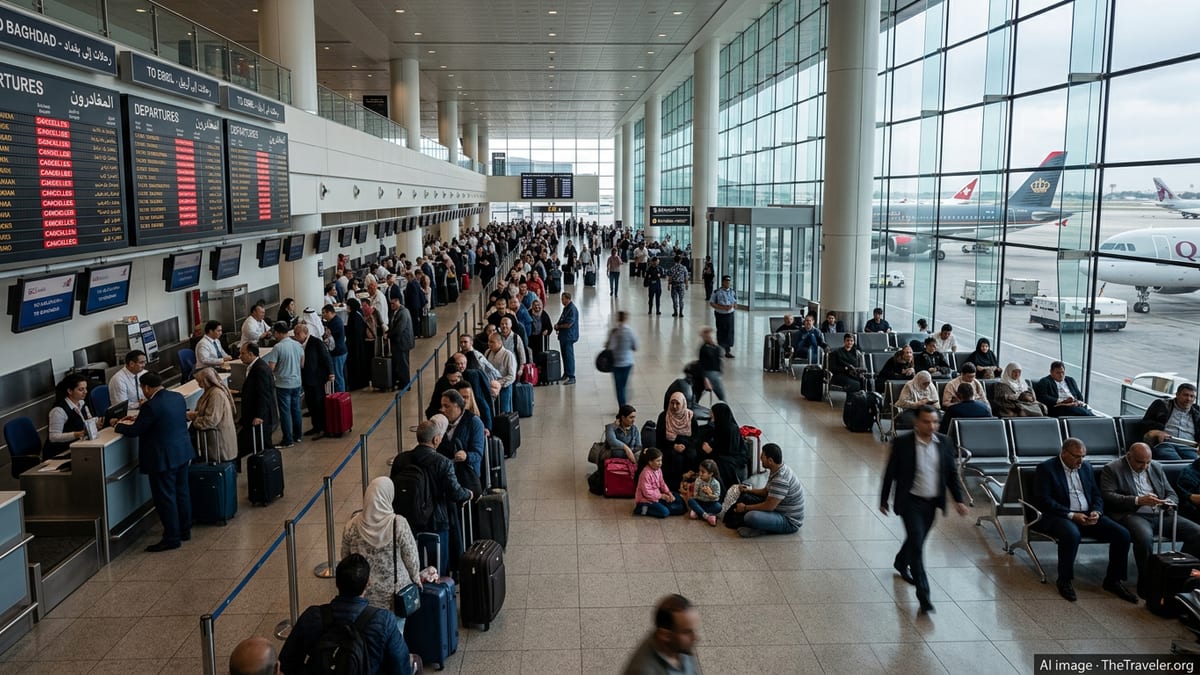
As the airspace closure drags on, scenes of crowded departure halls, long customer service queues and anxious passengers have become common across regional airports. At hubs such as Amman, Doha and Cairo, travelers originating in Iraq or attempting to return home have reported repeated cancellations and rebookings within days, and in some cases hours, of scheduled departure.
Travel industry sources say priority is being given to passengers who were already in transit when the airspace first closed, with many airlines arranging hotel stays and meal vouchers where local regulations require it. However, support varies by carrier and booking channel, and passengers who purchased tickets through third-party online agencies often face longer waits to secure refunds or alternative flights.
For Iraq-based travelers still at home, options are narrowing. With commercial flights suspended, some foreign nationals and aid workers are turning to overland routes toward neighboring countries, while others are postponing nonessential trips. Several governments have reiterated advisories against travel to Iraq, citing both security concerns and the lack of reliable air connections.
Travel insurers and corporate travel managers are now closely scrutinizing policies related to war and security disruptions, which can be treated differently from weather-related or technical cancellations. Passengers are being urged to keep all documentation of schedule changes and to check whether their coverage includes benefits for extended delays and forced itinerary changes linked to regional conflict.
What Airlines Are Offering Affected Travelers
In response to the scale of disruption, many airlines serving Iraq and the wider region have introduced temporary waivers and more flexible booking rules. Qatar Airways has published specific guidelines for customers whose flights fall between late February and March 22, outlining options to rebook within a limited window, reroute where capacity allows, or request refunds for cancelled services.
Royal Jordanian and EgyptAir have similarly relaxed change fees on impacted routes, allowing passengers to shift travel dates without additional penalties once operations resume. Iraqi Airways is providing vouchers and open tickets valid for future travel, although the timing of any restart remains dependent on decisions by national regulators.
Travel agents advise that affected passengers should act quickly once they receive cancellation notices, as available seats on alternative itineraries are snapped up fast. Where possible, travelers are encouraged to communicate directly with airlines through official channels rather than relying solely on third-party sellers, which may have slower response times during peak disruption.
With Iraq’s airspace closure currently extended only until at least midday on March 10, airlines are preparing for multiple scenarios, from a gradual reopening that would allow a phased restoration of flights to further extensions that could deepen the disruption. Until a clearer signal emerges from aviation authorities, passengers planning to travel to, from or over Iraq in the coming days are being urged to monitor airline updates closely and prepare for last-minute changes.