

More news on this day
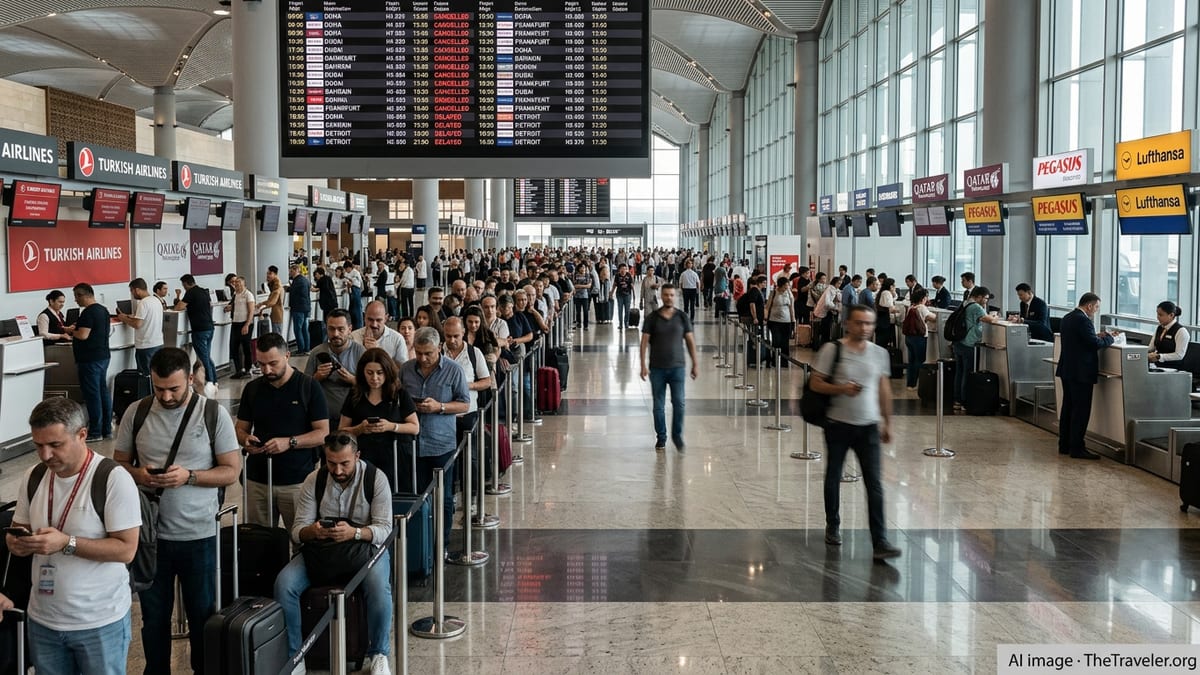
Air travel across Türkiye and the wider Middle East remained in turmoil on March 12 as Turkish Airlines, Qatar Airways, Pegasus, Lufthansa and other major carriers cancelled more than 20 flights, stranding passengers at Istanbul and other airports and disrupting key routes to Bahrain, Doha, Dubai, Frankfurt, Detroit and beyond.
Get the latest news straight to your inbox!
Airspace Closures Ripple Through Turkish Hubs
The latest wave of cancellations follows sweeping airspace closures and conflict-related restrictions across the Gulf and Levant, which have forced airlines to curtail or completely suspend services to several regional capitals. Turkish Airlines confirmed it is applying special rebooking and refund policies for passengers booked between late February and the end of March on routes touching Bahrain, Qatar, the United Arab Emirates, Kuwait, Saudi Arabia, Iraq, Syria and neighboring states, reflecting the scale of disruption now hitting its Istanbul mega-hub.
While Turkish authorities have not closed Türkiye’s airspace, carriers operating to and from the country are being pushed into last-minute schedule changes as neighboring nations restrict overflight permissions and airport operations. Flights that would normally transit Iranian, Iraqi or Gulf corridors are being rerouted over longer paths or pulled from the schedule entirely, with knock-on effects on aircraft and crew availability for services onward to Europe, North America and Asia.
Travel industry trackers report that this week alone has seen hundreds of cancellations across Europe and the Middle East, with a notable cluster tied to Istanbul and Antalya departures that connect onward to Gulf destinations. As a result, passengers attempting to travel from Türkiye to Bahrain, Doha or Dubai are facing a patchwork of limited services, long layovers at alternate hubs and, in many cases, outright cancellations with little advance warning.
At Istanbul Airport, one of Europe’s busiest international gateways, boards on Wednesday and Thursday showed a string of scrubbed departures and arrivals involving Gulf points, while domestic services largely continued as normal. Airport staff and airline call centers have been stretched as travelers line up to secure seats on the remaining flights or request refunds.
Turkish Airlines, Pegasus and Qatar Airways Cut Back
Turkish Airlines, Türkiye’s flag carrier, has issued a broad travel advisory outlining flexible options for passengers booked on affected routes throughout March. Customers travelling to or from Gulf and Levant destinations between late February and March 31 can change their tickets without a rebooking fee, subject to availability, or request refunds if their flights are cancelled. The airline has not published a full public list of cancelled services, but agents confirm numerous Istanbul departures to Bahrain, Doha, Dubai and other Gulf cities have been grounded on select days.
Pegasus Airlines, Türkiye’s main low-cost carrier, has similarly pared back its Middle East schedule. Turkish transport officials previously disclosed that Pegasus halted flights to Iran until at least March 12, and the carrier has also removed select services to Gulf destinations from its program. For budget-conscious travelers who rely on Pegasus to connect from secondary Turkish cities into the Gulf, the thinning timetable has meant long detours via Istanbul or the need to rebook on full-service rivals.
Qatar Airways, which normally channels Turkish passengers through its Doha super-hub to Asia, Africa and the Americas, is operating a limited schedule in and out of Doha. The airline has publicly confirmed that only a reduced number of flights are running while regional airspace remains constrained, and travelers report seeing forward bookings from cities such as Frankfurt and Singapore via Doha cancelled days in advance as the carrier consolidates operations.
The combination of Turkish carriers trimming their Middle East programs and Qatar Airways cutting frequencies has significantly reduced options for passengers starting or ending their journeys in Türkiye. Routes that once featured multiple daily choices have in some cases dropped to a single flight or disappeared from sales systems until the end of March.
Lufthansa and European Carriers Adjust Long-Haul Links
European airlines that depend on Turkish and Gulf routes for onward connections have also moved to protect crews and aircraft, leading to further disruption for passengers flying through Türkiye. Lufthansa has suspended several services into the wider Middle East, including connections to Dubai, Abu Dhabi, Dammam, Amman and Erbil, with some cancellations and suspensions stretching into late March and April. The German carrier has simultaneously mounted charter and repatriation flights from safer hubs such as Muscat to bring stranded passengers back to Frankfurt.
These adjustments are reverberating through itineraries that originate in or pass through Türkiye. Travelers with tickets from Istanbul to Frankfurt and onward to long-haul destinations such as Detroit are finding that while the core Türkiye–Germany leg may still operate on some days, their onward connection has been altered or cancelled as Lufthansa restructures its global network around the Middle East shutdowns.
Other European carriers, including Air France and Finnair, have also pared or suspended flights to Doha and Dubai, complicating rerouting options for Turkish travelers hoping to bypass the Gulf entirely. With traditional transit points under pressure, seats via alternative hubs in Central and Eastern Europe are becoming scarce, often at significantly higher last-minute fares.
For Turkish travel agencies, the constant schedule changes are creating a moving target. Agents say they are spending hours reissuing tickets and piecing together new routings for clients headed to North America and Asia, often via multiple connections instead of the usual one-stop options through Doha or Dubai.
Passengers Stranded and Searching for Alternatives
The immediate human impact of the cancellations is most visible at airports, where travelers with Turkish Airlines, Pegasus, Qatar Airways and Lufthansa tickets are queuing at service desks to salvage disrupted plans. Social media posts and traveler forums are filled with accounts of families stuck overnight in Istanbul and other Turkish cities after flights to Gulf destinations were pulled with only a few hours’ notice.
Some passengers connecting beyond the Gulf report being stranded mid-journey, particularly those whose itineraries hinged on a Doha or Dubai transfer. Travelers heading from Turkish cities to Southeast Asia or Australia via Qatar Airways and other Gulf carriers have had to seek alternative routings through European or Asian hubs, sometimes accepting multi-day delays as limited seats fill quickly.
Rebooking policies vary widely. While full-service airlines are generally offering free changes and refunds on cancelled flights, low-cost carriers have more restrictive rules, and hotel or onward rail bookings often fall outside airline responsibility. For many passengers, that means unexpected out-of-pocket expenses for extra nights of accommodation and new ground transport arrangements while they wait for a confirmed seat out of Türkiye.
Consumer advocates are reminding affected travelers departing from or transiting through European Union airports that they may be entitled to compensation under EU passenger rights rules if their cancellations are not directly tied to extraordinary security circumstances. However, the complex and fast-changing nature of the regional conflict makes each case highly fact-specific, and experts advise passengers to keep all receipts and written communications from airlines in case they pursue claims later.
What Travelers in and via Türkiye Should Do Now
With schedules changing by the hour, industry experts say any traveler due to fly to or from Türkiye with Turkish Airlines, Pegasus, Qatar Airways, Lufthansa or other carriers touching the Gulf should treat their booking as fluid rather than fixed. Passengers are being urged to monitor airline apps, email alerts and departure boards closely in the 24 to 48 hours before their trip, as some cancellations are being announced only shortly before check-in opens.
Travelers holding tickets to Bahrain, Doha, Dubai and other high-risk destinations in March are being advised to consider flexible alternatives, such as rebooking to later dates or rerouting through European or Asian hubs that do not require transiting closed or conflict-affected airspace. Where possible, experts recommend opting for tickets purchased directly from airlines rather than third-party resellers, as this often simplifies rebooking when disruptions occur.
For those already stranded in Türkiye, consular authorities and airline help desks remain the primary points of contact. Some governments are coordinating with carriers like Lufthansa and Turkish Airlines on special flights to move backlogged passengers from safer regional hubs into Europe and onward to North America, though seat availability on such services is limited and often prioritized for citizens and residents.
Looking ahead, airlines warn that the pattern of cancellations and limited schedules could persist beyond March if regional airspace restrictions are not lifted. Until then, Türkiye’s position as a crossroads between Europe, the Middle East and Asia means it will remain at the heart of a rapidly evolving aviation crisis that continues to reshape how, and whether, passengers can move between continents.