

More news on this day
Travel across Kuwait faced fresh turmoil this week as over a dozen international flights were cancelled from Kuwait International Airport, disrupting routes to New York, Amsterdam, Munich, Cairo and other major hubs, and leaving passengers stranded amid an ongoing regional airspace closure linked to the 2026 Iran conflict.
Get the latest news straight to your inbox!
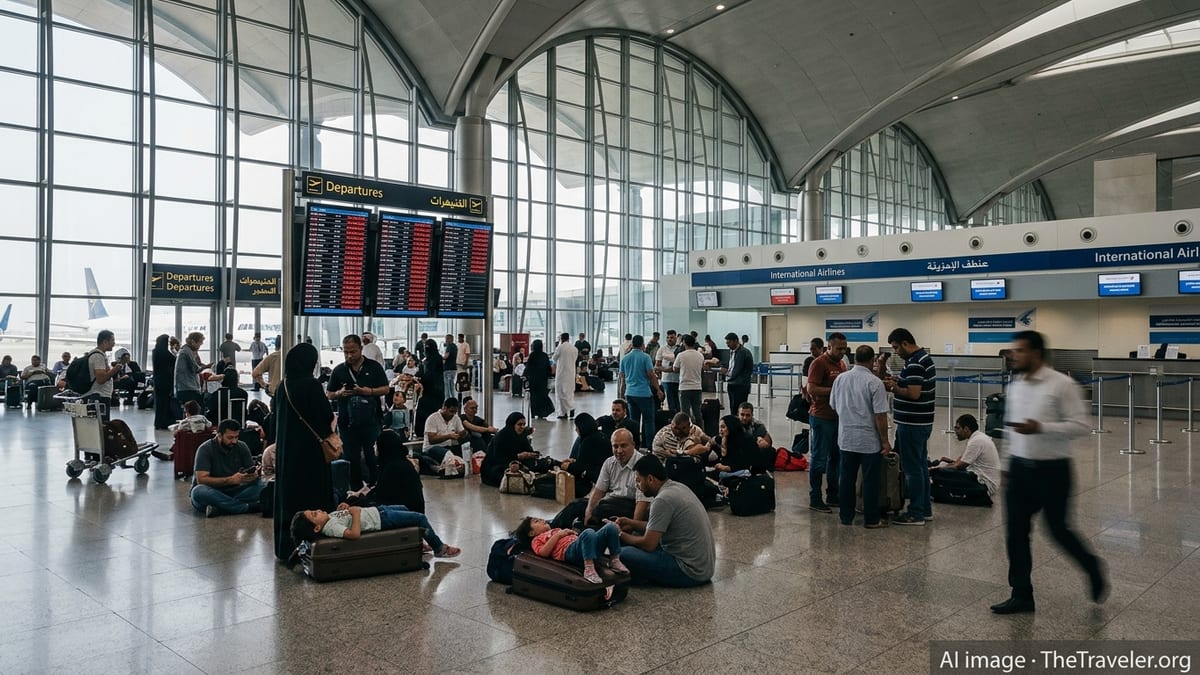
Wave of Cancellations Hits Key Long-Haul Routes
Published coverage on the continuing Gulf-wide aviation disruption shows that Kuwait International Airport remains largely shut to regular commercial traffic, with multiple carriers cancelling departures and arrivals as Kuwait’s airspace stays closed in connection with the 2026 Iran war. Flight tracking data and airline advisories indicate that services once linking Kuwait to North America and Europe are among the hardest hit.
Routes from Kuwait to New York, Amsterdam and Munich have seen widespread cancellations in recent days as carriers reroute aircraft away from Kuwaiti airspace. Reports indicate that some long-haul services that would normally pass through or originate in Kuwait have either been suspended outright or reconfigured to operate from alternative Gulf or Saudi airports.
Kuwait Airways, the country’s flag carrier, has halted regular operations at its home base since late February, while regional and international partners, including Gulf Air and EgyptAir, have adjusted their networks around the ongoing closure. Publicly available information shows that these changes have had a cascading effect across connecting traffic between Kuwait and major destinations in Europe and North America.
Travelers attempting to leave Kuwait or connect through the airport this week have described finding their flights listed as cancelled with limited rerouting options. Some passengers bound for onward destinations such as New York or Amsterdam have reported that they must first travel by road or short-haul sectors to other Gulf gateways in order to continue their journeys.
Gulf Air, Kuwait Airways, EgyptAir and Others Adjust Operations
According to regional aviation coverage, multiple major airlines operating at Kuwait International Airport are reshaping schedules in response to the uncertainty over when Kuwaiti airspace will fully reopen. Gulf Air has reduced exposure to Kuwait by consolidating services through its Bahrain hub, while maintaining links to key European cities such as Amsterdam and Munich from other points in the region.
Kuwait Airways has issued a series of public notices outlining broad cancellations across its network since the end of February, with many flights through at least late March affected. Passengers on Kuwait Airways services to destinations including New York and European capitals have seen their itineraries suspended, with the airline encouraging customers to seek refunds or rebooking once operations resume.
EgyptAir, which traditionally connects Kuwait with Cairo and onward African, European and North American destinations, has also curtailed activity involving Kuwait. Published airline updates indicate that some Kuwait–Cairo flights have been suspended, forcing passengers to rebook on services from other Gulf airports or to postpone travel altogether.
Other regional and international carriers that typically serve Kuwait, such as Jazeera Airways and various Asian and European airlines, are similarly constrained by the airspace shutdown. Some have temporarily redirected aircraft to Saudi or Emirati airports to keep parts of their global networks functioning while Kuwait’s primary gateway remains effectively offline for standard commercial services.
Passengers Stranded and Seeking Alternative Routes
The prolonged shutdown has left many travelers in Kuwait facing extended delays and complex journeys. Social media posts and travel forums over the past two weeks describe scenes of passengers stranded with cancelled itineraries and limited guidance, as airlines navigate evolving safety and regulatory conditions across multiple Gulf states.
Publicly shared accounts from Kuwait-based travelers describe last-minute cancellation notices for flights in mid and late March, including services to European cities and onward long-haul connections. Some passengers report waiting days for clarity on whether their flights would operate, only to receive confirmation of cancellation within 48 hours of departure.
With Kuwait International Airport functioning at only a minimal level for commercial traffic, travelers are increasingly relying on road links to neighboring countries to access operating airports. Reports indicate that some Kuwait residents are driving several hours into Saudi Arabia to reach alternative departure points, then connecting via Gulf hubs such as Riyadh or Jeddah to reach destinations like Cairo, Amsterdam and New York.
At the same time, passengers stranded overseas on itineraries that included Kuwait as a transit point have been forced to rebook at short notice, often bearing higher fares and longer routings. Accounts on travel discussion platforms suggest that securing timely assistance or refunds has been a particular challenge for those booked on heavily disrupted carriers.
Regional Airspace Closures Compound Kuwait Disruption
The situation in Kuwait is unfolding against a wider backdrop of airspace restrictions across the Gulf and Levant triggered by the Iran conflict. International analysis of the crisis notes that Iran, Iraq, Kuwait and several neighboring states have imposed at least partial closures of their skies since late February, causing thousands of daily cancellations and diversions.
Economic and aviation reports describe the current disruption as one of the most significant shocks to global air travel since the pandemic, with Gulf hubs that normally serve as critical connecting points between Europe, Asia and Africa now operating under tight constraints. Kuwait International Airport, which plays a central role in regional connectivity, has been particularly affected following reported strikes and debris incidents that damaged airport infrastructure and radar systems.
These safety concerns have prompted airlines to route aircraft along longer, more southerly or northerly paths to avoid conflict zones, increasing flight times and operational costs. In Kuwait’s case, the direct impact on its primary airport has transformed the country from a regional connector into an aviation bottleneck, at least in the short term.
Observers note that the knock-on effects of these closures reach well beyond the Middle East, with passengers in Europe, North America and Asia encountering sudden changes to flights that would ordinarily overfly the region. The suspension of Kuwait-related services by carriers such as Gulf Air, Kuwait Airways and EgyptAir is one visible manifestation of this broader upheaval.
Uncertain Timeline for Full Resumption of Kuwait Flights
As of late March, there is still no clear public timeline for the full reopening of Kuwait’s airspace or the return of normal operations at Kuwait International Airport. Government statements and aviation notices in the region emphasize that safety assessments and damage evaluations are ongoing, and that restrictions remain in place while security conditions are reviewed.
This uncertainty has complicated planning for both airlines and passengers. Carriers including Kuwait Airways have been extending cancellation and refund policies in short increments, often by several days at a time, reflecting the difficulty of forecasting when regular schedules can be restored. Travelers with tickets for late March and early April are watching for updates, aware that further cancellations remain possible.
Industry analysts suggest that once conditions allow, airlines are likely to phase back Kuwait services gradually, prioritizing high-demand regional routes before ramping up long-haul links to cities such as New York, Amsterdam and Munich. However, the pace of recovery will depend on the speed of infrastructure repairs, regulatory approvals and broader regional stability.
For now, Kuwait remains at the heart of one of the most disruptive aviation events in recent years, with Gulf Air, Kuwait Airways, EgyptAir and other major airlines forced into rolling cancellations that have reshaped travel patterns across the Middle East and beyond.