

More news on this day
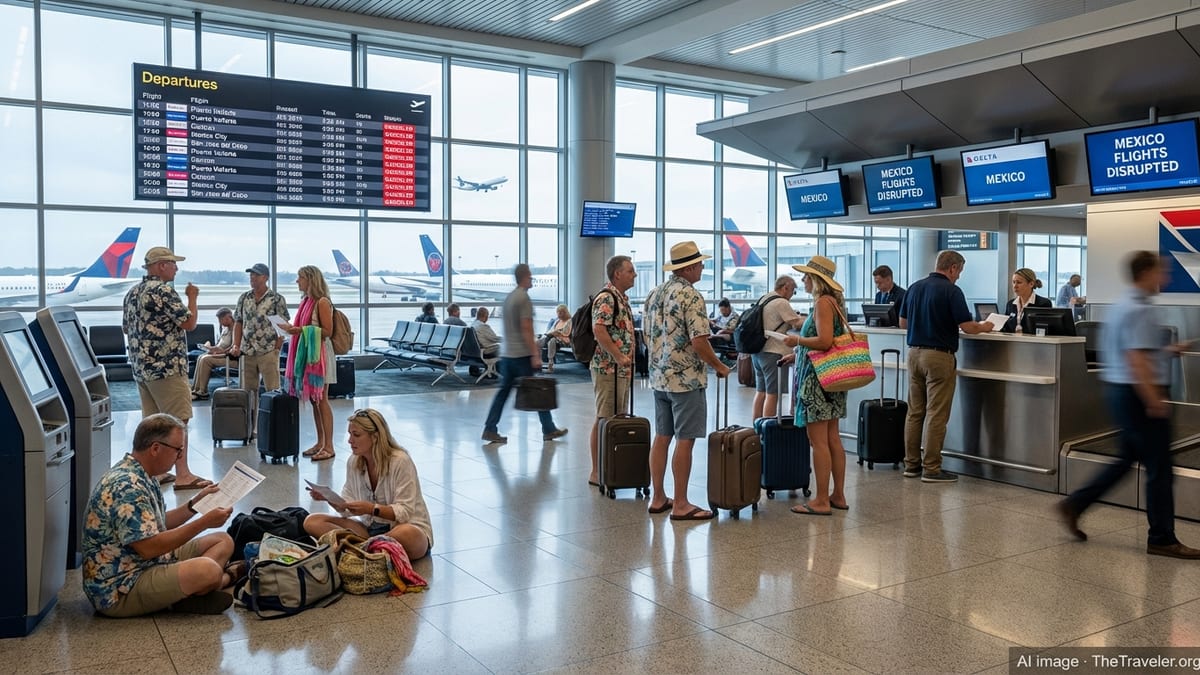
Thousands of travelers were stranded or forced to abruptly change plans on Sunday, February 23, 2026, after United Airlines, Southwest, American Airlines and Air Canada canceled flights to parts of Mexico amid a sudden surge in cartel-related violence and escalating security warnings.
Cartel Leader’s Killing Triggers Rapid Travel Shutdown
The wave of cancellations followed a major Mexican military operation on February 22 in the western state of Jalisco, where authorities said they killed Nemesio Rubén Oseguera Cervantes, known as El Mencho, the powerful leader of the Jalisco New Generation Cartel. The operation, carried out near the mountain town of Tapalpa, quickly reverberated across the country’s aviation network as cartel factions reportedly set vehicles ablaze, blocked highways and clashed with security forces in multiple states.
Within hours, what began as a localized security operation had spiraled into a broader crisis touching some of Mexico’s busiest tourist corridors. Reports of burning roadblocks near key access routes and sporadic gunfire around urban centers prompted local authorities and airport operators to tighten security and in some cases halt operations altogether. For airlines, the rapidly shifting risk picture left little room for partial measures.
By Sunday, U.S. and Canadian carriers were moving in step to suspend or sharply scale back service into affected regions, particularly along Mexico’s Pacific coast. For travelers headed to beach resorts at the peak of North America’s winter travel season, the violence translated into full aircraft returning to gates, diversions in midair and departure boards filled with red “canceled” notices.
The sudden deterioration also underscored long-standing security concerns around cartel power in western Mexico, even in destinations marketed as safe, controlled resort zones. This time, airline executives signaled, the intensity and geographic spread of the unrest made continuing normal operations untenable.
United, Southwest, American and Air Canada Pull Flights
United Airlines confirmed that it canceled its Sunday flights into Puerto Vallarta and Guadalajara, key gateways in Jalisco, from several U.S. hubs. Departures from major cities including Chicago, Denver and San Francisco were among those affected, leaving passengers either rebooked days out or asked to remain at home and monitor updates. In some cases, planes that had already boarded for departure were held at the gate until the airline made the call to scrub the route entirely.
Southwest Airlines, which serves Mexican leisure destinations from multiple cities in the United States, also halted flights into parts of western Mexico where the unrest was most acute. Travelers in large origin markets such as Houston and Phoenix reported same-day cancellations of flights to Puerto Vallarta and other Pacific resorts, with airport officials confirming that operations to some Mexican airports had been suspended until further notice.
American Airlines joined the pullback, canceling flights to airports in regions directly impacted by the security crisis and temporary airport shutdowns. American, which feeds significant vacation traffic from Dallas and other hubs into Mexican coastal destinations, told passengers that services would be paused while local authorities completed security operations and airfield conditions could be fully assessed.
Air Canada, meanwhile, announced it was temporarily suspending operations to Puerto Vallarta after describing an “ongoing security situation” in and around the resort city. The airline issued an advisory to customers already in the region, urging them to stay at their accommodation, avoid traveling to the airport and await further guidance on rebooking and refunds as conditions evolve.
Puerto Vallarta at the Center of the Crisis
Nowhere has the disruption been more visible than in Puerto Vallarta, one of Mexico’s most popular Pacific beach destinations and a linchpin of both U.S. and Canadian winter tourism. The city’s Licenciado Gustavo Díaz Ordaz International Airport became the focal point of the aviation fallout after violence and road blockades mounted in surrounding areas.
Airport operators and local authorities reported that while the terminal itself remained under the protection of federal security forces, access roads were affected by burning vehicles and attempted blockades. That combination of a heavily militarized perimeter and volatile ground transport conditions convinced multiple carriers to halt flights in and out of Puerto Vallarta, effectively isolating the resort for much of Sunday.
From Seattle to Chicago, San Francisco, Phoenix and Denver, airports reported that nonstop flights to Puerto Vallarta were either canceled before departure or forced to divert once airborne. In the Pacific Northwest, all nonstop services between Seattle and Puerto Vallarta were pulled from the schedule for the day, severing a busy corridor used by U.S. and Canadian vacationers. In the U.S. Midwest and Mountain West, passengers bound for the sun were told to disembark as aircraft remained parked at gates instead of pushing back.
Inside Puerto Vallarta, the uncertainty rippled quickly through the tourism sector. Many hotels encouraged guests to stay on property while monitoring official advisories. Taxi and ride-hailing services temporarily scaled back or suspended operations in some districts, and businesses near key routes closed early as images of burning vehicles and blocked highways circulated on local media and social platforms.
Violence Spreads Across Multiple Mexican States
Although Jalisco and its resort city of Puerto Vallarta have drawn most of the travel headlines, the unrest linked to the death of El Mencho has not been confined to a single region. Mexican authorities and foreign diplomats cited incidents in multiple states, including Tamaulipas, Guerrero, Nuevo León, Baja California, Quintana Roo, Guanajuato and Oaxaca, where vehicle burnings, clashes and illegal roadblocks were reported over the weekend.
In the border state of Tamaulipas and the industrial hub of Nuevo León, authorities documented torched vehicles and highway disruptions that raised alarms over the safety of long-distance bus and private car travel. In the south and southeast, including parts of Oaxaca and Quintana Roo, reports of sporadic road closures added to the sense of instability even in areas far from the initial security operation.
For airlines like United, Southwest, American and Air Canada, the geographic spread of incidents complicated risk assessments. While not every affected state hosts a major international airport, the patchwork of disruptions has implications for crew layovers, ground transport for staff and passengers, and alternate routing in the event of diversions. Even when airports technically remain open, blocked highways can prevent travelers and employees from safely reaching terminals.
The result has been a cautious, sometimes hour-by-hour approach to scheduling. Some carriers kept limited operations running to airports in regions deemed more stable, while others opted for broader pauses, citing the potential for rapid deterioration and the difficulty of guaranteeing safe passage between airports and surrounding cities.
Security Alerts, Travel Advisories and Shelter-in-Place Orders
The flight cancellations have unfolded against a backdrop of escalating government advisories. The U.S. embassy and consulates in Mexico issued security alerts on Sunday, urging U.S. citizens in several states, including Jalisco and key tourist hubs such as Puerto Vallarta, Guadalajara and Cancun, to shelter in place. The guidance cited ongoing security operations, criminal activity and road blockages, and instructed U.S. government staff in affected areas to do the same.
Canadian officials moved in parallel. Global Affairs Canada updated its Mexico travel advisory to urge a high degree of caution nationwide, flagging more than a dozen states for Canadians to avoid non-essential travel because of violence, kidnapping and the latest wave of cartel-related unrest. Specific mentions of deteriorating security around Puerto Vallarta and surrounding areas highlighted the aviation shutdown and roadblocks as key risks.
Air Canada reinforced those warnings in its own public statements, telling travelers in Puerto Vallarta and Guadalajara to remain at their hotels or current accommodations and not attempt to reach the airport until authorities provided clearer assurances on safety. The airline also introduced flexible change policies, allowing affected passengers to modify their plans without penalty once flights resume.
For many travelers on the ground, the layered alerts created a tense waiting game. Guests in resort zones accustomed to familiar warnings about petty crime or isolated incidents instead faced directives to avoid unnecessary movement altogether and maintain close contact with airlines and tour operators for updates on evacuation or outbound flight options.
Scenes of Disruption at North American Gateways
Across the United States and Canada, airports that serve as major feeders to Mexico’s Pacific coast experienced a day of confusion and disappointment. In Seattle, travelers expecting a routine midwinter escape found themselves in stalled check-in lines as all nonstop flights to Puerto Vallarta disappeared from departure boards. Airline staff worked to rebook passengers on later dates or alternate destinations, but limited capacity and the uncertainty of the situation meant many vacations were effectively canceled.
In Denver and Chicago, passengers already seated on aircraft bound for Puerto Vallarta and Guadalajara were asked to deplane after airlines decided that conditions in Mexico had deteriorated too quickly to guarantee safe arrivals. At other hubs, including Phoenix, flights to Puerto Vallarta and Mazatlán were canceled outright after airport websites and airline updates confirmed that destinations in western Mexico were no longer accepting inbound traffic.
For frontline airline employees, the evolving crisis brought a familiar challenge: explaining complex security decisions made at corporate and governmental levels to frustrated passengers at the gate. Many travelers expressed sympathy for safety concerns but voiced anger over the lack of clear timelines for rebooking, particularly those who had invested heavily in all-inclusive packages or family trips centered on specific dates.
Airport operations teams, meanwhile, scrambled to reposition aircraft and crews that would have otherwise overnighted in Mexican resort cities. The ripple effects of these moves are expected to continue into the early part of the week, with some North American routes potentially seeing reduced frequencies as carriers work to restore regular patterns once Mexican authorities stabilize conditions.
Airlines Balance Safety, Contracts and Customer Care
The coordinated cancellations by United, Southwest, American and Air Canada highlight the delicate balance airlines must strike between safety, regulatory obligations and customer expectations. Commercial carriers are responsible for assessing whether conditions at a destination airport and its surrounding region meet operational safety standards, and are empowered to halt flights even if runways remain technically open.
In this case, airline executives have made clear through public statements and internal advisories that the combination of violent incidents, road blockades and evolving military operations made it impossible to guarantee safe, predictable transport for passengers and crews. The decision to cancel or divert flights rather than operate with elevated risk reflects industry norms after previous crises in Mexico and elsewhere.
At the same time, carriers are facing pressure to offer flexible remedies to affected travelers. Airlines and vacation operators have begun waiving change fees, extending travel credits and relaxing fare rules for customers booked to Puerto Vallarta, Guadalajara and other affected destinations over the coming days. Some travelers may be able to reroute to alternate Mexican resorts not directly impacted by the violence, while others are opting to postpone international trips altogether.
Travel insurance is also coming under scrutiny, as policyholders seek clarity on whether civil unrest and government advisories qualify as covered reasons for cancellation or trip interruption. Consumer advocates are urging travelers to read fine print carefully and to document all airline communications regarding the crisis, in case disputes arise over refunds or future credits once immediate safety concerns have passed.
What Travelers Should Expect in the Coming Days
For now, airlines have not announced firm dates for restoring full schedules into Puerto Vallarta, Guadalajara and other routes most affected by the violence. Decisions are likely to hinge on how quickly Mexican authorities can reassert control over highways, lift roadblocks and demonstrate that major airports are accessible without placing passengers or staff at undue risk.
Industry analysts say travelers should prepare for rolling disruptions rather than a single, clear-cut resumption of service. Even once some flights return, frequencies may be reduced and last-minute cancellations will remain a possibility as carriers test conditions and wait for more stable patterns of security to emerge. Passengers holding tickets to affected regions in the coming week are being advised to monitor flight status closely and consider proactive rebooking if their plans are flexible.
The events of this weekend are also likely to influence how airlines plan for future operations in Mexico’s high-demand resort markets. While Puerto Vallarta, Cancun and other beach destinations have long been resilient in the face of localized security issues, the scale and speed of this latest crisis could lead carriers to build in greater contingency planning for alternative routes, crew layover locations and rapid suspension protocols.
For the thousands of travelers currently stranded or facing disrupted trips, those broader strategic questions are secondary to a simple priority: getting home or salvaging some part of their vacation. As United, Southwest, American and Air Canada continue to reassess the security map of Mexico in the days ahead, passengers will be watching departure boards and inboxes for the first concrete signs that normal connectivity to the country’s Pacific coast can safely resume.