

More news on this day
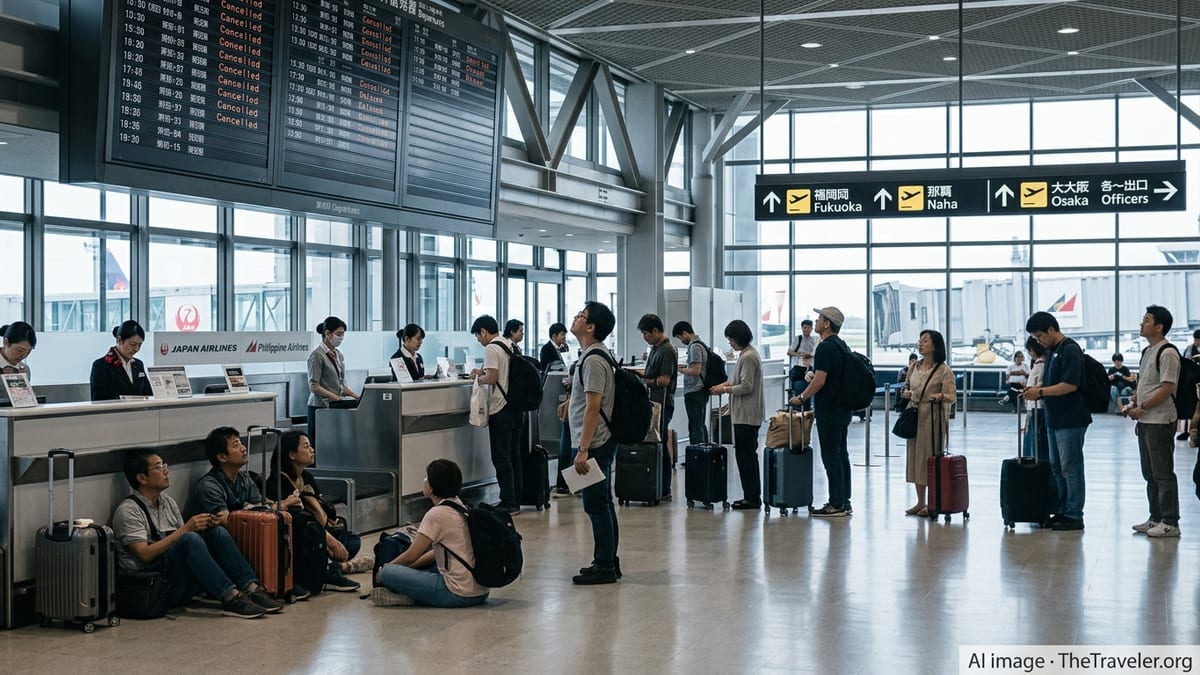
Travelers moving through Japan this week are facing widespread disruption after multiple carriers, including Japan Airlines, Philippine Airlines and Japan Air Commuter, canceled more than a dozen services across Narita, Fukuoka, Naha and Osaka, leaving passengers scrambling for replacement options and overnight accommodation.
Get the latest news straight to your inbox!
Wave of Cancellations Hits Major Japanese Gateways
Published flight information and local media reports indicate that a cluster of cancellations has affected domestic and regional routes serving Tokyo Narita, Fukuoka, Okinawa Naha and Osaka, with Japan Airlines group services and partner carriers among those most impacted. The disruption has been concentrated on short-haul sectors linking Japan’s key hubs, compounding congestion during an already busy spring travel period.
Operational data for the current schedule period show that several Japan Airlines and Japan Air Commuter rotations touching these airports have been removed or consolidated, particularly on thinner regional routes that feed larger trunk services. Aviation trackers and airport departure boards highlight same-day cancellations rather than long-term suspension on most routes, signaling an operational rather than strategic schedule change for many of the affected flights.
Passengers have reported arriving at airports to find last-minute notices of cancellation on services in and out of Narita and Osaka, with knock-on effects for connections to and from Fukuoka and Naha. In several cases, travelers described being rebooked onto later flights or rerouted via alternative airports, extending journey times and increasing crowding at check-in counters and customer service desks.
The pattern of disruption has been uneven across the day, with early-morning and late-evening departures appearing more vulnerable. This has particularly affected long-haul travelers using Narita as a gateway, who depend on tightly timed domestic links to reach cities such as Fukuoka and Naha on the same calendar day.
Japan Airlines Group Under Pressure on Domestic and Regional Links
Japan Airlines, together with regional affiliate Japan Air Commuter, has seen pressure on selected domestic routes that feed Narita and Osaka, according to operational data and schedule analyses. While the core trunk routes between major metropolitan centers remain largely intact, thinner services to secondary cities have experienced cancellations or aircraft changes, prompting missed connections and extended layovers.
Japan Air Commuter’s turboprop operations, which provide essential links between regional airports and larger hubs, are particularly exposed to weather variations, aircraft availability and crew scheduling. When even a small number of these short sectors are withdrawn, the impact can cascade through the network, leaving travelers in regional gateways waiting for infrequent alternatives.
The network complexity is further heightened by ongoing adjustments around Narita, where several carriers are reshaping their presence ahead of the late-March timetable change. Publicly available schedule information shows a tightening of some domestic connections to align with international arrival and departure banks, leaving less margin for recovery when irregular operations occur.
For travelers, the practical consequence is longer transit times, reduced redundancy and a higher likelihood that a single canceled domestic leg can unravel carefully planned multi-stop itineraries across Japan’s islands.
Philippine Airlines and Regional Carriers Adjust Japan Services
The disruption has not been limited to Japanese airlines. Philippine Airlines and other regional operators serving Japan have also made short-notice adjustments to flights touching Narita, Osaka and other points, according to published coverage from aviation-focused outlets and timetable databases. These changes come as airlines across East and Southeast Asia fine-tune capacity in response to evolving demand, currency shifts and competitive pressure on Japan routes.
Philippine Airlines in particular has been adjusting its network of services linking Manila and Cebu to Japanese cities, including Osaka Kansai and Tokyo-area airports. While many of these changes are scheduled in advance, day-of-operations cancellations can still occur due to aircraft rotation issues, technical checks or local weather at Japanese gateways.
In parallel, low-cost and hybrid carriers in the region continue to recalibrate their Japan offerings. Some have reduced or re-timed flights to Narita and Osaka, while others are repositioning aircraft to routes perceived as more resilient. For travelers, this has translated into a shifting patchwork of options, where flights that appeared available weeks earlier may be altered or withdrawn closer to departure.
The combination of strategic schedule reshaping and tactical cancellations has made it more difficult for passengers to rely on historical patterns when planning Japan trips, especially for those connecting between full-service and budget airlines across multiple airports.
Travelers Stranded, Rebooked and Rerouted Across Narita, Fukuoka, Naha and Osaka
Reports from passengers on social media and travel forums describe scenes of crowded information desks, long queues at rebooking counters and uncertainty over hotel arrangements at Narita, Fukuoka, Naha and Osaka. In some cases, travelers connecting from long-haul arrivals found their onward domestic legs canceled after landing, forcing overnight stays or long-distance rail journeys at personal expense.
At Narita, where many international flights arrive in concentrated waves, the loss of even a handful of onward domestic services can leave travelers with few same-day alternatives. Some visitors have opted to transfer into central Tokyo by rail and continue their journeys via Shinkansen, particularly for Fukuoka and Osaka routes, when replacement flights were not immediately available.
In Fukuoka and Naha, both key leisure gateways, stranded travelers have reported fully booked alternative flights following cancellations, especially on weekends and holiday periods. This has led some to accept routings via different airports or to shorten stays in regional destinations in order to safeguard onward international departures from Narita or Kansai.
Osaka Kansai has seen similar knock-on effects, with irregular operations prompting capacity pressure on remaining services and crowding at departure gates. The disruption is particularly challenging for travelers who had built itineraries combining multiple Japanese cities into tight timeframes.
What Affected Passengers Should Do Now
Publicly available guidance from airlines and consumer agencies suggests that affected travelers should first verify the current status of their flights using official airline channels before departing for the airport. Same-day schedule changes may not always be captured immediately by third-party booking sites or older confirmation emails, making direct checks essential.
Passengers whose flights have been canceled are typically offered rebooking on the next available service operated by the same carrier, subject to seat availability. When high-demand routes such as Narita to Fukuoka, Naha or Osaka are involved, this may mean accepting alternative routing, different airports within the same metropolitan area, or, in some cases, switching to rail for domestic segments.
Travelers stranded overnight are advised to retain all receipts for meals, ground transport and accommodation, as reimbursement policies vary by airline and ticket type. Travel insurance documents should be reviewed carefully, since coverage for disruptions related to operational decisions can differ significantly from protection for weather or airspace closures.
Given the ongoing network adjustments around Japan’s major hubs, prospective visitors are also encouraged to build additional buffer time into itineraries, avoid last-minute domestic connections after long-haul arrivals where possible, and monitor any schedule notifications closely in the weeks leading up to departure.