

More news on this day
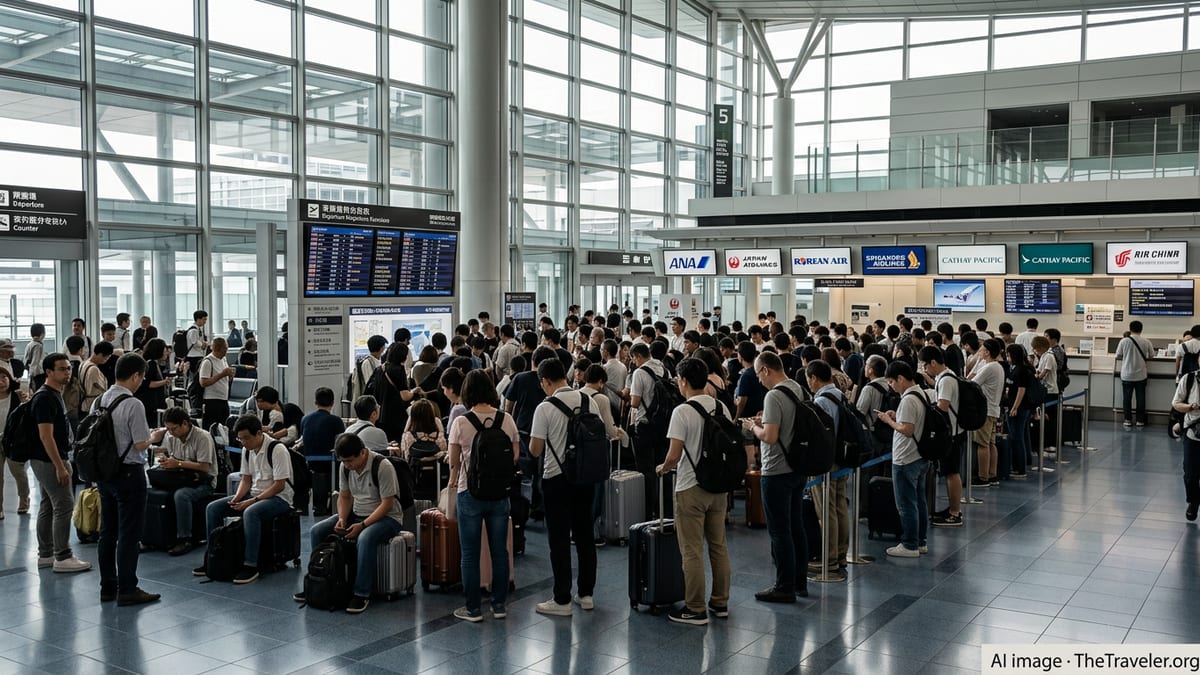
Hundreds of passengers have been left scrambling for alternatives as a wave of schedule cuts, cancellations, and last-minute changes by Asian and Chinese carriers disrupts flights across Japan’s main air hubs, from Tokyo and Osaka to Fukuoka, Okinawa, and Hokkaidō.
Get the latest news straight to your inbox!
Multiple Airlines Entangled in a Season of Disruptions
Recent weeks have seen a convergence of factors that are reshaping air travel to and within Japan just as demand remains strong. Published flight data and traveler accounts indicate that flagship Japanese carriers ANA and Japan Airlines, along with regional giants such as Korean Air, Singapore Airlines, Cathay Pacific, Air China and others, are all navigating schedule adjustments that are rippling through major airports nationwide.
Domestic networks operated by ANA and Japan Airlines were already undergoing capacity tweaks, with earlier notices flagging reductions on high-frequency routes that include Haneda to Sapporo in Hokkaidō and Haneda to Fukuoka. These trunk lines link Tokyo with key regional gateways and are vital for onward connections to smaller cities and islands. When even a fraction of daily rotations are trimmed, the impact can quickly cascade into missed links and bottlenecks for travelers trying to reach secondary destinations.
At the same time, international services feeding Japan from across Asia remain affected by a combination of political tensions, evolving airline strategies and constrained aircraft availability. Publicly available information on China–Japan relations shows that Chinese carriers, including Air China, were asked by regulators to sustain cuts on Japan routes into early 2026, reducing seat supply from key hubs such as Beijing and Shanghai. That shift has left many itineraries relying more heavily on connections via Seoul, Hong Kong and Singapore, putting additional pressure on those transit points.
For passengers, the result is a patchwork of reduced frequencies, re-timed flights and sold-out alternatives that can transform a straightforward trip into a multi-day detour. With large network airlines revising schedules across overlapping timeframes, disruptions are increasingly being felt not just on one carrier or route, but across entire travel plans.
Tokyo and Osaka Airports Under Strain
Tokyo’s dual hubs, Haneda and Narita, and Osaka’s Kansai International Airport are at the heart of the current disruption wave. These airports serve as the primary entry points for long-haul services from Europe and North America and as regional connectors linking Japan to Seoul, Hong Kong, Singapore and mainland China.
Schedule summaries from Kansai show dense operations by Japan Airlines and ANA alongside international operators including Korean Air, Singapore Airlines, Cathay Pacific and China-based carriers. Even modest reductions or seasonal reshuffles can quickly erode the number of viable connection options in and out of Osaka, particularly for travelers who depend on tight overnight or early-morning links for onward domestic flights.
Tokyo’s complex traffic patterns further amplify the challenges. The domestic corridor between Tokyo and Fukuoka alone hosts widebody aircraft at notably high frequencies, according to publicly shared timetable snapshots and traveler reports. When this level of capacity is recalibrated, even slightly, it can leave peak services fully booked and push travelers onto less convenient timings or alternative routes through Osaka and Nagoya.
Travelers have described crowded departure halls and limited same-day rebooking choices when flights are cancelled or re-timed at short notice. For those arriving off long-haul sectors into Tokyo or Osaka with separate domestic tickets, any delay or cancellation on the first leg can mean losing the entire day’s onward options, forcing overnight stays or long detours by rail.
Fukuoka, Okinawa and Hokkaidō Feel the Knock-On Effects
Fukuoka, Okinawa and airports across Hokkaidō serve as critical regional gateways for both domestic tourism and short-haul international services. Official schedules from Japanese carriers have in recent seasons flagged targeted reductions between Fukuoka and Okinawa and on routes linking Haneda with Sapporo and other northern cities. These reductions, while measured at the airline level, can significantly narrow options for travelers relying on one or two daily frequencies at off-peak times.
Okinawa’s Naha Airport, a key leisure destination and a hub for flights to outlying islands, is particularly sensitive to shifts in capacity. When connections from Tokyo or Osaka are disrupted, passengers can face extended layovers or the loss of same-day links to islands such as Ishigaki. Similarly, Fukuoka’s role as a bridge between Japan’s Kyūshū region and the rest of the country means that any reduction on core routes from Tokyo or Osaka can strand travelers attempting to reach smaller cities by rail or bus the same evening.
In Hokkaidō, Sapporo’s New Chitose Airport anchors both domestic and regional international traffic. Published domestic schedules show that even on traditionally well-served routes between Tokyo and Sapporo, airlines have trimmed some rotations during selected periods. This can leave popular early-morning and late-evening flights heavily oversubscribed, especially when weather or operational issues force consolidations or cancellations.
For visitors coordinating multi-city itineraries that include Fukuoka, Okinawa and Hokkaidō in a single trip, these regional pressures add layers of uncertainty. A missed or cancelled connection in Tokyo or Osaka can now more easily translate into an extra night in transit or the loss of prepaid hotel stays at the far end of the route.
Chinese and Regional Carriers Extend Japan Capacity Cuts
The disruption picture is further complicated by developments among Chinese and other regional airlines. Publicly available policy documents and news coverage of the ongoing China–Japan diplomatic crisis describe large-scale cancellations of China–Japan flights beginning in late 2025, along with guidance for carriers to sustain reduced capacity into 2026. Flag carriers such as Air China and several major Chinese peers have offered flexible refunds or changes for Japan-bound tickets, signaling an extended period of suppressed schedules.
These cuts remove a significant volume of point-to-point capacity between Chinese cities and Japanese gateways including Tokyo, Osaka, Fukuoka and Sapporo. Passengers who once relied on direct flights are increasingly being funneled through alternative hubs such as Seoul, Hong Kong and Singapore, raising the stakes when disruptions occur on those connecting services.
Regional carriers beyond China are also adjusting their Japan strategies. Korean Air, which now leads a consolidated Korean market following its merger with Asiana, has faced scrutiny over its dominant position on key Japan routes, prompting slot concessions on city pairs such as Incheon to Osaka, Sapporo and Fukuoka. While these measures are aimed at promoting competition, the transition period can introduce timetable reshuffles and uncertainty for travelers holding advance tickets.
At the same time, smaller and newer airlines that had been building up Japan routes are re-evaluating their plans. Some have announced the suspension of services to secondary Japanese cities, while others delay planned expansions, further limiting alternatives for travelers affected by cuts from larger network carriers.
Low-Cost Brands Retreat as Demand Remains Strong
Adding to the turbulence is the repositioning of low-cost brands that helped meet Japan’s post-pandemic travel rebound. ANA Group has confirmed that AirJapan, its medium- and long-haul brand flying under the ANA umbrella, will cease branded operations in late March 2026 as part of a wider restructuring of its multi-brand strategy. This retreat removes a growing player from competitive routes linking Tokyo Narita to cities such as Singapore, just as demand for affordable long-haul options remains robust.
Other low-cost and hybrid carriers around the region have been fine-tuning their Japan networks, dropping some smaller destinations or adjusting seasonal operations. While these moves may improve sustainability for airlines, they can leave travelers with fewer budget-friendly options and increase reliance on higher-fare services operated by full-service carriers.
Despite these shifts, publicly available booking data and traveler discussions suggest that appetite for Japan travel remains elevated. Flights to hubs like Tokyo and Osaka in popular months often sell out or command premium prices, even as schedule complexity increases. For passengers, this combination of strong demand and evolving capacity means that last-minute fixes are harder to find when disruptions strike.
Travel specialists increasingly recommend that visitors build additional buffer time into itineraries involving multiple domestic legs, particularly when connecting through Fukuoka, Okinawa or Hokkaidō, and to monitor airline communications closely for schedule changes. With major carriers and low-cost brands alike adjusting their Japan offerings, the current wave of disruptions underscores how quickly the region’s interconnected air network can shift, leaving even well-planned journeys vulnerable to sudden changes.