

More news on this day
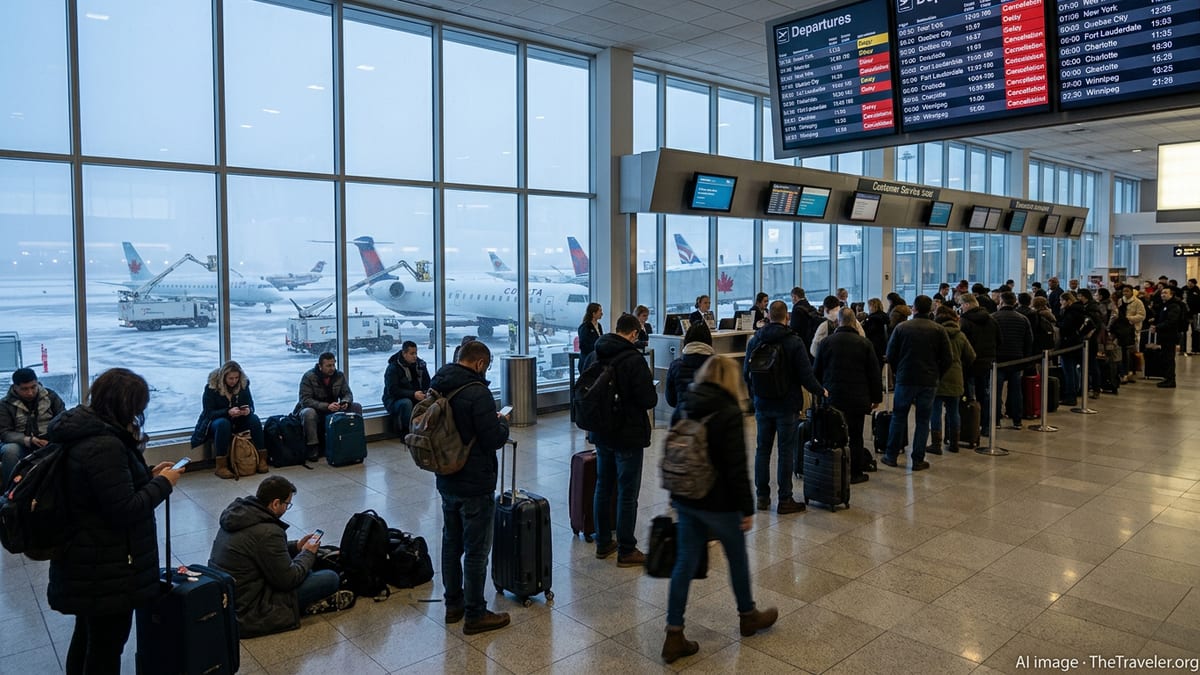
Canada’s already stressed air travel network faced fresh disruption today as Montréal–Trudeau International Airport reported 79 delayed departures and 20 cancellations, with regional and mainline carriers including Jazz Aviation, Air Canada and Endeavor Air struggling to keep schedules on track.
Get the latest news straight to your inbox!
Heavy Disruptions Hit Key Montreal Hub
Operational data published on airline and airport tracking platforms for March 26 indicate that Montréal–Trudeau International Airport is again under pressure, with dozens of departures pushed back and a significant number cancelled outright. The disruption spans domestic and transborder routes, affecting connections to major hubs in Toronto, New York and other US cities.
Jazz Aviation, operating as Air Canada Express on many regional routes, appears among the most affected operators, alongside Air Canada’s mainline services and US partner Endeavor Air. Several other North American carriers show scattered schedule changes, suggesting a system-wide ripple effect rather than an isolated problem at a single airline.
The pattern reflects an uneven recovery in Canada’s aviation sector, where traffic has largely returned to or exceeded pre-pandemic levels while airlines and airports continue to deal with tight staffing, aircraft availability constraints and volatile weather during the late-winter travel period.
Publicly available flight status boards show that delays at Montréal range from modest hold-ups of 30 to 45 minutes to multi-hour disruptions that effectively wipe out key connections for same-day travel.
Recent Accidents and Weather Add Strain
The latest wave of delays follows a difficult month for carriers operating through Montréal and the wider eastern Canada and northeastern United States corridor. Earlier in March, a powerful late-season winter storm brought high winds and heavy snow to parts of Quebec and Ontario, with Montréal experiencing gusts near hurricane force. That event led to substantial schedule adjustments and lingering crew and aircraft displacements as airlines worked to reposition fleets.
In addition, the regional network has been under scrutiny following the March 22 collision involving an Air Canada Express flight operated by Jazz Aviation at New York’s LaGuardia Airport. Public reporting indicates that the aircraft, which had departed from Montréal, collided with an airport firefighting vehicle on landing, resulting in a fatal accident and extensive damage to the aircraft. While investigations are in their early stages, the incident has required schedule reshuffling on cross-border routes served by similar regional jets.
Industry observers note that even a small reduction in available aircraft or crews on high-frequency regional corridors can quickly translate into cumulative delays and short-notice cancellations, especially when adverse weather events disrupt operations in quick succession.
For passengers at Montréal, the combination of residual weather impacts and the knock-on effects of the incident on transborder operations appears to be converging into another day of challenging travel conditions.
Impact on Passengers Across Canada and the United States
The latest figures at Montréal mean that hundreds, and potentially several thousand, passengers are facing changed itineraries. Delayed morning departures can cascade throughout the day, pushing back onward connections in Toronto, Ottawa, Halifax and Western Canada, as well as in US hubs such as New York and Chicago.
Reports from flight-status and traveller forums indicate that some passengers have been automatically rebooked on later flights, while others are being offered alternative routings through different hubs or on partner airlines when space allows. In several cases, same-day arrivals are no longer possible, forcing overnight stays and additional accommodation and meal costs for affected travellers.
Families starting March break holidays, business travellers on tightly timed itineraries and international passengers connecting through Montréal to Europe and North Africa have all reported uncertainty as they monitor evolving departure times. With airport road access and security lines still recovering from earlier peaks this month, many travellers are arriving at the terminal extra early in anticipation of further complications.
The situation underscores the broader fragility of North American air travel, where a relatively small number of hubs handle a large share of connecting traffic. When a key node such as Montréal experiences disruption, the consequences can quickly extend far beyond Quebec’s borders.
Regulatory Context and Passenger Rights in Canada
The renewed disruption at Montréal also brings fresh attention to Canada’s air passenger rights regime. The federal Air Passenger Protection Regulations set out minimum standards for communication, rebooking and, in some circumstances, financial compensation when flights are delayed or cancelled.
Recent policy discussions in Canada have focused on tightening these rules so that airlines would be required to compensate passengers for most delays and cancellations, except in clearly defined exceptional circumstances such as severe weather or security issues. Draft changes published by the federal government outline a move toward a single, more stringent compensation framework that would apply regardless of airline size.
In practice, this means that passengers affected by today’s delays and cancellations at Montréal may have different entitlements depending on the reason behind each disruption, the length of delay at arrival and the size of the carrier involved. Travellers are being encouraged by consumer advocates to keep receipts, track arrival times and review airline explanations once operations stabilize.
Consumer groups have argued that repeated waves of delays and cancellations, particularly when they arise from operational or staffing issues, highlight the importance of clear, enforceable rules and accessible remedies for affected passengers.
Carriers Work to Restore Operations
While today’s figures for Montréal are striking, industry data for recent years show that sustained recovery is possible once airlines move through acute shocks. Previous large-scale disruptions in Canada, including holiday-period meltdowns and strike-related shutdowns, were generally followed by a week or more of schedule normalization efforts, including added sections and upgauged aircraft on busy routes.
Operational plans published by major airlines suggest a similar pattern may follow the current turbulence. As aircraft return from unscheduled maintenance, investigations progress and weather stabilizes, carriers are expected to concentrate on core domestic and transborder routes from Montréal to rebuild reliability and reconnect disrupted passengers.
However, analysts caution that the broader operating environment remains fragile. Staffing reserves across airlines, airport security and ground handling providers are still tight, and aircraft supply chains remain under pressure. Any new bout of adverse weather or additional safety-related constraints could prolong the unsettled conditions faced by travellers through Montréal and other Canadian hubs.
For now, the high number of delays and cancellations at Montréal–Trudeau International Airport serves as another reminder of how quickly Canada’s air travel network can be thrown into turmoil, even outside peak holiday travel dates, when operational challenges converge at a major hub.