

More news on this day
Passengers at Cairo International Airport faced extensive disruption as publicly available flight data showed 106 delays and five cancellations affecting EgyptAir, Flynas, Nile Air, and Air Cairo services to London, Dubai, Riyadh, and Amman amid ongoing regional airspace constraints.
Get the latest news straight to your inbox!
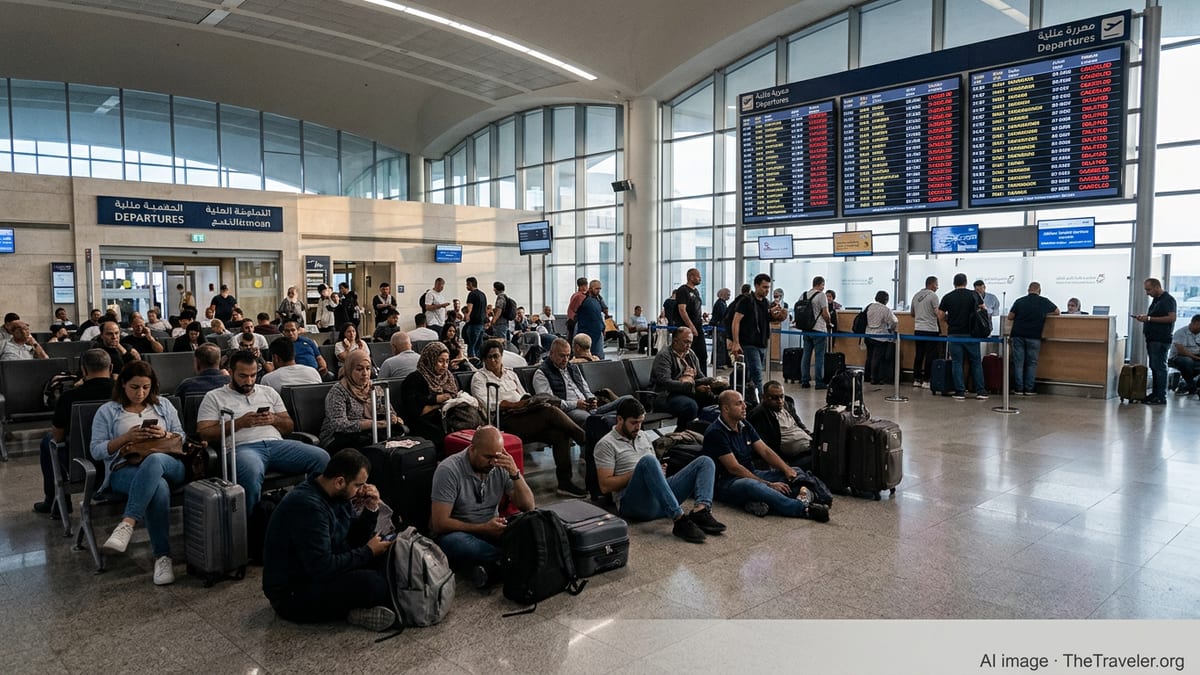
Heavy Disruptions Hit Key Regional and International Routes
Operational tallies compiled from real-time flight tracking platforms and airport movement logs indicate that Cairo International Airport experienced a fresh wave of disruption, with 106 delayed services and five outright cancellations concentrated over a single operating period. The majority of affected flights involved Egypt-based carriers and regional operators linking Cairo with major hubs in Europe and the Gulf.
Services to London, Dubai, Riyadh, and Amman featured prominently among the disrupted routes, reflecting Cairo’s role as a connecting node between Europe and the Middle East. Delays stretched from minor schedule slips to extended hold times of several hours, leaving many travelers waiting in crowded gate areas or queuing at transfer and ticketing desks in search of alternatives.
While the headline numbers fall short of the 155 delays and six cancellations recently recorded on another particularly congested day at the airport, reports indicate that the latest disruption was concentrated on a tighter set of departure banks. This created visible knock-on effects around specific long-haul and regional connections, especially for passengers relying on tight transfer windows.
The disruption adds to a mounting pattern of irregular operations at Cairo, where earlier assessments have already highlighted clusters of late departures and arrivals as airlines adjust schedules around evolving airspace conditions and revised routings over the wider region.
EgyptAir, Flynas, Nile Air, and Air Cairo Bear the Brunt
Publicly available flight logs show EgyptAir once again appearing as one of the most heavily affected carriers at Cairo, with numerous departures pushed back from their scheduled times. Several of the airline’s services to and from Dubai and London were reported delayed, echoing earlier periods when EgyptAir announced temporary schedule changes and gradual resumptions on Gulf routes amid regional tension.
Saudi carrier Flynas, which operates multiple links between Cairo and Riyadh as well as other points in Saudi Arabia, also figures in the disruption pattern. Delayed departures on Riyadh services complicated onward connections for travelers heading to domestic destinations within Saudi Arabia, according to flight-status snapshots compiled during the affected period.
Nile Air and Air Cairo, both important players in Egypt’s short and medium haul market, were likewise impacted, with some flights to Riyadh and Amman subject to protracted delays and a portion of the total cancellations. These operators serve a mix of point-to-point travelers and connecting passengers, so irregular operations in Cairo can quickly ripple through to leisure and labor traffic flows between Egypt, the Gulf, and neighboring states.
The combined effect of delays across these four airlines strained airport infrastructure and customer service capacity. Check-in and transfer counters saw extended queues as ground staff worked through rebooking options for passengers facing missed connections or late-night arrivals in their final destinations.
Regional Airspace Constraints and Operational Pressures
The latest problems at Cairo come against the backdrop of broader disruption across Middle East air corridors. Aviation bulletins and regional news coverage in recent weeks have pointed to rolling airspace restrictions and reroutings linked to heightened military tensions involving Iran, Israel, and the United States, with knock-on effects observed from Egypt and Jordan to Saudi Arabia and the United Arab Emirates.
Reports indicate that previously, Egypt’s airports have absorbed diverted flights when neighboring states temporarily closed portions of their airspace, reinforcing Cairo’s role as a contingency hub. This added traffic has increased operational complexity, even when Egyptian airspace itself remains open for transit, and has contributed to tighter turnaround windows for aircraft and crews.
Industry analysis has highlighted that carriers such as EgyptAir have been forced to re-time or reroute certain services to Gulf destinations including Dubai, while at other points they have announced phased resumptions as security assessments evolved. Each adjustment can create a cascade of minor delays that accumulate into sizable schedule disruptions on busy travel days.
For regional airlines like Flynas, Nile Air, and Air Cairo, which operate dense schedules on popular labor and pilgrimage routes, the additional flying time created by detours and congestion can quickly eat into buffers. When combined with ground handling constraints and aircraft availability limits, a small number of early delays can grow into a more widespread pattern of late departures by mid-afternoon and evening.
Impact on Passengers and Airport Experience
Travelers passing through Cairo during the disruption period encountered a familiar mix of uncertainty and inconvenience. Flight tracking platforms showed rolling departure time revisions for a number of services to London, Dubai, Riyadh, and Amman, with some passengers informed of new times only shortly before boarding or scheduled pushback.
Accounts shared in recent weeks about travel through Cairo frequently mention concerns about tight connections, long lines at transfer security, and difficulty getting up-to-date information during irregular operations. The latest wave of delays appears to have reinforced this perception, particularly among long-haul travelers relying on Cairo as a mid-journey transfer point between Africa, Europe, and the Gulf.
With overnight and late-evening services among those affected, some passengers faced the prospect of missed same-day onward flights or significantly shortened rest periods before early morning departures. Others traveling point to point to cities such as Riyadh and Amman contended with delays that altered ground transport, accommodation check-in, and work schedules upon arrival.
Airlines involved have previously advised customers to monitor flight status closely before heading to the airport and to allow additional time for connections, guidance that takes on renewed importance during periods of heightened regional volatility. For travelers planning itineraries through Cairo in the coming days, observers suggest building in generous buffers and remaining flexible about routing options where possible.
Ongoing Uncertainty for Cairo’s Role as a Regional Hub
Cairo’s position as a bridge between Europe, Africa, and the Middle East is both an asset and a vulnerability. As alternate routings send more aircraft through Egyptian airspace and airports, Cairo International gains strategic prominence but also faces mounting operational challenges in handling shifting traffic patterns.
Recent commentary from aviation analysts underscores that Egypt’s carriers have been expanding services to Gulf hubs, including Dubai and Abu Dhabi, in response to increased demand and altered regional traffic flows. At the same time, the environment in which these services operate remains fluid, with the potential for new advisories, reroutings, or temporary restrictions to reshape schedules at short notice.
The tally of 106 delays and five cancellations tied to services operated by EgyptAir, Flynas, Nile Air, and Air Cairo to London, Dubai, Riyadh, and Amman represents another data point in a wider story of instability affecting Middle Eastern air travel in early 2026. For both operators and passengers, it underlines how quickly a confluence of regional and operational pressures can translate into disruption on the ground at one of the region’s key gateways.
In the near term, the experience at Cairo suggests that travelers across the network should anticipate a degree of unpredictability. Careful itinerary planning, close monitoring of flight information, and a readiness to adapt plans remain central strategies for those navigating the evolving landscape of air travel through Egypt and its neighboring states.