

More news on this day
Hundreds of travelers faced long waits and disrupted plans at Charlotte Douglas International Airport in North Carolina as widespread operational disruptions delayed at least 185 flights and led to three cancellations, snarling connections on major routes to New York, Chicago, Atlanta and other key hubs across the United States.
Get the latest news straight to your inbox!
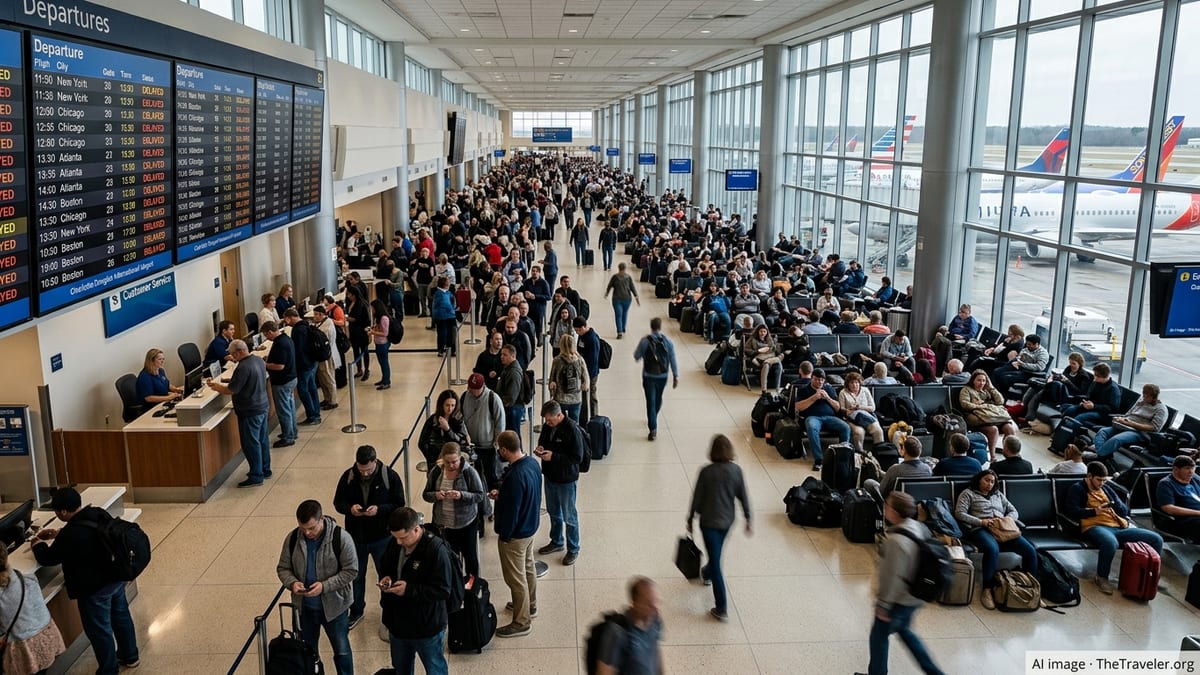
Weather Turbulence and Congested Skies Slow Charlotte Operations
Publicly available flight-tracking data and recent storm reports indicate that a volatile weather pattern across the eastern United States combined with heavy traffic flows through Charlotte Douglas International Airport to trigger a new wave of delays. The airport, a major connecting hub for American Airlines and a key station for Delta Air Lines, Southwest Airlines and several regional carriers, saw departure and arrival boards fill with yellow and red alerts as thunderstorms and low clouds moved through the Carolinas and surrounding states.
Recent national storm systems have repeatedly disrupted major corridors linking the Southeast with the Northeast and Midwest, and Charlotte’s position on those routes has made it particularly vulnerable. When conditions deteriorate along these corridors, aircraft and crews can be held on the ground, forced into holding patterns, or diverted, which in turn ripples through subsequent flights on the same aircraft. Those knock-on effects have contributed to the latest count of 185 delayed flights and a smaller number of outright cancellations at the airport.
Travel operations data show that storms and air-traffic-control flow programs focused on the New York metropolitan area and Chicago often constrain arrival slots during peak hours. When that happens, departures from Charlotte bound for airports such as John F. Kennedy, LaGuardia, Newark and Chicago O’Hare can be forced into ground holds, leaving passengers waiting at the gate even as the weather in Charlotte itself may appear relatively calm.
In addition to weather and traffic-management programs, Charlotte Douglas continues to operate near the limits of its capacity. Passenger volumes have grown far beyond the levels for which the original terminal complex was designed, and periods of intense arrival and departure activity magnify the impact of any disruption, from a brief thunderstorm to a staffing issue on a single flight.
Hundreds of Passengers Face Long Lines, Missed Connections and Overnight Delays
The latest disruption has left travelers facing a familiar list of challenges: long waits at crowded gates, missed connections to smaller cities and, for some, the prospect of unplanned overnight stays in Charlotte. With 185 flights delayed and three canceled, even a modest percentage of affected passengers translates into several hundred people contending with changed itineraries and uncertain arrival times.
Connections to New York, Chicago and Atlanta have been particularly affected, according to flight-status boards and airline operations summaries. Those three metropolitan areas anchor some of the busiest travel corridors in the country, and many passengers use Charlotte as a connecting point between smaller southeastern markets and large northern or western gateways. When delays accumulate on those trunk routes, they quickly cascade into missed onward flights to secondary destinations.
Published travel accounts and aviation discussion forums frequently describe Charlotte as a challenging place to connect when weather or schedule pressures arise. Travelers have reported that even modest schedule slips can force them to sprint between distant concourses, and that missed connections during peak disruption periods can mean several hours before another seat becomes available. The current wave of delays appears to fit that pattern, with many passengers finding that rebooking options are limited during already busy travel days.
For some travelers, the impact is more than an inconvenience. Business trips, family events and international connections can be derailed when a key domestic leg out of Charlotte is significantly delayed or canceled. Reports from previous storm-related disruptions at the airport suggest that passengers sometimes spend much of the night in terminal seating while waiting for early-morning recovery flights to depart.
American, Delta, Southwest and Regional Partners Scramble to Recover
American Airlines, which maintains one of its largest hubs at Charlotte Douglas, bears much of the operational burden when the airport experiences widespread disruption. Many of the delayed flights in the latest incident appear to involve American and its regional affiliates, which operate dense banks of departures to cities across the East Coast and Midwest. When severe weather or air-traffic programs reduce capacity into New York and Chicago, those banks can quickly back up, leaving aircraft waiting for gates and passengers waiting on the tarmac or in crowded concourses.
Delta Air Lines and Southwest Airlines also serve Charlotte with important links to Atlanta and other regional destinations. Flight-tracking services indicate that departures to Atlanta and other southeastern cities can be particularly sensitive to thunderstorms, given the tendency for storm cells to form and intensify during late afternoon and evening hours. When flights in those time windows are held, late-running aircraft can miss scheduled turnarounds, adding to the disruption.
Airlines typically respond to these events by consolidating lightly booked flights, rerouting aircraft, and prioritizing longer-haul segments that are harder to reschedule. Published operational analyses note that shorter regional hops from Charlotte can be among the first to be delayed or cut when carriers are attempting to restore system-wide reliability. That dynamic can leave passengers on shorter routes facing outsized delays in comparison with those on larger jets headed to major hubs.
The recovery process often extends well beyond the immediate weather event. Aircraft and crews displaced by diversions or excessive duty times must be repositioned before normal timetables can resume. As a result, passengers traveling through Charlotte may continue to see residual delays and scattered cancellations for several cycles after the worst storms have moved on.
Charlotte’s Hub Design and Expansion Pressures Magnify Disruptions
Charlotte Douglas International Airport has evolved into one of the highest-volume hubs in the United States, yet much of its core infrastructure dates from an era when annual passenger levels were a fraction of today’s totals. Public information on the airport’s development shows that the original terminal complex was intended for only a few million annual travelers, compared with the tens of millions who now pass through each year.
To manage that growth, the airport has undertaken a multi-year terminal lobby expansion and related projects to widen concourses and improve security and baggage-handling capacity. Construction activity and temporary bottlenecks associated with those projects, however, can add friction to passenger flows, particularly when disruption forces large numbers of travelers into the terminal at once. Crowded checkpoints, limited seating and long walks between gates can all exacerbate the experience of a delay.
Aviation analysts and frequent flyers have also pointed to the scheduling patterns at Charlotte as a contributing factor. Many departures and arrivals are clustered into tight windows to maximize connections for hub-and-spoke operations. While efficient when everything runs on time, those concentrated waves of traffic can lead to congestion at gates and on taxiways when delays intervene, intensifying the impact of even minor schedule variations.
Previous national data on on-time performance suggest that Charlotte performs near the middle of the pack among major U.S. hubs, but its role as a connecting gateway in a weather-prone region means that passengers may feel disruptions more acutely. The latest batch of delays and cancellations illustrates how closely the airport’s operations are tied to conditions not only in North Carolina but also in distant cities where storms and traffic restrictions can ripple through the system.
Travelers Urged to Monitor Flight Status and Build in Extra Time
Publicly available guidance from airlines and aviation agencies emphasizes that during periods of volatile weather affecting multiple regions, passengers should closely monitor flight-status tools and be prepared for schedule changes, especially when connecting through busy hubs like Charlotte. Same-day notifications via airline apps and airport information displays often provide the earliest warning that a departure has slipped beyond its scheduled time.
Travel planners frequently recommend scheduling longer connection windows at airports known for dense traffic and weather sensitivity. For Charlotte, that can mean avoiding very tight connections, particularly in the late afternoon and evening periods when storm activity and traffic peaks routinely align. Travelers bound for time-sensitive events may also benefit from booking earlier flights in the day, which are statistically more likely to depart close to schedule before rolling delays accumulate across the network.
As airlines work to recover from the current round of disruptions, passengers stranded at Charlotte Douglas International Airport continue to navigate rebooking lines, standby lists and overnight arrangements. The episode underscores how a combination of severe weather, constrained airspace and hub congestion can quickly upend travel plans across multiple states, even when the underlying numbers show only a handful of canceled flights alongside a larger wave of delays.