

More news on this day
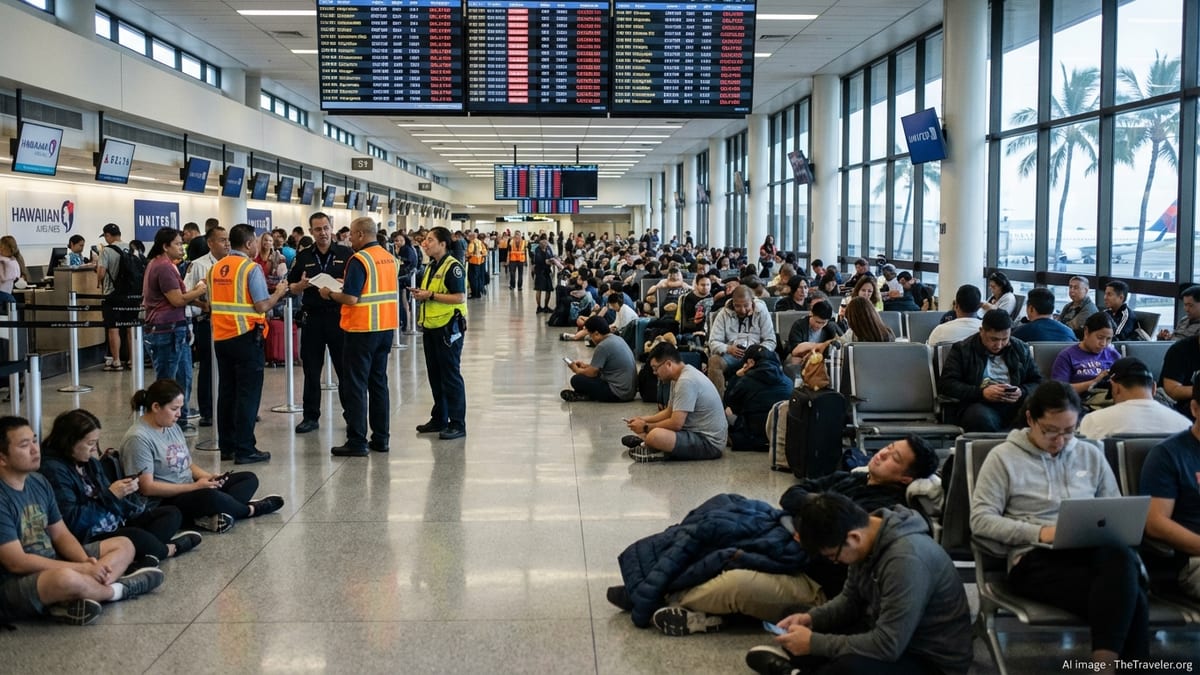
Travelers passing through Honolulu’s Daniel K. Inouye International Airport on Thursday faced significant disruption as more than 50 flights were delayed and at least eight were canceled, snarling international and domestic connections across the Pacific.
Heavy Operational Strain Across Key Pacific Routes
The disruption at Daniel K. Inouye International Airport, Hawaiʻi’s primary aviation hub, affected a wide mix of long haul and regional services linking the islands with the U.S. mainland and major destinations in Asia and the South Pacific. Airport data on Thursday morning local time showed that roughly one in three departures was experiencing delays, with an average hold of close to an hour and a small but impactful share of outright cancellations.
Hawaiian Airlines, the state’s largest carrier, reported knock on effects across its transpacific network, including services to Tokyo and other major Japanese gateways. Delays on morning and midday departures to Japan forced some travelers to miss onward connections, while late arriving widebody aircraft created further pressure on the afternoon schedule.
U.S. mainland carriers were also heavily affected. Delta Air Lines and United Airlines, which both operate high demand services connecting Honolulu to major hubs on the West Coast and in the central United States, faced a mix of departure and arrival delays. Passengers on through tickets to cities across North America reported missed connections and unexpected overnight stays as the day’s disruptions rippled through evening departure banks.
International links beyond Japan were not spared. Flights serving the Philippines and New Zealand, including services operated or codeshared by Air New Zealand and partner airlines, encountered schedule changes and gate holds, adding uncertainty for leisure travelers and for migrant workers relying on tight itineraries.
Runway and Taxiway Works Add Pressure to Busy Holiday Period
The latest wave of disruption comes as the Hawaiʻi Department of Transportation continues a program of airfield improvements at Honolulu, including the repaving of Taxiway L and a series of runway and shoulder rehabilitation projects. To accommodate the work, authorities have temporarily closed sections of the airfield and shifted most widebody operations from Terminal 1 and the Mauka Concourse to Terminal 2, concentrating large aircraft movements in a smaller operating footprint.
Airport officials have warned in recent days that the combination of construction constraints and a busy travel period was likely to increase the risk of congestion on the ground. With widebody jets for transpacific routes now funneled into fewer gates and stands, any late arrival or technical delay can more easily cascade into conflicts over parking positions, jet bridges and towing operations.
Ground handling teams on Thursday worked to reposition aircraft and equipment while juggling compressed turnaround windows. Airline staff reported that even routine tasks such as fueling, catering and baggage loading were taking longer than normal, particularly when flights required towing between remote stands and passenger gates.
The work is part of a broader modernization effort aimed at improving long term reliability and safety at Daniel K. Inouye International Airport. However, in the short term it has added complexity to day to day operations just as demand on Honolulu’s international network continues to recover and, in some markets, surpass pre pandemic levels.
Passengers Face Missed Connections and Overnight Stays
For travelers, Thursday’s problems translated into long lines at check in counters, crowded departure lounges and anxious waits at boarding gates as estimated departure times were repeatedly revised. Families heading to the U.S. mainland after island vacations described waiting hours beyond their scheduled boarding times, while some visitors beginning their trips in Honolulu worried about losing prepaid hotel nights and tours at overseas destinations.
Passengers on flights to Japan reported particular stress, because delays out of Honolulu can jeopardize tight connections at Tokyo hubs to domestic Japanese cities and to onward Asian destinations. Travelers bound for the Philippines and New Zealand faced similar challenges, with many itineraries built around once daily or limited frequency services that leave little room for schedule recovery.
Airlines responded with a mix of rebooking options and hotel vouchers, prioritizing customers with same day international connections or with no alternative same day flights. However, travelers reported that call centers, airport ticket counters and customer service desks were quickly overwhelmed, leading to long waits for assistance.
Some visitors opted to extend their stays in Honolulu voluntarily, choosing to push back their departures rather than risk tight connections through multiple hubs. Others, especially those on work trips or with family commitments overseas, expressed frustration at the lack of clear timelines as rolling delays made it difficult to plan even simple activities while waiting in the terminal.
Airlines Coordinate Recovery Plans as Weather Remains Favorable
Despite the operational turmoil, weather conditions around Honolulu remained generally favorable, with only light winds and scattered clouds reported throughout the morning. That allowed air traffic controllers to maintain steady arrival and departure flows once individual aircraft were ready to move, helping to prevent even longer backups in the sky.
Airline operations control centers for Hawaiian, Delta, United and other affected carriers spent much of the day reshuffling aircraft and crew assignments, seeking to protect long haul departures to North America and Asia. In several cases, departure times were pushed later in the afternoon to allow incoming aircraft from other islands or mainland cities to arrive and turn around.
For flights to New Zealand and the Philippines, where long overwater segments and strict crew duty limits leave less flexibility, carriers weighed options such as swapping aircraft types, combining lightly booked services or, in the most constrained cases, canceling individual rotations to preserve the integrity of the wider schedule. Industry analysts noted that in such circumstances, airlines often prioritize routes with the highest number of connecting passengers or with limited alternative travel options.
Honolulu’s role as a mid Pacific crossroads meant that the disruption was felt thousands of miles away. Late departures from Daniel K. Inouye International Airport translated into late arrivals in mainland U.S. cities, Tokyo, Manila and Auckland, compressing overnight ground times and leaving crews and aircraft out of position for the next day’s operations.
Advice for Travelers Heading Through Honolulu
With the airfield works at Honolulu scheduled to continue for several days, aviation officials and airlines are urging passengers to build extra time into their journeys. Travelers departing Daniel K. Inouye International Airport are being advised to arrive at the terminal earlier than usual, particularly for morning and midday long haul flights, to allow for longer check in, security and boarding processes.
Passengers connecting in Honolulu, especially those traveling between the U.S. mainland and Asia or the South Pacific, are being encouraged to choose itineraries with longer layovers where possible and to monitor flight status closely on the day of travel. Flexible tickets and travel insurance that covers delays and missed connections may also offer additional protection during this period of heightened disruption.
Airport officials emphasize that the current wave of schedule interruptions is expected to ease once the current phase of runway and taxiway work is complete. In the meantime, travelers can expect occasional gate changes, bus transfers to remote stands and longer waits at baggage claim as airlines and ground crews work through the backlog created by Thursday’s disruptions.
For many visitors and residents, the latest wave of delays serves as a reminder of how central Honolulu’s Daniel K. Inouye International Airport is to life in Hawaiʻi. With limited alternative gateways and a heavy reliance on air links for tourism, business and family ties, even a day of elevated disruption in Honolulu can reverberate across the Pacific.