

More news on this day
Hundreds of travelers have been left in limbo after more than 80 flights were canceled at Bahrain International Airport in recent days, as regional airspace restrictions and security concerns ripple across major hubs in the Gulf.
Get the latest news straight to your inbox!
What Is Happening at Bahrain International Airport
Publicly available aviation notices and regional travel advisories indicate that commercial operations at Bahrain International Airport have been severely disrupted through March, with a large wave of cancellations affecting both inbound and outbound services. Industry monitoring suggests that more than 80 scheduled flights have been withdrawn from the departure and arrival boards over a short period, leaving hundreds of passengers unable to travel as planned.
The disruption is closely linked to broader instability across Middle East air corridors, where multiple states have imposed partial or full airspace closures. Advisory documents circulated to corporate and government travelers describe Bahrain International Airport as operating on a heavily restricted basis, with only limited or exceptional movements permitted in certain windows.
Airlines using Bahrain as a regional hub have responded by grounding aircraft, repositioning fleets to nearby countries, or suspending ticket sales on affected routes. Travelers report that flights which had appeared as “on time” in booking systems have been canceled or repeatedly rescheduled at short notice, adding further uncertainty for those already at the airport.
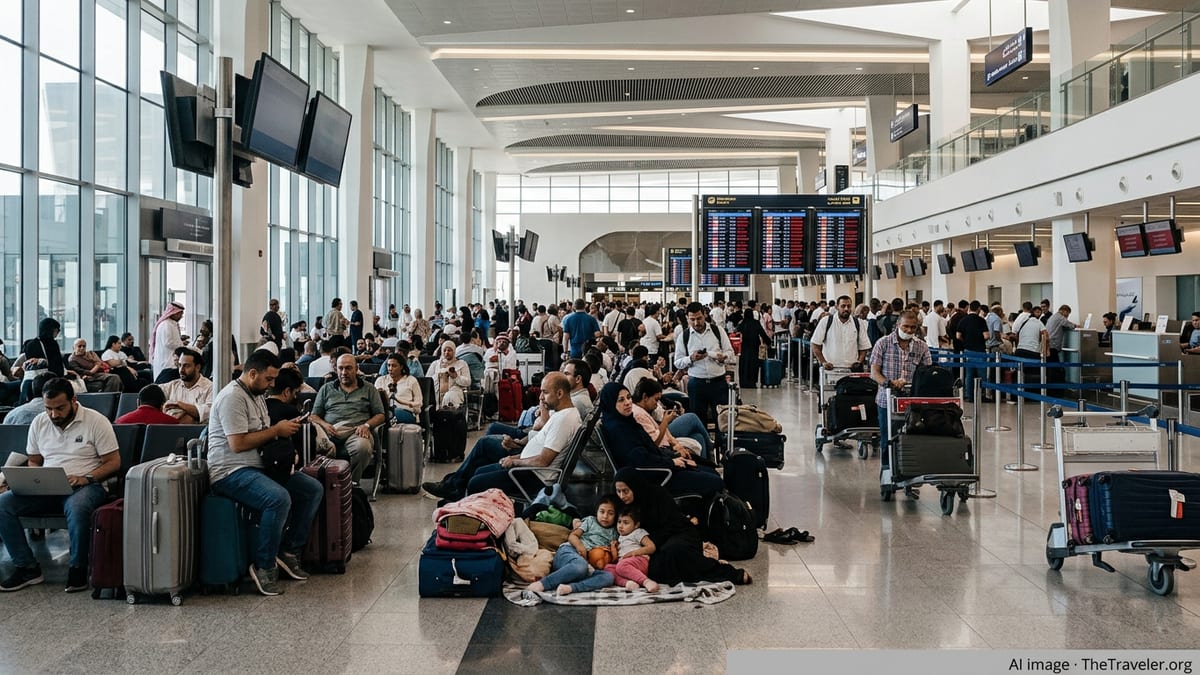
Images shared through local outlets and social media platforms show crowded waiting areas and long queues at service desks, consistent with previous disruption events at the airport when fog or other operational issues led to large numbers of stranded passengers.
Why Flights Are Being Canceled Across the Region
The cancellations in Bahrain are part of a wider pattern of aviation disruption tied to heightened regional tensions and the closure or restriction of several Gulf airspaces. Reporting by international media and open-source trackers points to a series of missile and drone incidents affecting critical infrastructure, including areas close to major airports and fuel facilities, prompting authorities in multiple countries to sharply curtail routine commercial flying.
Travel risk advisories current for early to mid March describe Bahrain International Airport as “mostly halted,” alongside similarly constrained operations at hubs such as Doha and Kuwait City. In these briefings, carriers are warned that routine schedules may not be viable and that short-notice changes to airspace availability are likely as the security situation evolves.
Airlines have responded conservatively, preferring to cancel or consolidate services rather than route aircraft through airspace that might be subject to sudden closure. Some carriers have shifted operations to airports in neighboring Saudi Arabia, using road links such as the King Fahd Causeway to move passengers between Bahrain and alternative departure points.
The result is a complicated patchwork of limited special flights, humanitarian or repatriation rotations, and charter services that operate alongside large-scale cancellations. For ordinary travelers, this makes it difficult to predict whether a confirmed booking will actually depart, even when check-in and timetable information appear normal.
How Stranded Passengers Are Being Affected
Accounts shared by travelers transiting through Bahrain and other affected Gulf hubs describe days of waiting in terminals, repeated rebooking attempts, and difficulties obtaining clear information on when normal service might resume. Some passengers have reported that their flights were canceled multiple times, while others found that onward connections via Bahrain were withdrawn with little or no advance notice.
Accommodation and meal assistance appear to vary significantly by airline and ticket type. Full-service carriers with hub operations in the region are more likely to arrange hotel stays or transport to alternative airports, while budget airlines and some codeshare arrangements may leave travelers to manage their own arrangements and seek reimbursement later.
Travelers with tight visa limits, non-refundable hotel stays, or time-sensitive commitments are particularly exposed. Online forums show growing concerns from visitors about overstaying visas or missing vital connections, as well as confusion over which country’s rules apply for refunds and rerouting when multiple airlines and transit points are involved.
At the same time, some passengers have managed to depart by securing seats on special or alternative routes, often via Saudi Arabian airports that retain more regular operations. However, these options can be costly and may require additional transit visas or overland journeys that are not practical for all travelers.
What Travelers Should Do If They Are Booked Through Bahrain
Travel experts and passenger advocates emphasize that anyone with upcoming flights touching Bahrain International Airport should treat itineraries as provisional and monitor them closely in the days and hours before departure. This includes not only flights originating or ending in Bahrain, but also connections that route through the airport or over nearby airspace.
For travelers already ticketed, the first step is to check directly with the operating airline through official channels such as mobile apps or customer portals, as these are typically updated before third-party booking sites. Many carriers in the region are publishing rolling advisories outlining eligibility for free date changes, routing changes via alternative hubs, or full refunds in cases of cancellation.
Passengers who must travel urgently may wish to explore overland options via the King Fahd Causeway into Saudi Arabia, where other international airports may offer more reliable departures. However, this is only feasible if travelers meet entry and transit requirements, and they should verify visa rules and security guidance from their home country before attempting to cross borders.
Travel insurance policies may provide additional protection, particularly where coverage includes “travel disruption,” “civil unrest,” or “airspace closure” clauses. Policyholders are typically required to document cancellations and any extra costs incurred, so retaining boarding passes, booking confirmations, and written notices of schedule changes can be important later.
Key Considerations for Upcoming Trips Through the Gulf
With the regional situation still fluid, publicly available risk assessments suggest that irregular operations at Bahrain International Airport and other Gulf hubs could continue for some time. Travelers planning new trips are being advised in many forums to build flexibility into their itineraries by allowing longer connection windows, avoiding tight back-to-back meetings, and considering fully refundable or changeable fares where budgets permit.
Those who have not yet booked may prefer to route through airports and regions that are less directly exposed to current tensions, even if that requires longer flight times. Travel agents and corporate travel managers are increasingly recommending routings that avoid potentially affected airspace altogether, particularly for non-essential journeys.
For anyone who must fly through Bahrain or neighboring hubs in the coming weeks, close monitoring of airline bulletins, airport announcements, and government travel advisories remains critical. Conditions may improve quickly if airspace restrictions are eased, but equally, further cancellations are possible if the security outlook deteriorates or infrastructure near airports is affected again.
The situation underscores how interconnected modern air travel has become. Even a single airport facing restrictions can trigger a chain reaction across global networks, and the disruption now unfolding in Bahrain offers a clear example of how rapidly travel plans can be upended when security and aviation concerns converge.