

More news on this day
Hundreds of passengers traveling through Switzerland on Thursday faced major disruption after a technical issue in the country’s air traffic control system led to 123 flight delays and 30 cancellations at Geneva and Zurich airports, affecting operations at Lufthansa, easyJet, Helvetic Airways and several other European carriers.
Get the latest news straight to your inbox!
Technical Glitch Triggers Network-Wide Disruption
According to information from aviation and passenger-rights monitoring platforms, the disruption began early on Thursday after a technical fault affected air traffic management systems handling flows into and out of Geneva and Zurich. The knock-on effect quickly cascaded across morning and midday schedules, forcing airlines to slow operations, hold aircraft on the ground and re-sequence departures.
By mid-afternoon, a combined total of 153 flights had been impacted across the two airports, with 123 departures and arrivals operating with significant delays and 30 services cancelled outright. While both airports remained open, capacity restrictions and safety buffers imposed by air traffic control reduced movements, particularly during peak waves.
The disturbance added strain to an already tight European aviation network at the tail end of the winter season, where high load factors and limited spare aircraft leave little room to absorb sudden timetable shocks. Passengers connecting through Zurich in particular reported missed onward flights and lengthy rebooking queues at airline transfer desks.
Swiss authorities indicated that contingency procedures were activated to maintain safe separation between aircraft, but restoring normal flow rates proved gradual. As a result, disruption extended well beyond the initial technical window, with late-running aircraft causing further delays into the evening bank of flights.
Lufthansa, easyJet and Helvetic Among Worst Hit
Flag carrier Lufthansa and its Swiss-based partners were among the most affected operators, as Zurich functions as a key hub for the Lufthansa Group’s European and long-haul network. Several short-haul rotations to and from German, Italian and Central European cities were delayed or cancelled when aircraft and crews were held out of position.
Low-cost carrier easyJet, a dominant presence at Geneva and a major player on leisure routes linking Switzerland with the United Kingdom and France, also reported multiple delayed sectors. Some early-morning flights departed with extended ground holds, while a number of later rotations were scrubbed as the airline sought to stabilize its network and respect local night-flight curfews.
Regional operator Helvetic Airways, which operates a mix of scheduled and wet-lease services for larger network carriers, faced operational headaches of its own. With a relatively small fleet, the airline had limited flexibility to reassign aircraft once rotations began to slip, leading to cancellations on select intra-European routes.
Other carriers with smaller but significant footprints at the Swiss hubs, including Swiss International Air Lines and several European network and holiday airlines, reported knock-on delays throughout the day. For many passengers, this meant tight connections evaporated and same-day arrival at final destinations was no longer guaranteed.
Queues, Missed Connections and Overnight Stays for Passengers
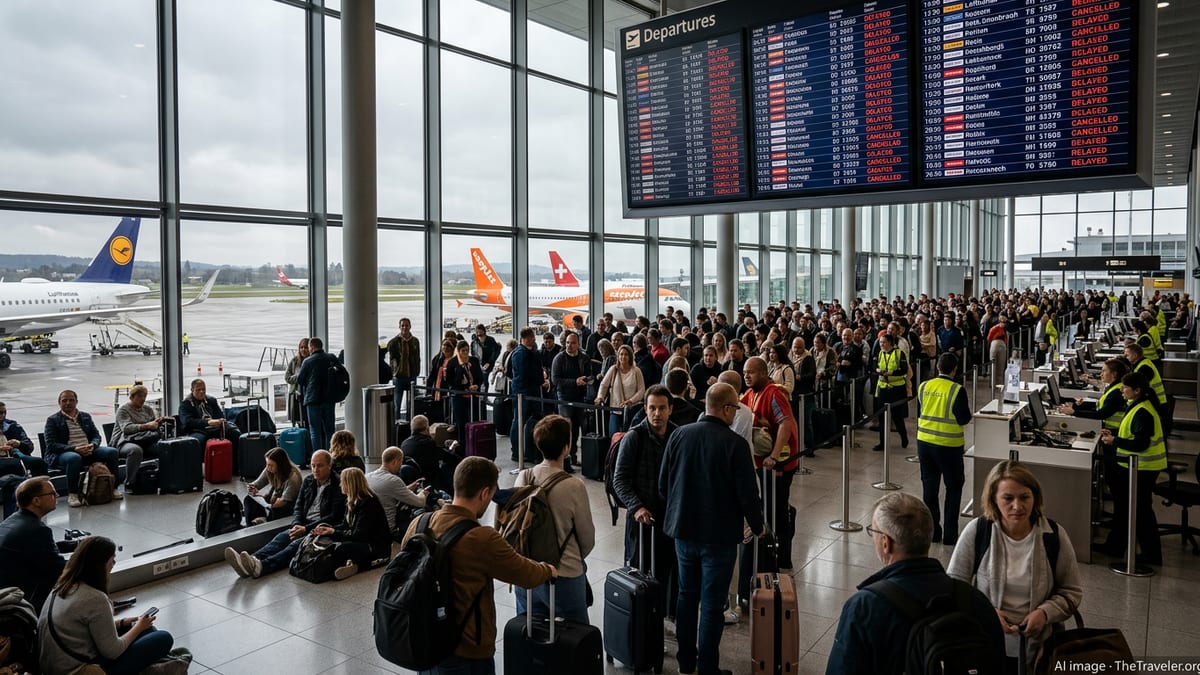
Inside the terminals, the operational problems translated into crowded departure halls, long queues at customer service counters and mounting frustration for travelers. Screens across both airports displayed clusters of delayed flights, with estimated departure times frequently revised as air traffic control adjusted the flow of aircraft.
Passengers on affected flights described waiting in boarding areas with limited information as crew and ground staff awaited updated slot times. In some cases, boarding was completed only for aircraft to remain on stand or at holding points for extended periods, further compressing available turnaround time at destination airports.
For those connecting through Zurich, missed onward flights became a central concern. Travelers with tight connections to long-haul services reported being rebooked onto later departures, sometimes routed through alternative hubs in Germany, France or the Netherlands. Families and business travelers alike faced last-minute changes to itineraries and, in some instances, overnight hotel stays near the airports.
While airlines moved to issue meal vouchers and arrange accommodation where required, peak-time demand for assistance outpaced available staff. Many customers turned to airline apps and call centers in an attempt to secure rebookings more quickly, adding digital congestion to the day’s physical bottlenecks.
Airlines Urge Passengers to Check Flight Status Before Traveling
As the scale of the disruption became clear, airlines operating at Geneva and Zurich urged passengers to monitor their flight status closely before heading to the airport. Carriers including Lufthansa, easyJet and Swiss reminded customers that live updates were being pushed via mobile apps, text messages and email for those with contact details stored in reservations.
Some airlines introduced limited flexible rebooking policies for same-day travel from the affected airports, allowing passengers with non-essential journeys to switch to alternative dates at no additional fare. This helped to ease terminal crowding slightly and freed up seats for travelers with pressing commitments or onward international connections.
Airport operators recommended that passengers allow extra time for check-in and security, particularly during the late afternoon and evening when the residual backlog of delayed aircraft overlapped with scheduled peak departures. Those already in transit were advised to stay close to their gate areas and pay attention to announcements, as rapid gate changes were used to keep operations moving where possible.
Despite the challenges, operations teams stressed that safety remained the overriding priority. Technical capacity limits imposed on airspace and runway use were kept in place until engineers and controllers were confident that systems were functioning normally and that traffic flows could be increased without compromising safety margins.
Passenger Rights and What Affected Travelers Can Do
The disruption has once again focused attention on passenger rights under European air travel rules. For flights departing from Switzerland operated by European carriers such as Lufthansa, easyJet, Helvetic or Swiss, travelers whose services were cancelled at short notice may, in some circumstances, be entitled to cash compensation in addition to refunds or rebookings, depending on the root cause of the technical fault and the length of the delay at arrival.
Consumer advocates recommend that affected passengers keep all documentation related to their trip, including booking confirmations, boarding passes and receipts for meals, transport and accommodation purchased during the disruption. These records can be helpful when submitting claims directly to airlines or, if necessary, escalating complaints to national enforcement bodies or mediation services.
Travelers are also encouraged to check whether their travel insurance policies offer additional coverage for missed connections, extended delays or extra hotel nights. Many comprehensive policies include provisions for such incidents, though terms and claim procedures vary widely between insurers.
As airlines and airports work to restore normal operations, industry observers note that the event underscores the sensitivity of Europe’s tightly scheduled air network to even short-lived technical faults. With limited spare capacity and rising passenger numbers, similar episodes at major hubs can quickly ripple across borders, leaving travelers far from their intended destinations, even when the original problem is confined to a single country’s airspace.