

More news on this day
Numerous flights to and from Hamad International Airport in Doha have been cancelled in recent weeks, leaving hundreds of passengers stranded worldwide as Qatar’s main hub grapples with ongoing airspace restrictions and a patchwork of limited evacuation services.
Get the latest news straight to your inbox!
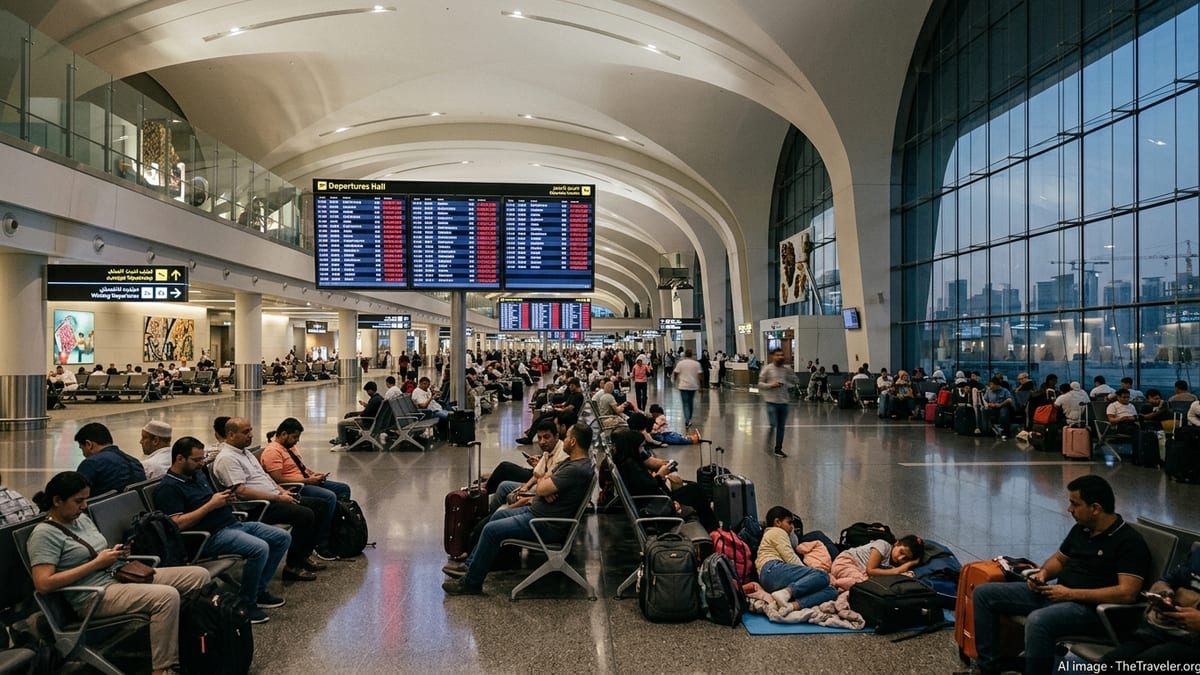
What Is Causing the Flight Cancellations in Doha
Flight disruption at Hamad International Airport intensified after a sharp escalation in regional tensions at the end of February 2026. Publicly available information shows that Qatar, along with several neighboring states, imposed temporary airspace closures in response to Iranian missile and drone attacks linked to the wider Iran–US–Israel conflict. The closures disrupted normal traffic flows across much of the Middle East and forced airlines to rapidly reassess routings and schedules.
Reports indicate that Qatar’s airspace was initially shut to routine commercial operations following strikes and intercepts near key infrastructure, including locations around Doha. While Hamad International Airport itself has not been reported closed as a facility, restrictions on the skies above Qatar significantly curtailed the ability of carriers to operate their usual wave of long-haul connections through the hub.
Industry briefings and government notices reviewed by travel and business outlets describe widespread cancellations across major regional airports, with Doha listed among the most affected. Analysts note that the nature of hub-and-spoke operations means that when a central hub like Hamad International Airport is constrained, disruption rapidly cascades across the network, affecting passengers far from Qatar who were scheduled to transit through Doha.
As a result, many passengers have found themselves stranded not only in Doha but also in cities across Europe, Asia and Africa, either unable to start their journeys or stuck mid-route after onward segments via Doha were cancelled at short notice.
Current Situation at Hamad International Airport
Travelers arriving at or departing from Hamad International Airport in recent days have faced a reduced schedule, with only a fraction of the usual services operating. According to published airline updates and media coverage, Qatar Airways has been running a limited program of flights under special authorizations, prioritizing passengers whose final destination is Doha and specific repatriation routes.
The scene at the airport has varied by day and time, but accounts circulating via news outlets and passenger forums describe a quieter terminal than usual, punctuated by clusters of stranded travelers waiting for clarity on rebooking options. Some passengers who were already in Doha when the crisis unfolded report remaining in the city for days or weeks, checking airline apps repeatedly as schedules are updated and flights are added or removed.
Publicly available advisories emphasise that limited operating corridors approved by the Qatari Civil Aviation Authority allow only selected services to operate and do not represent a full reopening of Qatar’s airspace. This means that while some flights are departing and arriving, large numbers of scheduled services remain cancelled, and day-to-day operations can change quickly depending on the security situation.
Airlines that rely on Doha as a transit hub are continuing to adjust. Interim timetables shared through official channels and secondary reporting show repeated revisions, including the cancellation of previously planned services and the gradual addition of a small number of extra routes as conditions permit.
Impact on Passengers: Who Is Affected Most
The most severely affected travelers are those who were already en route when the first waves of cancellations took effect. Many had completed the initial leg of their journey and were expecting to connect through Doha to long-haul destinations in Asia, Europe, Africa or Oceania, only to discover that their onward flights were suspended.
Reports from passenger communities indicate that some groups have been stuck in Doha since late February, while others are stranded in intermediate cities such as Rome, Istanbul or various Gulf and European hubs after their connecting flights via Hamad International Airport were cancelled. With capacity on the limited repatriation and point-to-point services in and out of Doha heavily constrained, rebooking can take days or longer.
Travelers with departures scheduled for the second half of March have also been hit as airlines repeatedly extend or modify cancellation periods. Some carriers have reportedly cancelled most or all services through at least late March, while still loading tentative post-crisis schedules into booking systems. This has left many passengers unsure whether their flights will operate until shortly before departure.
Families, migrant workers and students appear particularly exposed. Many rely on fixed-term visas, job start dates or academic calendars and have limited flexibility to delay their journeys. In addition to logistical challenges, social media posts and traveler testimonies compiled by news outlets highlight the emotional strain of prolonged uncertainty, especially for those hearing air defense activity in the vicinity of Doha while waiting for a safe route out.
What Airlines Are Doing for Affected Travelers
Publicly available airline statements indicate that most major carriers operating to and from Doha, led by Qatar Airways, have introduced temporary policies intended to give passengers more flexibility. These typically include options to rebook onto a later date, reroute via an alternative hub where available, or request refunds or travel credits without standard change fees.
Qatar Airways in particular has outlined special provisions for customers holding tickets for travel during the most heavily impacted period, roughly from late February into the second half of March. Reports indicate that eligible passengers are able to make at least one free change or seek refunds, although the precise rules may vary by ticket type, point of sale and route.
At the same time, limited capacity on operating flights has constrained how quickly airlines can clear the backlog. Repatriation-style services and narrow operating corridors mean that even with flexible policies in place, not every stranded passenger can be accommodated immediately. Some carriers have prioritized travelers with imminent humanitarian, medical or residency-related needs, according to publicly reported criteria, but capacity remains tight.
Call centers, airline apps and online chat channels have at times struggled to keep up with demand, leading to long wait times and difficulty in obtaining live assistance. As a result, many travelers are relying on a combination of airline notifications, travel agent updates and independent tracking of flight status through publicly accessible tools to piece together their options.
Practical Advice if You Are Booked Through Doha
For travelers scheduled to fly via Hamad International Airport in the coming days and weeks, the most important step is to monitor the status of your booking closely. Experts quoted in travel industry coverage recommend checking your reservation directly with the airline or booking agent rather than relying solely on generic flight timetables, which may not reflect last-minute changes.
If your flight has been cancelled, review the disruption policy that applies to your ticket. Many airlines are waiving change fees and fare differences within certain date windows or allowing full refunds. These rules are time-limited and can differ depending on when the ticket was purchased, so it is advisable to confirm the exact conditions attached to your booking and act promptly if you want to change plans.
Passengers who are already in Doha, or who become stranded at another transit point, are encouraged by travel advisories and consular notices to stay in close contact with both their airline and, where relevant, their embassy or consulate. Embassies in the region have been issuing regular updates on regional airspace closures, security assessments and potential evacuation or repatriation options.
Travelers yet to start their journeys may wish to explore alternative routings that do not depend on transiting Doha, particularly if they are traveling before the end of March or while airspace restrictions remain in place. However, any decision to reroute should be weighed against ticket conditions, availability and the broader regional security picture, which continues to evolve. For now, the situation at Hamad International Airport remains fluid, and passengers are likely to face continued disruption as airlines and authorities balance safety considerations with mounting demand to restore normal connectivity.