

More news on this day
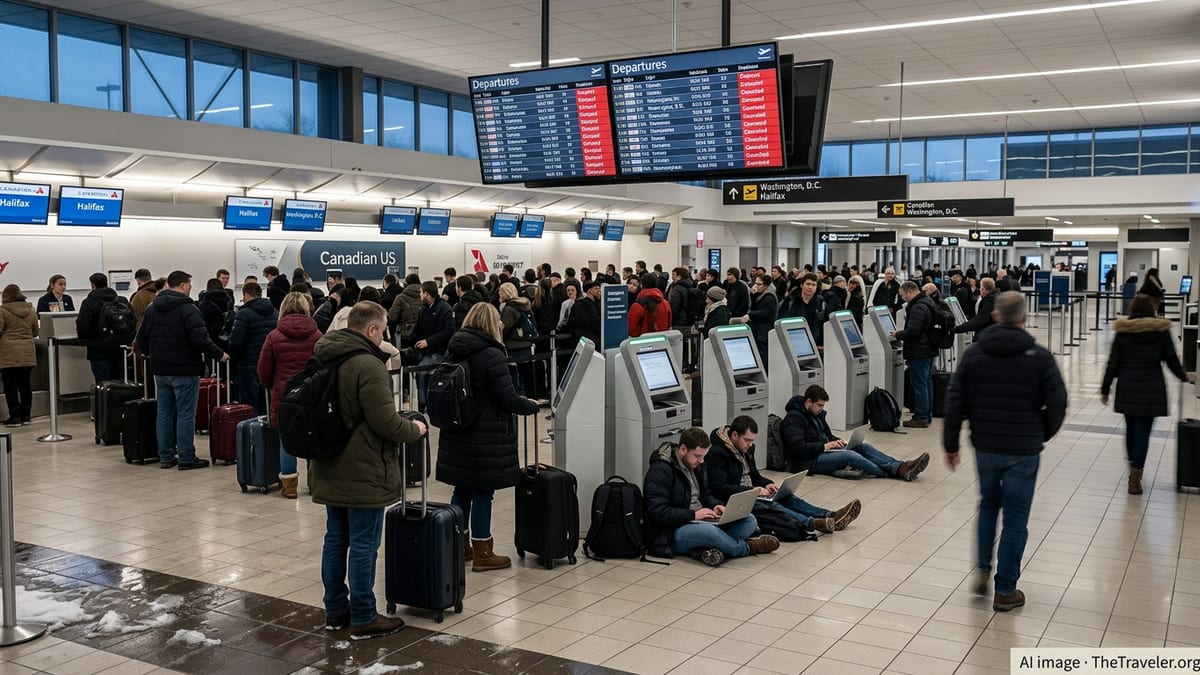
Travelers across Canada and the United States faced major disruptions this weekend after 24 delayed flights and 40 cancellations at Ottawa Macdonald-Cartier International Airport triggered a cascade of missed connections and overnight strandings from Halifax and Fredericton to Washington D.C. and several other cities.
Get the latest news straight to your inbox!
Ripple Effects Across Canadian and U.S. Hubs
Operational data and airport status boards for Sunday, March 15, indicate that Ottawa Macdonald-Cartier International Airport experienced an unusually high number of schedule disruptions, with 24 flights delayed and 40 canceled. The disruption window spanned much of the day, affecting both departing and arriving services on domestic and transborder routes.
Because Ottawa serves as a key connector between Atlantic Canada, central Canada, and the U.S. Northeast, the knock-on effects quickly extended beyond the national capital region. Travelers reported being left in limbo at Halifax Stanfield International Airport, Fredericton International Airport, and airports in the Washington D.C. area, as onward flights to or from Ottawa were either heavily delayed or removed from the boards entirely.
Publicly available information from flight-tracking platforms shows that some aircraft never departed their originating airports, while others were forced into extended ground holds. This pattern created a network-wide imbalance in aircraft and crew availability, further compounding the difficulties for passengers trying to rebook same-day connections.
In several cases, transborder travelers stranded in the United States were unable to secure same-day alternatives back to Canada, particularly on smaller regional routes that operate only a few frequencies per day. As a result, what began as a localized problem in Ottawa quickly became a multi-city disruption affecting both Canadian and U.S. passengers.
Halifax and Fredericton See Stranded Passengers
In Atlantic Canada, Halifax and Fredericton emerged as two of the hardest hit regional airports for travelers whose journeys depended on an Ottawa connection. Flights linking these cities with Ottawa are typically limited in frequency, leaving little slack in the system when a disruption of this scale occurs.
Reports from passengers in Halifax describe instances where morning departures to Ottawa were first delayed and then canceled outright, leaving travelers queued at service desks searching for alternatives through Montreal, Toronto, or other hubs. Some were offered rebooking options departing the following day, while others attempted to reach their destinations by ground transportation after learning that no same-day seats were available.
At Fredericton International Airport, travelers on routes connecting through Ottawa also faced abrupt changes to their itineraries. Information shared on social platforms by stranded passengers points to lengthy waits, intermittent updates on departure times, and frustration over limited options to reroute around the bottleneck in Ottawa.
These regional impacts highlight the vulnerability of smaller markets when a primary connection point experiences a surge in cancellations. With relatively few daily departures and arrivals, a cluster of canceled Ottawa flights can effectively sever same-day links between Atlantic Canada and other parts of the country.
Washington D.C. and U.S. Northeast Connections Disrupted
The impact was also felt in the United States, particularly around Washington D.C., where cross-border routes to and from Ottawa play an important role for government, business, and leisure travelers. Publicly available status boards at Washington area airports showed a series of delayed and canceled services tied to the Ottawa operation.
Passengers connecting through U.S. hubs reported missed onward flights when their inbound aircraft from Ottawa failed to arrive on time or were canceled at the origin. In some cases, travelers attempting to return home to Canadian cities via Ottawa found themselves stranded in Washington overnight, dependent on limited rebooking options and available hotel rooms near the airport.
The disruption also spilled over into the broader U.S. Northeast corridor, where weather and congestion frequently interact with cross-border operations. With aircraft and crews out of position due to the schedule breakdown in Ottawa, some U.S. flights unrelated to the original cancellations still experienced secondary delays as airlines attempted to reconstruct a functional schedule for the following day.
For international travelers with tight connection windows in Washington, the irregular operations created additional complications around immigration formalities and baggage handling. Passengers who missed their onward flights reported concerns about checked luggage being held at intermediate airports while they were rebooked on alternative routes.
Weather, Operations and Capacity Pressures
While a detailed breakdown of causes for each delayed or canceled flight has not yet been fully itemized in public reporting, recent weather volatility across central and eastern Canada, combined with tight airline schedules, appears to have created a fragile operating environment. Winter conditions in the region often require extensive de-icing procedures, runway clearing, and reduced takeoff and landing rates, all of which can quickly translate into schedule disruptions.
Industry data published in recent months shows that Canadian airports, including Ottawa and Halifax, have continued to face periods of elevated delay and cancellation rates during active winter weather systems. When combined with high passenger loads during weekends and limited spare aircraft and crew, even a modest operational shock can trigger a chain reaction that persists for several days.
Observers note that Ottawa’s role as both an origin and a connecting point amplifies this vulnerability. Cancellations on one segment can strand entire aircraft rotations, depriving other cities of the inbound aircraft they rely on. Once this cycle begins, recovering the schedule typically requires a coordinated effort to reposition planes, reassign crews, and consolidate lightly booked flights.
Publicly available flight data from previous winter storms demonstrates that similar patterns of disruption have occurred in the past, with widespread cancellations at major Canadian hubs leading to multi-day knock-on effects for smaller markets and U.S. transborder routes. The latest wave of disruptions at Ottawa fits into that broader seasonal pattern, even if the specific operational triggers on March 15 remain under review.
Passenger Rights, Rebooking Options and Next Steps
For stranded travelers, the immediate challenge has been securing alternative transportation and understanding their rights to refunds, vouchers, or accommodations. Information from consumer advocacy groups and government transportation resources emphasizes that passengers on canceled flights are generally entitled to a choice between rebooking and a refund, although details can vary depending on the carrier, route, and reason for the disruption.
Travel guidance circulating on airline and government websites encourages passengers to monitor their flight status frequently, use mobile apps to request rebooking, and keep documentation of all out-of-pocket expenses in case reimbursement options are available. In cases where delays or cancellations are linked to factors within an airline’s control, such as maintenance issues, passengers may have stronger grounds to pursue compensation than when the primary driver is severe weather or air traffic restrictions.
Travel experts also recommend that passengers facing irregular operations in Ottawa or any affected city consider alternative routing through larger hubs when possible, even if it involves a detour. With seats at a premium during disruption events, flexibility on departure time and destination airport often increases the chances of reaching the final destination within a reasonable timeframe.
As airlines and airports work through the backlog created by the 24 delayed and 40 canceled flights at Ottawa Macdonald-Cartier International Airport, travelers across Halifax, Fredericton, Washington D.C. and other linked cities are expected to feel residual impacts into the start of the new week. Industry observers will be watching closely to see how quickly the network stabilizes and what measures carriers adopt to reduce the risk of similar large-scale disruptions as the late winter travel season continues.