

More news on this day
Rail passengers across central England faced hours of disruption after a major signalling problem at Birmingham New Street led to extensive delays, cancellations and overcrowding, rippling across some of the UK’s busiest intercity and regional routes.
Get the latest news straight to your inbox!
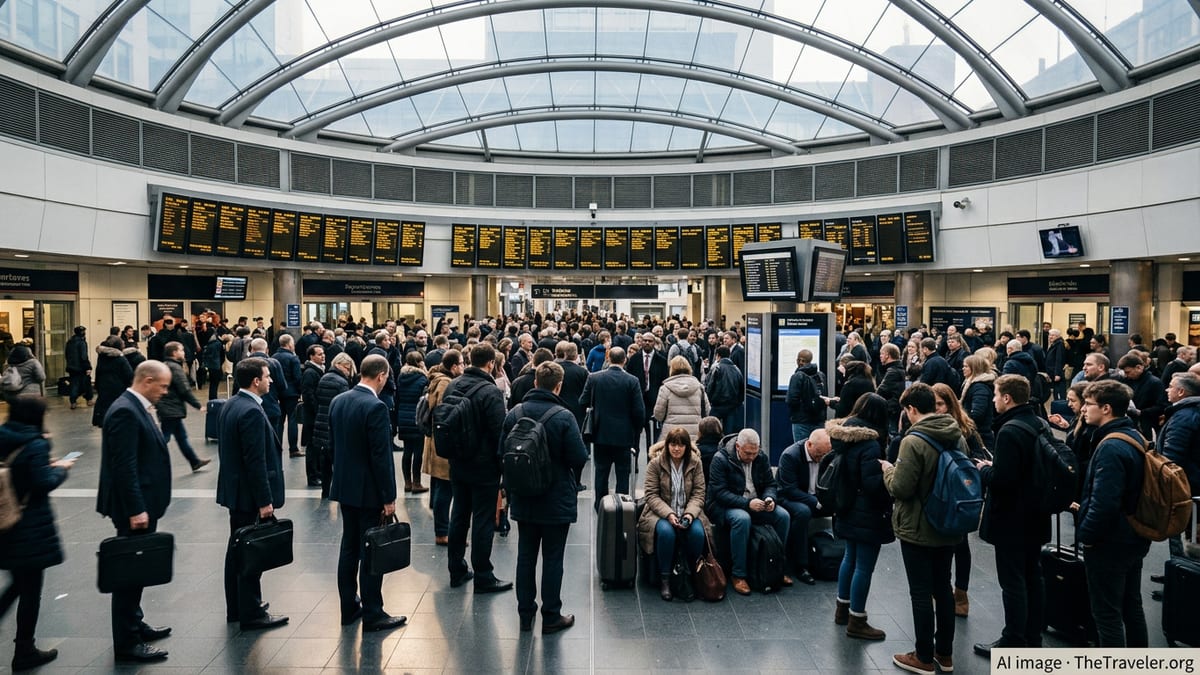
A Critical Hub Brought to a Standstill
Birmingham New Street is one of the most important junctions in the national rail network, handling long distance intercity services alongside dense commuter traffic across the West Midlands. Publicly available information shows that even minor delays at the station can quickly cascade into wider disruption, and the latest signalling fault has underlined just how sensitive the network is around this bottleneck.
Reports indicate that trains in and out of New Street were subject to severe delays, with some services held outside the station while routes were reconfigured and safety checks carried out. Passengers reported waits of well over an hour on some cross country and regional services, while others saw their trains diverted, short formed or cancelled outright.
The disruption hit at a time when the wider West Midlands network is already managing extended engineering work and timetable changes, adding further strain to operators’ ability to recover. The result was a patchwork of altered stopping patterns, emergency turnbacks and overcrowded trains as operators attempted to keep at least a skeleton service moving through the city.
For many travellers, the episode reinforced Birmingham New Street’s reputation as both a vital artery and a single point of failure, where any infrastructure issue can have outsized consequences for journeys spanning hundreds of miles.
Knock-on Delays Across the Midlands and Beyond
The immediate impact of the fault was felt on routes radiating from Birmingham towards London, Manchester, Bristol and the East Midlands, with delays propagating far from the original problem. According to live travel updates and operator statements, services between Birmingham New Street and key junctions such as Birmingham International, Wolverhampton, Derby and Cheltenham were particularly affected.
Some long distance trains were terminated early at outlying stations, leaving passengers to wait for onward connections or to seek alternative routes. Others ran but skipped intermediate stops in an attempt to recover time, frustrating commuters who rely on regular calling patterns to get to work or education.
Planned engineering activity across the wider region complicated the situation further. Recent timetables show rail replacement buses and diversions already in place on sections of line serving Birmingham, meaning that spare capacity was limited and contingency plans had to work around existing blockades. The combination of unplanned signalling problems and scheduled works produced a complex web of alterations that was difficult for passengers to navigate in real time.
On social media and rail discussion forums, travellers shared screenshots of departure boards filled with delayed and cancelled services, noting that the disruption was not confined to a single operator but spread across multiple franchises that use Birmingham New Street as a central interchange.
How Commuters Are Coping on the Ground
With platforms crowded and departure times uncertain, many commuters pivoted rapidly to alternative modes of transport. Bus and tram routes across central Birmingham saw increased demand as rail users sought to bridge gaps between suburban stations and the city centre, or to bypass New Street entirely where possible.
Passengers posted practical tips for others online, suggesting use of regional hubs such as Birmingham Moor Street or Birmingham Snow Hill as workarounds, and highlighting walking routes between stations to maintain connections. Some travellers opted to travel via Birmingham International, Coventry or Wolverhampton to rejoin main line services, accepting longer journey times in return for more predictable departures.
Others simply abandoned rail for the day, turning to car sharing, taxis or remote working where employers allowed. Anecdotal accounts described commuters leaving home significantly earlier than usual or delaying evening returns to avoid the peak of disruption, turning what would normally be a straightforward commute into a multi stage logistical exercise.
Digital tools played a prominent role in helping passengers make decisions. Journey planning apps and operator feeds were widely used to track platform changes, short notice cancellations and revised arrival times, although some users noted that information sometimes lagged behind events on the ground when services were being reconfigured at short notice.
Travel Advice and What Passengers Should Expect Next
Rail operators have urged passengers in the Birmingham area to check for the latest service information before setting out, as residual delays and short notice alterations are expected to continue while timetables are reset and trains and crew are returned to their correct locations. Publicly available journey planners for the coming days continue to show minor retimings and rolling stock changes on some routes passing through New Street.
Season ticket holders and regular commuters are being directed towards compensation schemes for significant delays, including delay repay mechanisms where thresholds are met. Travel experts advise passengers to keep records of disrupted journeys, including photos or screenshots of departure boards, to support any claims.
For those who must travel through Birmingham New Street, rail commentators recommend allowing extra time for connections and considering earlier or later services to reduce the risk of missed links. Where reasonable alternatives exist via Moor Street, Snow Hill or other regional hubs, some travellers may find it more reliable to route around New Street until services have fully stabilised.
Looking ahead, industry reports highlight ongoing investment in signalling upgrades and infrastructure improvements around Birmingham designed to reduce the chances that a single fault can paralyse such a large section of the network. For now, though, this latest episode has served as a reminder of how dependent UK rail travel remains on the smooth running of one very busy station in the heart of the Midlands.