

More news on this day
Travelers moving through Detroit Metropolitan Wayne County Airport faced significant disruption as publicly available flight-tracking data showed roughly 326 delays and 74 cancellations affecting routes to New York, Chicago, Los Angeles and other major U.S. cities, with Delta, SkyWest, Spirit and several other carriers heavily impacted.
Get the latest news straight to your inbox!
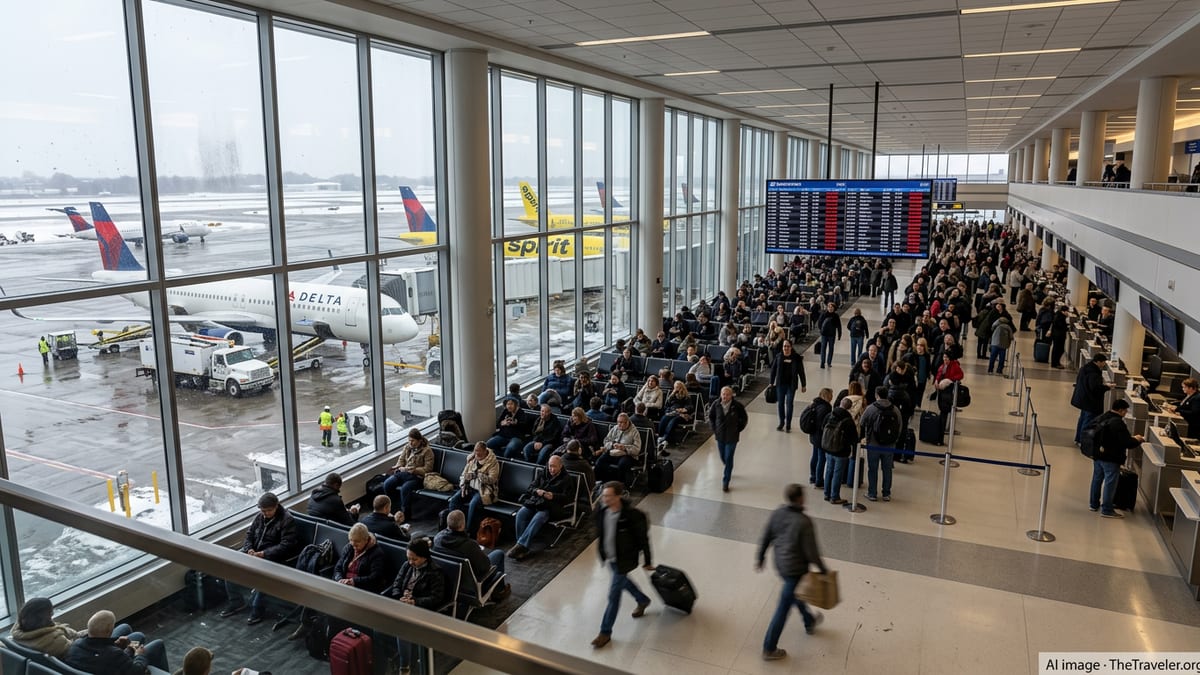
Stormy Weather and System Strain Converge on a Key Midwest Hub
The latest wave of disruption at Detroit Metro appears to be closely tied to a broader pattern of severe late-winter weather that has unsettled air travel across large parts of the United States. Recent storm systems sweeping through the Great Lakes and Northeast have triggered blizzard warnings, icing conditions and strong winds, conditions that routinely force airlines and airports to slow or suspend operations for safety.
Detroit Metro, a critical connecting point between the Midwest and both coasts, is especially vulnerable when weather deteriorates along multiple parts of the network at once. When storms affect both origin and destination airports, as has recently occurred in the Northeast and Upper Midwest, schedules quickly become unstable and even on-time departures can be held back by delayed inbound aircraft and displaced crews.
Operational data and public reports from recent winter storms indicate that such events can generate thousands of cancellations nationwide within a 24 to 48 hour period. The figures now associated with Detroit Metro fit within that broader national pattern, suggesting that local disruption is part of a larger system-wide shock rather than an isolated incident.
As the storm systems move east and conditions gradually improve, airlines typically begin the difficult process of rebuilding their schedules, repositioning aircraft and crews, and working through a backlog of stranded passengers. That recovery period often extends well beyond the end of the weather event itself, meaning travelers can see residual delays long after skies have cleared over Detroit.
Impact on Major Routes to New York, Chicago and Los Angeles
The disruption at Detroit Metro has been most visible on some of the country’s busiest corridors, including flights to and from New York, Chicago and Los Angeles. These routes link key business centers and serve as vital connections for domestic and international itineraries, so even modest schedule changes can cascade into missed connections and extended layovers for hundreds of travelers.
New York–area airports have recently faced their own weather and congestion challenges, amplifying the impact on Detroit-originating flights. When arrival rates are reduced along the East Coast due to low visibility, wind, or runway configuration, flights departing Detroit for New York can be held on the ground, leading to rolling delays. Passengers on early-morning flights may bear the brunt of these constraints, but knock-on effects can carry into afternoon and evening banks.
Chicago connections have also been hit, as that region has contended with bouts of snow and low ceilings that reduce airport capacity. For Detroit-based travelers relying on quick hops to Chicago for onward domestic or international journeys, even short disruptions can translate into the loss of same-day connections, forcing schedule changes or overnight stays.
Flights between Detroit and Los Angeles, while typically less sensitive to snow, remain affected by disruptions elsewhere in the network. If aircraft and crews are delayed or stranded at other hubs, long-haul services to the West Coast can shift later into the day or be consolidated, leaving travelers with fewer options and tighter margins to make onward connections to Asia and the Pacific.
Delta, SkyWest, Spirit and Other Carriers Feel the Pressure
The bulk of operations at Detroit Metro are handled by Delta Air Lines and its regional partners, including SkyWest, alongside low-cost carriers such as Spirit. Publicly available on-time performance statistics from federal transportation datasets show that these airlines typically maintain completion rates in line with national averages, but that their operations can be significantly disrupted during severe weather and peak travel periods.
In Detroit, Delta’s large hub operation means even small schedule adjustments can affect a wide range of destinations. When conditions deteriorate, the airline and its partners often trim regional flights first, including services operated by SkyWest under major-carrier brands. This can concentrate cancellations on shorter routes and smaller markets, even as some longer-haul flights continue to operate with delays.
Spirit, which operates a sizeable schedule from Detroit focused on leisure destinations, has also been affected. Public discussions among passengers and aviation observers in recent weeks have highlighted staffing constraints and tight aircraft utilization at some low-cost carriers, factors that can magnify the impact of any weather-related disruption or airspace slowdown.
Other carriers serving Detroit, including additional U.S. mainline and regional airlines, can experience similar operational challenges when turbulence in the national air traffic system arises. With gate space, ground handling resources and deicing capacity in high demand during a disruption, conditions at a hub like Detroit Metro can quickly become strained across all airlines sharing the airfield.
Ripple Effects for Passengers Across the United States
The 326 delays and 74 cancellations recorded at Detroit Metro represent only part of the wider story, as each affected flight connects to onward journeys across the United States and beyond. A single missed connection in Detroit can strand a traveler en route between smaller cities, where alternative flights may be infrequent or fully booked during a disruption.
Publicly available commentary from passengers over the past several days describes long lines at customer service desks, difficulty rebooking on preferred routes, and challenges securing hotel accommodation when overnight stays become necessary. In some cases, travelers report resorting to rental cars, trains or intercity buses to complete trips that began by air.
These experiences are consistent with patterns observed during earlier large-scale weather events that hit major hubs. Once cumulative delays reach a certain threshold, crew duty-time limits and aircraft maintenance windows become binding constraints, forcing airlines to cancel additional flights even after the immediate weather threat subsides.
Downstream airports in New York, Chicago, Los Angeles and other major metropolitan areas can then see their own schedules thrown off balance as late-arriving Detroit flights bump up against nightly curfews, gate availability issues or local weather variations, perpetuating a cycle of delay that can take days to fully unwind.
What Travelers Through Detroit Metro Can Expect Next
As the current weather systems move out of the region and flight operations gradually stabilize, Detroit Metro passengers can expect a phased return toward normal schedules rather than an immediate reset. Airlines typically prioritize restoring core trunk routes and high-demand banks of flights, then layer back thinner services as crews and aircraft are repositioned.
Recent experience from similar disruption events suggests that same-day rebooking options may remain limited for a time, especially during peak morning and evening travel periods. Travelers holding flexible tickets or willing to accept alternate airports may have more success securing earlier departures, while those with fixed plans might face longer waits.
Public guidance from aviation consumer advocates generally emphasizes the importance of monitoring flight status frequently, using airline apps or departure boards at the airport, and being prepared for last-minute gate or timing changes. Travelers whose journeys touch multiple hubs, particularly in weather-affected regions, are often advised to allow extra connection time where possible.
With Detroit Metro serving as a central link between the Midwest and both coasts, any further late-season storms or system shocks in the coming days could generate additional turbulence in the schedule. For now, the figures logged at the airport capture the scale of the disruption already felt by hundreds of passengers whose plans have been reshaped by delays and cancellations across the national air network.