

More news on this day
Thousands of air travelers across Europe have faced hours-long disruptions as 88 cancellations and 749 delays hit major hubs in the Netherlands, Denmark, Germany, France, the United Kingdom and Italy, straining airline operations and leaving passengers isolated at airports from Amsterdam and Copenhagen to Frankfurt, Paris, London and Milan.
Get the latest news straight to your inbox!
Weather, Congestion and Knock-on Delays Cripple Key Hubs
Publicly available flight-tracking data and operational reports indicate that a combination of adverse weather, air traffic control constraints and airport congestion has led to significant schedule disruption across Europe. Amsterdam Schiphol, Copenhagen Kastrup, Frankfurt, Paris Charles de Gaulle and Orly, London Heathrow and City, and Milan Malpensa and Linate have all reported high levels of delayed and cancelled services in recent days.
The disruption has rippled across regional and flag carriers alike. Services operated by HOP!, SAS, CityJet, British-branded flights and other European and regional airlines have been particularly exposed on short-haul routes linking secondary cities with these hub airports, where tight turnarounds mean even minor delays can quickly cascade through the network.
Operational statistics from recent seasons show that these airports already rank among Europe’s most delay-prone, with Amsterdam, Frankfurt, Paris and Milan regularly logging double-digit percentages of late-running departures. When additional pressure from winter weather systems or localized capacity shortages is added, day-to-day resilience can erode quickly, amplifying the impact on passengers.
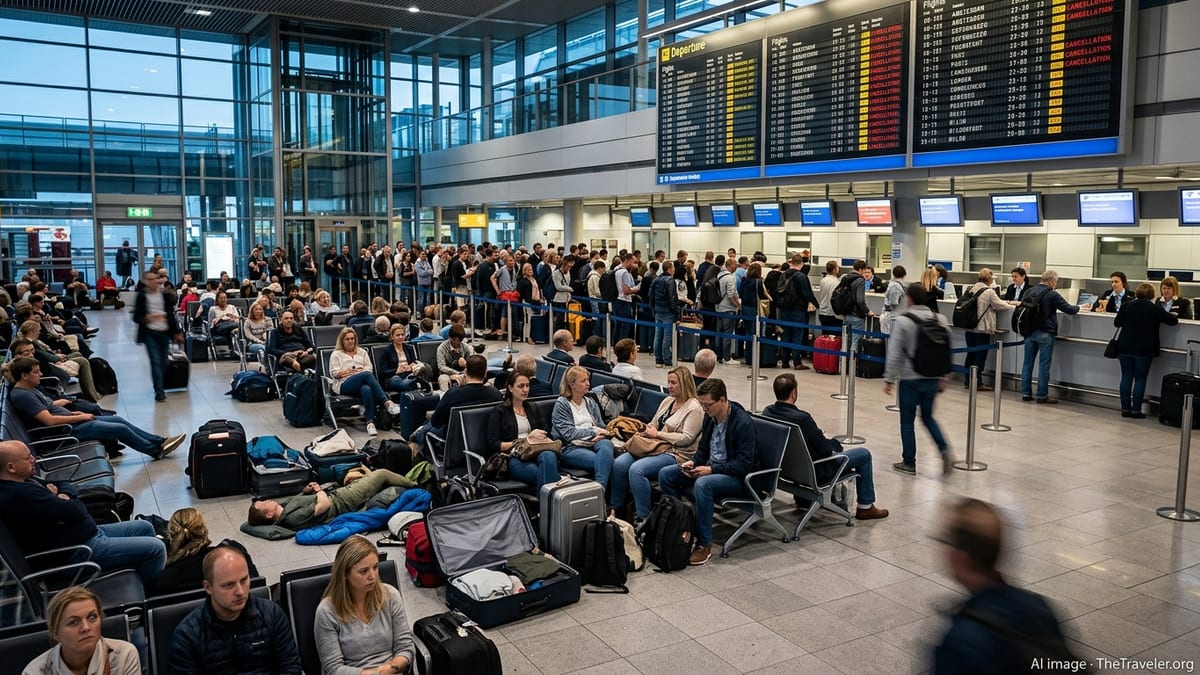
On the ground, this has translated into long queues at check-in and transfer desks, crowded departure halls and uncertainty over rebooking options, particularly for travelers on multi-leg itineraries or those connecting between different airline groups and alliances.
Thousands of Passengers Stranded and Re-Routed
The wave of 88 cancellations and 749 delays has stranded or heavily inconvenienced thousands of travelers across the affected countries. Passengers report being held on aircraft awaiting departure slots, facing sudden gate changes, or discovering late in the day that their flight has been cancelled with limited same-day alternatives available.
At major hubs such as Amsterdam, Frankfurt, Paris and London, disrupted travelers have been funneled onto already busy later departures, overnight services or indirect routings via other European cities. This has put further strain on airlines’ ability to find seats, particularly on popular evening departures and first-wave morning flights that are critical for business and long-haul connections.
Regional airports feeding into the main hubs have also felt the effects. Cancellations on thinner routes operated by carriers such as HOP!, SAS and CityJet can mean that a single lost frequency leaves entire communities temporarily cut off from the wider network, forcing travelers to seek alternative ground transport or wait for the next available flight, sometimes a day or more later.
Social media posts and public forums show travelers attempting to navigate complex rebooking chains involving multiple airlines, with some itineraries shifted from one carrier to another mid-journey. In particular, disruptions on British-flagged services have had knock-on effects for passengers ticketed through partner airlines that rely on London as a connecting gateway.
Impact on HOP!, SAS, CityJet, British-Branded and Partner Airlines
Regional subsidiaries and partner airlines have been on the front line of the disruption. HOP! services feeding French hubs, SAS flights linking Scandinavian cities via Copenhagen, CityJet’s regional operations and a variety of British-branded and franchise operations into London have all been affected by the concentrated wave of delays and cancellations.
These carriers often operate high-frequency, short-haul services with tight schedules and limited spare aircraft or crew. When a hub airport faces weather or air traffic control constraints, regional routes are among the first to experience rotations being curtailed or aircraft being out of position, which can lead to rolling delays throughout the day.
Publicly available information on airline schedules shows that many of these routes connect smaller regional centers to major hubs in the Netherlands, Denmark, Germany, France, the UK and Italy. When those links are interrupted, travelers can miss onward long-haul flights or crucial cross-border connections, compounding the sense of isolation at intermediate points in their journey.
Codeshare and alliance arrangements can soften the blow by allowing rebooking onto partner carriers, but they can also complicate the customer experience when responsibility for care, compensation and communication is divided between operating and marketing airlines.
Passenger Rights Under European and UK Regulations
The scale of the current disruption has renewed attention on passenger protection rules in Europe. Under Regulation EC 261/2004, travelers departing from EU and EEA airports, or flying to them on EU carriers, may be entitled to assistance and, in some circumstances, financial compensation when flights are heavily delayed or cancelled. A parallel framework, commonly referred to as UK261, applies similar principles to flights departing from UK airports or operated by UK carriers.
These regulations generally require airlines to provide care and assistance, including meals, refreshments and accommodation where necessary, when delays pass certain thresholds. Compensation may be payable when cancellations or long delays are not caused by what regulators define as extraordinary circumstances, although each case depends on the specific cause and operational context.
Consumer organizations monitoring the situation note that passengers often remain uncertain about their entitlements during large-scale disruptions. Complex itineraries involving multiple airlines, as well as different legal regimes across the EU, UK and non-EU European countries, can make it challenging for travelers to know which rules apply to their journey.
Travelers are being encouraged by advocacy groups and legal information services to retain documentation, boarding passes and receipts, and to submit claims directly through airline channels or alternative dispute mechanisms where appropriate, once their immediate travel needs have been addressed.
What Travelers Can Expect in the Coming Days
Operational data and recent experience of similar disruption patterns suggest that the effects of 88 cancellations and 749 delays will not be confined to a single day. Aircraft and crews out of position, missed maintenance windows and overbooked subsequent departures can all contribute to lingering instability at major hubs.
Travel analysts note that recovery times vary by airport and airline, but that large European hubs such as Amsterdam, Copenhagen, Frankfurt, Paris, London and Milan typically require several operational days to fully absorb a spike in cancellations and delays, especially during busy travel periods. As a result, travelers across the Netherlands, Denmark, Germany, France, the UK and Italy may continue to encounter altered schedules, longer connection times and reduced flexibility.
Passengers with upcoming itineraries through affected airports are being advised by travel information services to monitor their bookings closely, allow additional time for transfers and consider earlier departures where possible. Those with critical connections, such as long-haul flights or time-sensitive commitments, may benefit from building in extra buffer time or exploring alternative routings to reduce exposure to further disruption.
While airlines and airports work to restore normal operations, the current wave of delays and cancellations highlights the continuing vulnerability of Europe’s dense short-haul network to weather shocks and capacity constraints, and underscores the importance for travelers of understanding their rights and preparing contingency plans for complex journeys.