

More news on this day
Hundreds of travellers were left stranded in Denmark today as widespread disruption at Copenhagen Airport triggered 157 flight delays and 29 cancellations, affecting services operated by Cityjet, Scandinavian Airlines (SAS), Norwegian Air Sweden and several other carriers on key routes across Northern Europe.
Get the latest news straight to your inbox!
Heavy Disruptions Across Key Nordic Routes
Operational data from Copenhagen Airport on April 5 indicates a sharp spike in irregularities, with a combined 186 flights disrupted through a mix of delays and cancellations. The impact has been felt most acutely on short-haul regional routes that connect the Danish capital with nearby Nordic cities, including Aalborg in northern Jutland as well as Kristiansand and Stavanger in southern Norway and Helsinki in Finland.
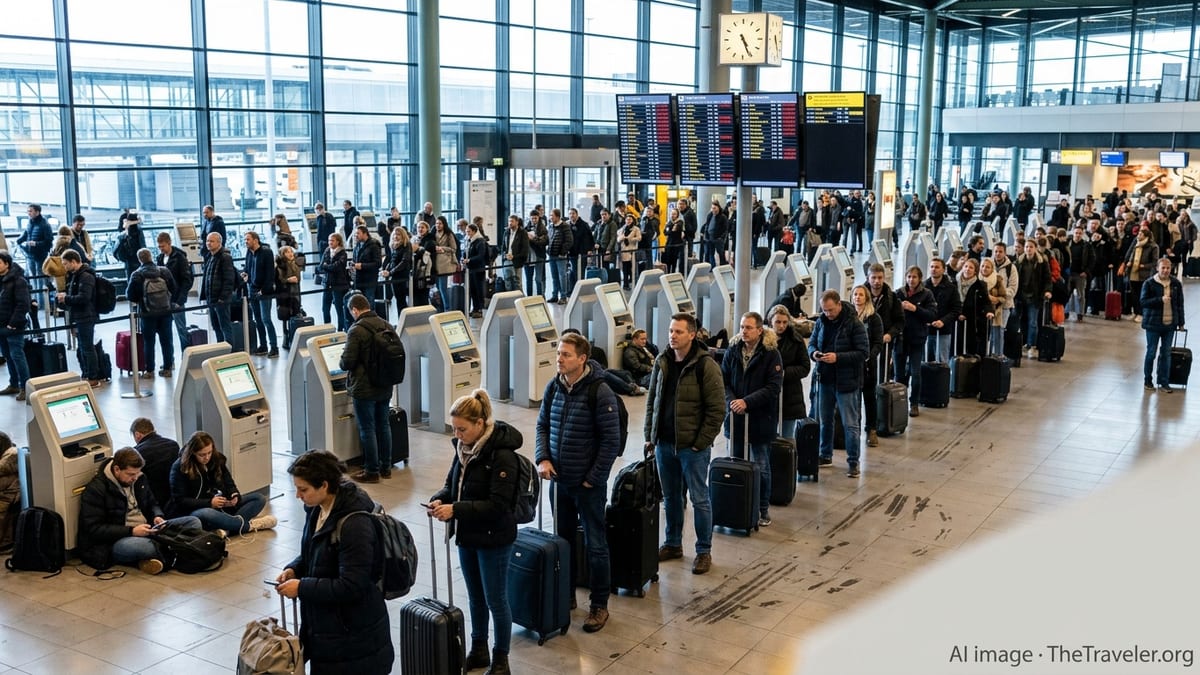
Reports show that the 29 cancellations are concentrated on high-frequency domestic and regional sectors that typically serve business commuters and weekend travellers. With some departures removed from the schedule at short notice and others facing prolonged delays, passengers have encountered long queues at customer-service desks and crowded departure halls while they await rebooking.
Tracking services and publicly available airport statistics point to knock-on effects for onward journeys, as missed connections force travellers to be rerouted via alternative hubs or to defer trips by a day or more. The situation has been particularly challenging for those bound for smaller regional airports, where substitute services are limited and later departures already operate with narrow margins.
Although Copenhagen remains operational, the scale of delays has effectively throttled the airport’s punctuality rate over the course of the day, with the majority of disrupted flights departing well behind schedule. The disruption at this single hub is feeding into a wider pattern of irregular operations across northern Europe over the same weekend.
Multiple Carriers Hit, Led by SAS, Cityjet and Norwegian Air Sweden
Publicly available flight data suggests that Scandinavian Airlines, Cityjet and Norwegian-branded operators are among the most heavily affected at Copenhagen. SAS, which uses the airport as a key hub for both domestic and international operations, has seen several departures to regional cities retimed, merged or cancelled outright as part of the disruption.
Cityjet, which operates regional services in cooperation with larger network airlines, has also been caught up in the irregular operations, particularly on thinner routes where aircraft and crew availability are more constrained. When a single sector is delayed or cancelled, it can leave little flexibility to re-accommodate passengers on later departures, intensifying the impact on travellers heading to or from smaller Nordic cities.
Norwegian-branded services, including those operated by Norwegian Air Sweden, have additionally experienced delays on departures from Copenhagen to neighbouring Scandinavian destinations. The ripple effect of extended turnaround times, crew duty limitations and aircraft rotations has made recovery slower through the day, with some flights departing hours later than scheduled.
Other European carriers serving the Danish capital, including low-cost and full-service airlines, have reported a smaller but still noticeable number of delayed departures as slots, ground handling and air traffic flow are adjusted to cope with the disruption created by the most affected operators.
Routes to Aalborg, Kristiansand, Helsinki and Stavanger Among the Worst Affected
The disruption has been especially visible on intra-Nordic routes that typically rely on frequent, short-hop services from Copenhagen. Flights to Aalborg, one of Denmark’s busiest domestic corridors, have experienced a mix of delays and cancellations, leaving travellers facing extended waits for available seats on later departures or being rebooked via other Danish or regional airports.
Services linking Copenhagen with Kristiansand and Stavanger in Norway have also been hit. These routes, which serve both business travellers and those connecting onward to Norway’s coastal and energy hubs, offer fewer daily frequencies than domestic Danish sectors. As a result, a cancelled flight can translate into hours of additional travel or even overnight stays when seats on replacement services are scarce.
Connections to Helsinki have not been spared either, according to available schedule and tracking information. Delays on these flights can quickly cascade into missed long-haul connections for travellers planning to continue beyond Finland, compounding inconvenience and forcing airlines to arrange complex re-routing via alternative hubs in northern or central Europe.
Regional airports at the receiving end of these routes are consequently experiencing irregular arrival patterns, with clusters of late inbound flights followed by lulls in traffic. This, in turn, may disrupt local ground transport connections such as buses and trains that are normally timed to coincide with scheduled flight arrivals.
Knock-On Effects Across Scandinavia and Wider Europe
The disruption in Copenhagen forms part of a broader pattern of operational challenges across Scandinavia and northern Europe this week, as reported by multiple aviation and travel outlets. Separate coverage has highlighted significant numbers of delays and cancellations at airports in Norway and Sweden, affecting many of the same carriers that have encountered difficulties in Denmark.
Norwegian, SAS and partner operators have been grappling with a combination of factors in recent weeks, including congested schedules, aircraft rotation constraints and variable weather conditions across the region. Public updates on some airline channels have referenced strong winds and adverse conditions in parts of southern Norway, southwestern Sweden and Denmark, which can in turn complicate operations at hub airports such as Copenhagen.
The effect is a web of interconnected delays, where a late arrival into one airport can translate into a delayed departure from another, particularly during peak periods. Even when operations gradually stabilise, residual delays may persist throughout the day as airlines work to reposition aircraft and crews and as air traffic managers balance slot availability with safety and capacity constraints.
At the same time, data from other major European hubs indicates that the strain is not confined to Scandinavia. Recent days have seen elevated levels of disruption at airports in Spain, Italy, the Netherlands and the United Kingdom, underlining the fragility of airline schedules when multiple regions experience operational pressure at the same time.
Travellers Face Long Waits, Rebookings and Limited Alternatives
For individual travellers caught up in the Copenhagen disruptions, the immediate concern has been how quickly they can reach their destinations. With 29 flights cancelled and many more delayed, rebooking options on the same day have in some cases been limited, particularly for those heading to regional airports with modest flight frequencies.
Passenger experiences shared through public forums and social channels from recent disruption events in Denmark and Norway describe long queues at service counters, extended waits for updated departure information and uncertainty around baggage handling when flights are retimed or cancelled outright. In some instances, travellers report being rebooked several days later when nearer-term options are fully booked.
Consumer-rights guidance for European air travel notes that passengers affected by significant delays or cancellations on eligible flights may have entitlements under EU and UK regulations, including rerouting, reimbursement and care such as meals and accommodation in certain circumstances. However, practical access to these measures can vary, especially when many flights are disrupted at once and contact centres and airport desks are under pressure.
With irregular operations at Copenhagen feeding into a wider network of disruptions across northern Europe, travellers planning to fly to or through the Danish capital in the coming days are being advised, in public-facing travel updates, to check their flight status regularly, allow additional time at the airport and consider alternative routings where feasible.