

More news on this day
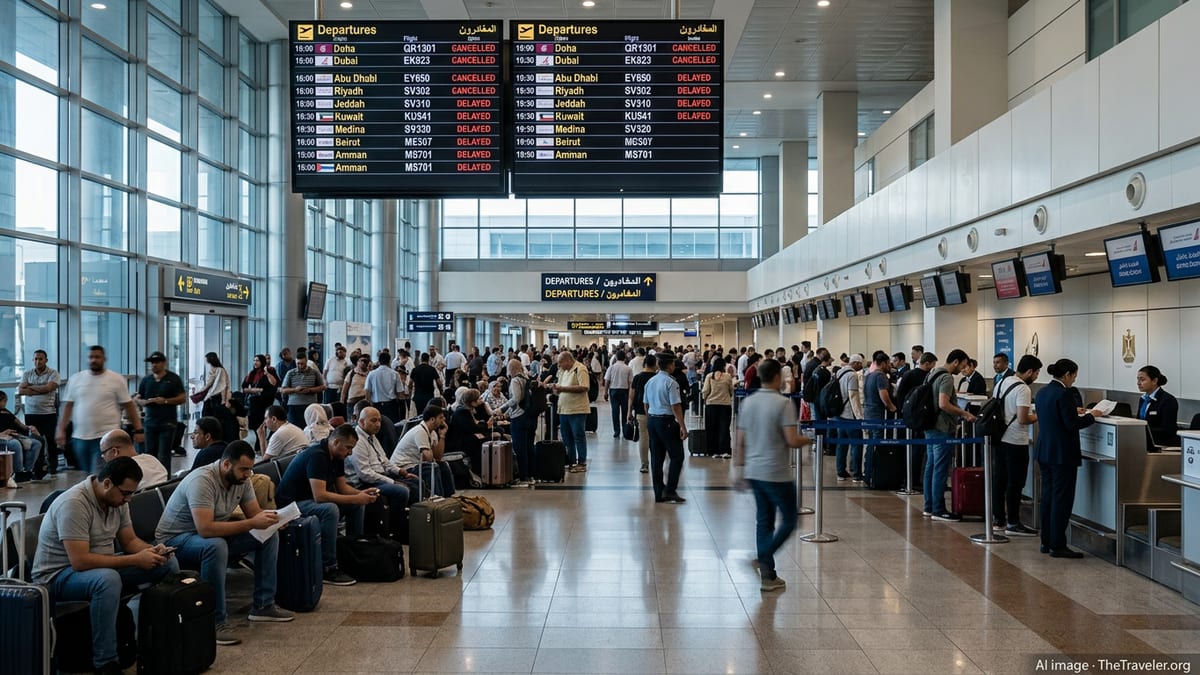
Air travel across Egypt and the wider Middle East entered a new phase of disruption on March 11, 2026, as Qatar Airways, EgyptAir, Gulf Air and several other regional and international carriers cancelled or suspended more than 50 flights linking Cairo and other Egyptian cities with major hubs including Doha, Dubai, Abu Dhabi, Riyadh, Jeddah, Beirut, Kuwait City, Medina and Amman.
Get the latest news straight to your inbox!
Regional Conflict Drives Worsening Flight Disruptions
The latest wave of cancellations is directly tied to the continuing Iran conflict and the resulting web of airspace closures and restrictions stretching across the Gulf, Iraq, Iran and parts of the Levant. Aviation and security authorities in multiple states have imposed severe limits on overflights, forcing airlines either to ground services entirely or to route aircraft on long detours that are often commercially unviable.
Consultancy and government briefings in early March projected thousands of regional flight cancellations in the first weeks of the crisis, with major hubs such as Dubai, Abu Dhabi and Doha among the hardest hit. Egypt’s airspace remains open, but carriers serving the country are deeply exposed to the knock-on effects from neighboring closures, particularly for routes that normally funnel passengers through Gulf megahubs to Asia, Europe and North America.
Industry analysts say the pattern that has now emerged over Egypt is familiar across the region: large-scale cancellations on high-frequency city pairs, selective restoration of “lifeline” services, and an emphasis on ad hoc repatriation missions rather than regular commercial schedules. Travelers, meanwhile, are discovering that even confirmed bookings can be altered or cancelled with little warning as conditions shift by the hour.
Qatar Airways Limits Doha Connections While Operating Relief Flights
Qatar Airways has been at the center of the disruption, after earlier blanket suspensions to and from several neighboring states gave way to a skeletal network of relief and repatriation flights coordinated with the Qatar Civil Aviation Authority. A series of advisories since March 5 confirmed that Hamad International Airport is handling a heavily reduced schedule under temporary authorizations that define narrow safe corridors in and out of Doha.
In recent days the carrier has focused on operating limited services to cities such as Cairo and Jeddah alongside long-haul destinations including London, New York, Frankfurt and Johannesburg, prioritizing stranded passengers and those on essential travel. Passenger guidelines circulated over the past week stress that travelers should not go to the airport unless they hold a revalidated, confirmed ticket on one of the few operating flights.
The impact on Egypt has been acute. Cairo–Doha and Alexandria–Doha rotations, usually among the busiest links for Egyptian workers and families connecting to the wider Gulf and Asia, have seen widespread cancellations, leaving passengers dependent on sporadic rescue flights or costly re-routing via third countries. Travel agents in Cairo report that some customers originally booked through Doha are now being rebooked on entirely different routings via European hubs when seats are available.
EgyptAir, Gulf Air and Other Carriers Slash Services
Egypt’s flag carrier EgyptAir has also enacted sweeping cuts to services that rely on Gulf and Levant airspace. Corporate notices and regional travel bulletins indicate that flights from Cairo to Doha, Abu Dhabi, Manama, Kuwait City and Beirut have been suspended or sharply reduced during the peak period of restrictions, even as domestic operations inside Egypt continue as normal.
Gulf Air, the Bahraini flag carrier, has temporarily suspended most operations in and out of Bahrain, including flights linking Cairo and other Egyptian gateways to the kingdom. The airline has cited regional airspace closures and operational constraints, aligning with decisions by other Gulf-based carriers that have halted or rerouted services involving Abu Dhabi, Dubai, Riyadh and Jeddah.
The squeeze is not limited to Middle Eastern airlines. European and Asian carriers that typically operate to Egypt via Dubai, Abu Dhabi or Doha have cancelled or reshaped their schedules, removing key one-stop options from Egyptian cities to the wider world. British and European carriers have confirmed cancellations on routes serving Dubai, Doha and Amman, in some cases into late March, further constraining choices for Egyptian travelers seeking onward connections.
Passengers Face Cancellations, Long Detours and Complex Rebookings
For travelers, the practical impact is being felt in a cascade of last-minute emails, app notifications and airport announcements as flights are pulled or rescheduled. Reports from Cairo International Airport describe long queues at airline desks as passengers attempt to secure alternative connections to Gulf destinations or to recover the cost of disrupted trips.
Where flights do operate, many are taking extended routings to avoid closed or high-risk airspace, adding hours to journeys between Egypt and cities such as Dubai, Riyadh or Kuwait City. Aviation specialists say detours around the Gulf region and northern Middle East can increase flight times by up to six hours and fuel burn by up to a third, costs that make some routes unsustainable on a commercial basis.
Airlines have introduced varying degrees of flexibility. Several carriers are allowing passengers booked to travel through at least mid to late March to change dates without additional fees or to request refunds, though policies differ by ticket type and point of sale. Travel advisors warn that high demand for the limited remaining seats to Doha, Dubai, Abu Dhabi, Jeddah, Medina, Amman and Beirut is pushing fares upward and leaving many routes sold out days in advance.
What Travelers Need to Do Now
With the situation evolving daily, industry experts and consumer advocates are urging passengers with imminent travel plans involving Egypt and any Gulf or Levant hub to take a proactive approach. That begins with closely monitoring airline apps and direct communications rather than relying on generalized airport departure boards, which may lag behind rapid schedule changes.
Travelers holding tickets on Qatar Airways, EgyptAir, Gulf Air and other affected carriers are being advised to confirm not only that their flight number still appears in the schedule, but that it is actively operating on the day, with a reissued or revalidated ticket. Passengers connecting through hubs such as Doha, Dubai, Abu Dhabi, Riyadh, Jeddah, Kuwait City, Medina, Amman or Beirut are particularly vulnerable to missed onward legs if one segment of their itinerary is cancelled.
Travel consultants also recommend allowing substantially longer connection windows, avoiding separate tickets on different airlines where possible, and considering alternative routings that bypass the most restricted airspace, even if that means additional stops in Europe, North Africa or Asia. Given the prospect of continued instability, many corporate travel managers are temporarily discouraging non-essential trips to and through the affected hubs until airlines can restore more predictable schedules.