

More news on this day
Major flight disruptions at Moscow’s Sheremetyevo Airport and St Petersburg’s Pulkovo Airport have triggered waves of cancellations, delays and diversions, affecting key domestic and international routes and prompting travelers to urgently recheck their itineraries.
Get the latest news straight to your inbox!
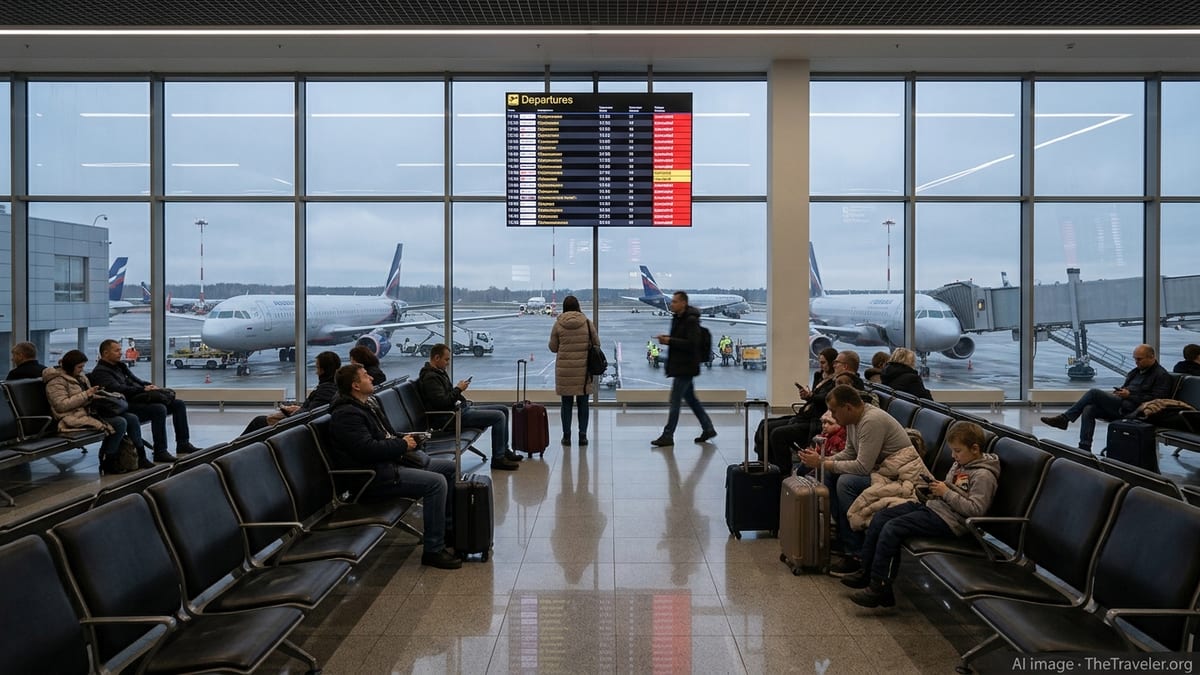
Disruptions Ripple Across Russia’s Two Key Hubs
Publicly available flight-tracking data and media coverage show that Sheremetyevo, Russia’s busiest airport, and Pulkovo, the main gateway to St Petersburg, have both experienced concentrated clusters of cancellations and delays over recent days. The problems have affected morning and evening peaks in particular, when banks of flights are tightly scheduled and turnaround times are shortest.
Reports indicate that dozens of departures and arrivals at both airports have been removed from departure boards or placed into extended holding patterns, with some services ultimately diverted to alternative Russian airports. Passengers at Sheremetyevo have faced rolling gate changes and prolonged waits, while travelers at Pulkovo have reported a sharp increase in flights marked as delayed or canceled within short time windows.
The pattern mirrors earlier episodes of disruption at Russian hubs over the past two years, when waves of operational, technical and security-related issues have temporarily curtailed movements at multiple airports. In this latest spell, the impact has been especially visible because Sheremetyevo and Pulkovo function as central nodes in Russia’s domestic network and as key connection points for the limited range of international services still operating.
Key Routes and Airlines Most Affected
According to published coverage and live schedule boards, the largest concentration of cancellations is appearing on short and medium-haul routes linking Moscow and St Petersburg with other major Russian cities. Services between Sheremetyevo and destinations such as Sochi, Krasnodar, Yekaterinburg and Novosibirsk have seen multiple flights removed from schedules or merged, creating bottlenecks throughout the day.
At Pulkovo, disruptions have been particularly visible on flights to central and southern Russia, as well as on the heavily trafficked corridor connecting St Petersburg with Moscow’s airports. Aircraft have at times been placed in holding patterns south of St Petersburg before either returning to origin or diverting, while other services have remained on the ground awaiting updated departure slots.
On the international side, publicly available information shows a more selective but still significant impact. Routes linking Sheremetyevo and Pulkovo with hubs in Türkiye, the Caucasus and parts of the Middle East have recorded cancellations or substantial delays, complicating onward connections for passengers using these airports as transfer points. In a reduced international network already reshaped by airspace restrictions and airline withdrawals, the temporary loss of even a handful of frequencies can leave travelers with limited alternatives on the same day.
What Travelers Should Do if They Are Booked Through Sheremetyevo or Pulkovo
With schedules shifting rapidly, travelers holding tickets to or from Sheremetyevo or Pulkovo in the coming days are being urged by airlines and airports, via public advisories, to verify their flights repeatedly before departure. Same-day checks are particularly important, as flights that appear confirmed early in the morning have, in some instances, been rescheduled, retimed or canceled closer to departure.
Public guidance from travel operators stresses the importance of using multiple channels: airline mobile applications, official airline and airport information feeds and, where available, text or email alerts linked to a booking reference. These tools typically update faster than printed timetables or third-party listings and can show rebooking options when a flight is disrupted.
Travel industry advisories also recommend allowing significantly more time than usual for connections if an itinerary involves a transfer within Russia. Where practical, passengers are being encouraged to book longer layovers or to consider overnight stops instead of tight same-day connections through Sheremetyevo or Pulkovo, particularly when traveling onward on international legs that may operate less frequently.
Broader Context of Repeated Disruptions at Russian Airports
The latest wave of cancellations at Sheremetyevo and Pulkovo comes against a broader backdrop of recurrent disruptions across Russian air transport. Over the past two years, Russia’s main airports have repeatedly appeared in news reports for suspensions of operations, temporary airspace closures, large-scale delays and sudden timetable changes triggered by a mix of security alerts, drone incidents, cyberattacks and wider operational pressures.
Coverage by international and Russian outlets has previously highlighted episodes in which hundreds of flights across multiple Moscow airports were delayed or canceled within a short period, leaving tens of thousands of passengers stranded or diverted to regional hubs. St Petersburg’s Pulkovo has also periodically faced concentrated disruption windows, during which a significant share of departures and arrivals were delayed or scrubbed in response to external events.
Analysts quoted in open sources have noted that such instability increases pressure on carriers already working with constrained fleets, spare parts challenges and complex airspace restrictions. When a major hub like Sheremetyevo or Pulkovo experiences even a short interruption, the knock-on effects can extend far beyond the day in question, as aircraft and crews fall out of normal rotation and recovery flights must be slotted into already busy schedules.
How to Check If Your Flight Is Affected
For travelers trying to determine whether their specific flight through Sheremetyevo or Pulkovo is affected, the most reliable approach is to cross-check multiple real-time sources. Airline booking pages and mobile apps linked to a reservation code generally provide the earliest formal confirmation of cancellation or retiming, often accompanied by options to accept a new itinerary or request a refund or voucher in line with the carrier’s policy.
Airport departure and arrival boards, both at the terminal and via official digital channels, are another key reference point. These displays show the current status of all movements at Sheremetyevo and Pulkovo and can indicate broader patterns, such as clusters of cancellations for certain airlines or destinations that might signal wider operational issues on a given day.
Travelers can also monitor independent flight-tracking services and aviation data platforms, which often visualize holding patterns, diversions and ground stops around Moscow and St Petersburg. While these tools do not replace official confirmation from an airline, they can offer early situational awareness, especially for those already en route to the airport or in transit.
Given the fluid situation, passengers are advised to keep boarding passes, booking confirmations and receipts readily accessible in case rebooking or accommodation is needed. Travel insurance documents should also be at hand, as some policies provide coverage for extended delays, missed connections or forced overnight stays when flights are canceled for reasons outside the traveler’s control.