

More news on this day
Air travel across Germany is facing another wave of disruption as Gulf Air, Qatar Airways, Lufthansa, and several other major carriers cancel or reroute dozens of flights, hitting key routes to Paris, Doha, London, Stockholm, Tel Aviv, and other European hubs and leaving travelers scrambling for alternatives.
Get the latest news straight to your inbox!
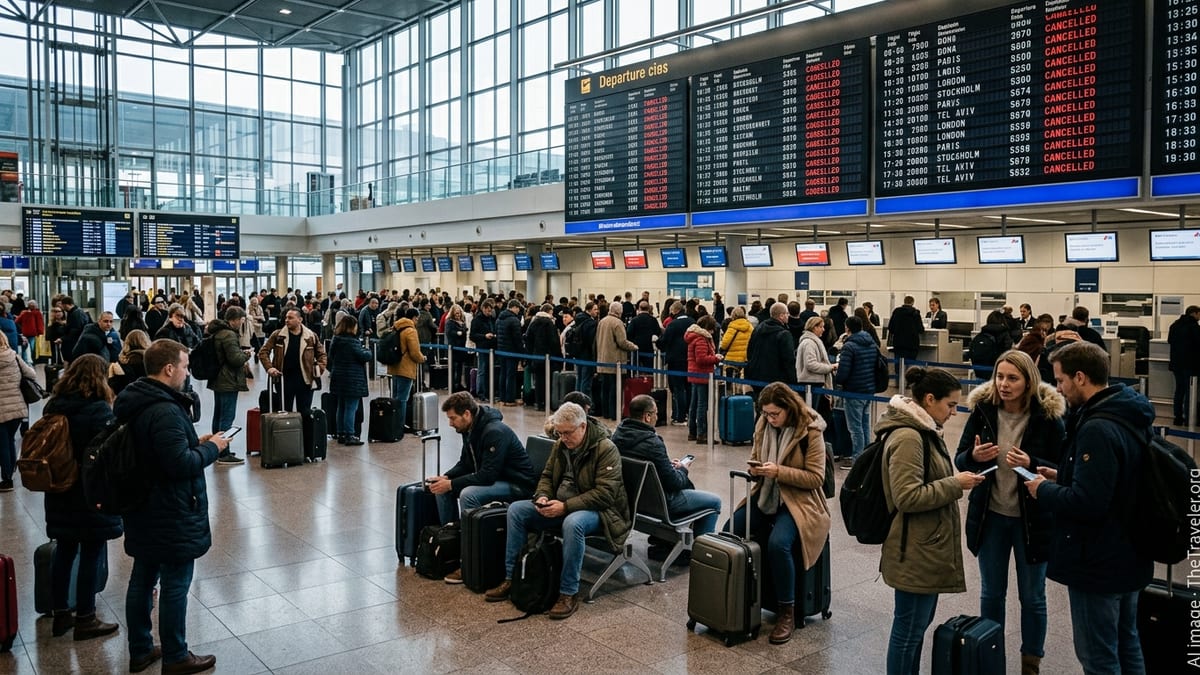
Fresh Cancellations Hit Germany’s Key International Gateways
Germany’s major airports, including Frankfurt, Munich, Berlin, and Düsseldorf, are once again at the center of Europe’s aviation turbulence as multiple long haul and regional services are pulled from schedules at short notice. Publicly available flight-monitoring data and airline advisories show a spike in cancellations and heavily delayed departures on routes linking Germany with major European and Middle Eastern hubs.
Lufthansa and other European carriers have been adjusting timetables for weeks in response to security concerns, operational constraints, and fragile demand patterns on routes touching the eastern Mediterranean and Gulf region. Recent patterns indicate that connections from Germany to Paris, London, Stockholm, and Tel Aviv are among those seeing repeated disruptions, often only confirmed to passengers within days or even hours of departure.
Gulf-based airlines have been particularly affected where routings require overflight of sensitive airspace. Reports indicate that Germany’s role as a key connecting point between Europe and the Middle East has amplified the impact, creating knock on effects for travelers whose journeys originate as far afield as Asia, Africa, and Oceania but pass through German hubs.
For passengers, the result is a patchwork of partial schedules in which some flights run as normal while adjacent departures are suddenly marked as cancelled, forcing last minute rebookings and extended layovers across the network.
Qatar Airways and Gulf Air Struggle With Ongoing Gulf Airspace Constraints
The most severe disruption continues to center on Doha, where Qatar Airways’ global hub is operating under limited conditions. According to published coverage of regional security developments and travel advisories, Qatari airspace closures and restricted corridors have led to widespread suspension of regular commercial services, with only tightly controlled relief or repatriation flights running on select days to cities such as London, Paris, Madrid, Rome, and Frankfurt.
Germany–Doha itineraries have been especially volatile. Online passenger reports describe multiple rounds of cancellations on Frankfurt, Munich, and Berlin services, with some travelers offered new dates days or weeks later and others redirected over alternative hubs in Europe or Asia. In several cases, outward legs between Germany and Doha have been cancelled even while connecting segments to onward destinations remained loaded in booking systems, creating confusion over which parts of an itinerary would actually operate.
Gulf Air services have faced similar headwinds, particularly on routes to and from Bahrain that rely on predictable overflight permissions and stable regional routings. Publicly available timetables and travel agent advisories show trimmed frequencies and ad hoc cancellations on certain Germany–Gulf rotations, with aircraft and crews redeployed to shorter or more secure sectors where demand remains robust.
For travelers trying to reach Doha or connect onward to Asia, Africa, and Australia, the combination of constrained Qatari airspace and reduced Gulf Air and Qatar Airways schedules has sharply limited options from German airports, driving up loads and prices on remaining seats via rival hubs.
Lufthansa and European Partners Cut Tel Aviv and Wider Middle East Capacity
Lufthansa Group, which includes SWISS, Austrian Airlines, and Brussels Airlines, has also scaled back operations on routes touching the eastern Mediterranean and Middle East. According to widely reported schedule updates, the group previously suspended flights to Tel Aviv and other destinations in the region in response to deteriorating security conditions, and has extended or deepened some of those cuts into 2026.
Germany–Tel Aviv flights have largely vanished from near term schedules, affecting not only Lufthansa but also partner and competitor airlines that rely on code sharing and shared feed from German hubs. Capacity reductions have spilled over into adjacent markets such as Amman, Beirut, and Gulf gateways, as carriers prioritize aircraft for more stable and profitable European and North Atlantic routes.
These changes have had direct repercussions for passengers departing Germany en route to Paris, London, and Stockholm when their journeys are tied to onward connections into the affected region. Even where the intra European leg remains scheduled, cancellations further down the line often trigger full itinerary reissues, leaving travelers in Germany without their originally planned departure.
Public schedules indicate that some carriers continue to operate limited services into the wider Middle East, but with altered routings, longer flight times, and frequent day of flight changes. Travelers departing from German airports are being warned, via airline and airport messaging, to treat all bookings involving Tel Aviv and neighboring markets as subject to late change.
Knock On Disruptions Across Europe: Paris, London, Stockholm, and Beyond
While much of the attention has focused on Germany’s role, the ripple effects are now clearly visible in other European hubs. Flight tracking data shows irregular patterns on services connecting Paris Charles de Gaulle, London Heathrow, Stockholm Arlanda, and other major airports with German cities, especially where those flights are timed around long haul departures to Doha, Tel Aviv, or other high risk destinations.
In Paris and London, banks of flights that usually funnel passengers onto Gulf and Levant routes are now operating with altered timings or in some cases not at all, as airlines adjust to the absence or reduction of downstream connections. Stockholm and other northern European airports are seeing smaller but noticeable disruptions, with some departures to Germany cancelled outright and others merged to consolidate demand onto fewer frequencies.
These schedule changes can be subtle on paper but significant in practice. A single cancelled Frankfurt service from Paris or London, for example, can strand passengers whose onward long haul flights are still operating, forcing them into overnight stays or multi leg reroutings via third countries. For those traveling on tight business or event related timelines, particularly to major gatherings in the Gulf region, these lost hours and additional stops are proving costly.
The network effect means that even travelers whose final destination is within Europe but whose ticket was built around a Gulf or eastern Mediterranean connection can find their German and intra European sectors reshuffled with little warning, underscoring the interconnected nature of modern airline scheduling.
What Travelers Using German Airports Should Expect Next
Looking ahead to the coming days, publicly available airline statements and booking engine data suggest that schedules into and out of Germany will remain fluid, particularly for any routing involving Doha, Tel Aviv, or nearby airspace. Some carriers have loaded tentative flights into reservation systems while keeping them flagged for potential cancellation pending security and operational assessments.
Passengers booked on Gulf Air, Qatar Airways, Lufthansa, and their partners are being advised through airline channels and travel agency communications to monitor their reservations frequently, use mobile apps for real time status checks, and ensure contact details are up to date so that schedule changes and rebookings can be communicated quickly.
Travel experts note that under European air passenger rights rules, travelers departing from EU airports generally enjoy protections including re-routing and, in some cases, compensation, although security related disruptions and extraordinary circumstances may limit eligibility. Even where compensation does not apply, airlines operating from Germany are typically responsible for finding alternative transport or offering refunds when they cancel a flight.
For now, the safest assumption for anyone planning to travel through German airports on routes touching the Gulf, Tel Aviv, or neighboring regions is that conditions may change with little notice. Flexible tickets, additional connection time, and backup routing ideas via alternative hubs such as Amsterdam, Zurich, or Istanbul can help reduce the risk of severe disruption as airlines continue to reshape their schedules day by day.