

More news on this day
Hundreds of passengers were left in limbo at Doha’s Hamad International Airport as widespread disruption led to 42 flights being cancelled and at least 61 delayed, affecting services operated by Qatar Airways, Royal Jordanian, Virgin Australia and several other carriers on key routes to Europe, the Middle East and Asia.
Get the latest news straight to your inbox!
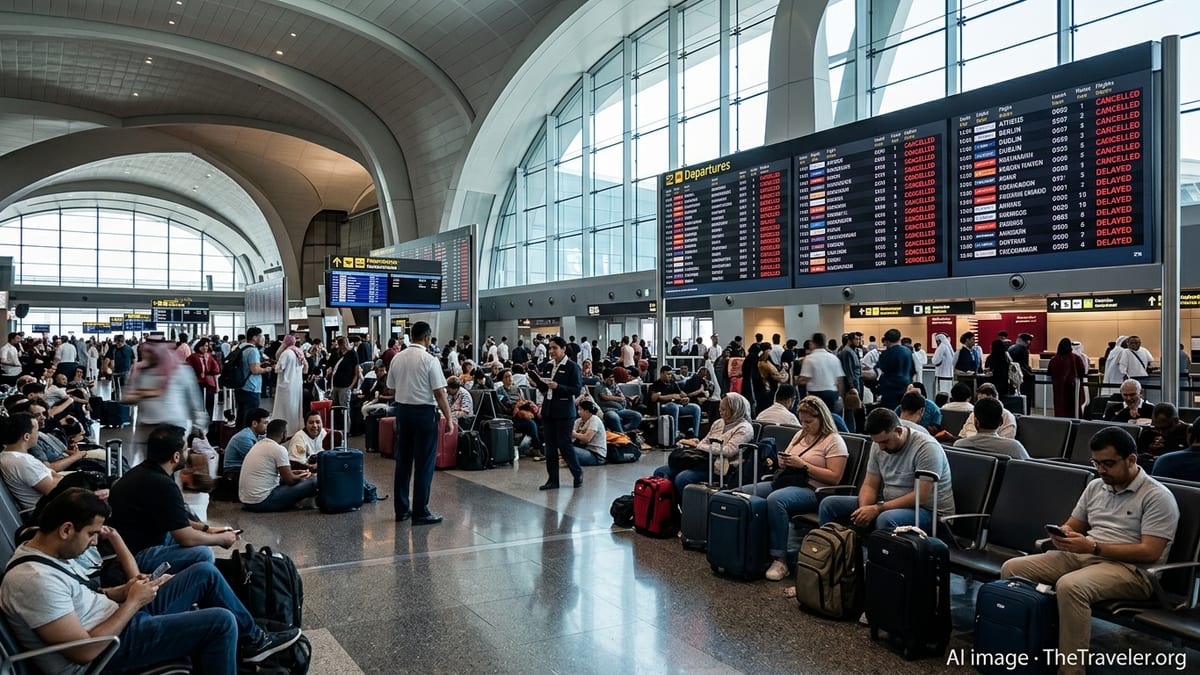
Severe Disruption Hits a Major Global Hub
The latest disruption at Hamad International Airport has rippled across one of the world’s busiest transit hubs, interrupting tightly timed connections and leaving transit passengers facing long waits in crowded terminals. Publicly available flight-tracking data and passenger reports indicate that dozens of departures and arrivals were either grounded or significantly delayed within a short period, compounding existing operational pressure on airlines already managing regional airspace constraints.
The impact has been particularly acute for travellers relying on Doha as a connecting point between Europe, the Middle East and the Asia Pacific region. With multiple services cancelled outright and others pushed back by many hours, passengers reported missed onward connections, unexpected overnight stays and difficulties securing alternative routes at short notice.
While the specific mix of causes varies across airlines and destinations, the pattern of disruption reflects how quickly operations at a centralised hub can become strained when schedules are tightly banked and contingency capacity is limited. Once cancellations begin to cascade, crews and aircraft are displaced, making recovery more complex and prolonging delays well beyond the initial shutdown window.
Europe Routes to Athens, Berlin and Dublin Among the Worst Hit
Routes between Doha and major European cities such as Athens, Berlin and Dublin have been among those most visibly affected. Travellers connecting between Australia or Asia and these European gateways rely heavily on Doha as a mid-point, and publicly shared itineraries show numerous journeys being rebooked through alternative hubs or postponed by several days.
Passengers attempting to reach Berlin and Dublin reported repeated cancellations and rebooking attempts, with some accounts describing being offered new itineraries two or more days later due to the lack of available seats. This has been particularly challenging for those starting their journeys in cities with limited long-haul options, such as Melbourne, where alternate routings to Europe are often more expensive or already heavily booked.
Services to Athens also faced knock-on effects, with itineraries involving Doha experiencing extended delays or re-routing via different European gateways. For many travellers, this has translated into total journey times stretching well beyond 24 hours, as well as added costs for accommodation, meals and ground transport when travel insurance or airline policies did not fully cover incidental expenses.
Regional Connections to Katunayake and Beyond Disrupted
The disruption has not been limited to Europe-bound routes. Flights between Doha and regional destinations such as Katunayake, the international gateway for Colombo in Sri Lanka, have also seen schedule changes and cancellations. As a key transit point linking South Asia to the Middle East and onward to Europe and Australia, Doha’s reduced capacity quickly translated into fewer available seats and tighter connection windows for travellers heading to or from Sri Lanka.
Published aviation data and recent airline schedules show that services into Bandaranaike International Airport have had to adjust to evolving regional airspace advisories and altered routings, leaving little room for additional capacity when a hub like Doha experiences a concentrated day of cancellations and delays. For passengers, this has meant longer waits for the next available flight and, in some cases, the need to accept complex itineraries involving multiple stops.
Neighbouring routes across the Gulf and wider Middle East have also felt the strain, as airlines attempt to reposition aircraft and crews and prioritise certain long-haul sectors. Even when flights are technically operating, altered routings and air traffic control restrictions can extend flight times, further stretching already disrupted schedules.
Multiple Airlines, Shared Challenges
The disruption has affected a mix of carriers that rely on Doha as either a primary hub or a key partner gateway. Qatar Airways, the dominant operator at Hamad International Airport, has faced the brunt of schedule changes as it attempts to manage a global network whose flows are heavily concentrated through Doha. Reports from recent days describe a combination of cancelled services, heavily delayed departures and a gradual introduction of limited repatriation-style flights on selected long-haul routes to help clear backlogs.
Royal Jordanian, which uses Doha for certain connecting traffic in coordination with regional partners, has also been drawn into the broader network disruption. Published coverage on wider Middle East flight issues highlights how carriers based in Jordan and elsewhere have been forced to re-time or reroute services in response to shifting airspace conditions, indirectly adding pressure to shared hubs such as Doha.
Long-haul operators including Virgin Australia that interline with Qatar Airways for onward connections through Doha have seen their passengers particularly exposed when the Doha segment is cancelled. In these cases, travellers may find the first leg of their trip operating as scheduled but face uncertainty over how and when they will be able to complete their journey if the connecting sector from Doha is not available.
Passengers Face Long Queues, Complex Rebookings and Policy Confusion
Accounts shared publicly by affected travellers describe crowded terminals, long queues at transfer and ticketing desks and extended waits for information on new travel arrangements. With hundreds of passengers simultaneously seeking rebooking options, airport staff and airline call centres have struggled to keep pace, and some travellers report spending many hours in line before receiving updated itineraries.
Rebooking has been complicated by limited spare capacity on alternative flights, especially on popular routes between Australia and Europe and on regional services during peak travel periods. Even when airlines make additional flexibility available, such as temporary free cancellation windows or expanded options to re-route via different hubs, passengers still depend on seat availability and the willingness of carriers to endorse tickets onto partner or non-partner airlines.
Confusion over eligibility for accommodation, meal vouchers and alternative routes has also been a recurring theme in passenger reports. Policies can differ depending on the airline, the length and cause of the delay, and whether a journey was booked directly or through a third party. As a result, travellers on similar itineraries have sometimes encountered very different outcomes regarding support and compensation.
For now, publicly available information suggests that operations at Hamad International Airport remain in a gradual recovery phase, with airlines working through backlogs of displaced passengers while continuing to navigate regional operational constraints. Travellers with upcoming itineraries involving Doha are being urged, through airline updates and online travel forums, to monitor their flight status closely, allow extra time for connections, and consider flexible alternatives where possible.