

More news on this day
Thousands of travellers were stranded across Europe and beyond on Sunday as severe disruption at Amsterdam Schiphol and Paris Charles de Gaulle led to 474 delayed and 54 cancelled flights, snarling operations for carriers including KLM, Qatar Airways, Saudia and Air Canada and triggering missed connections from Dubai and Frankfurt to Manchester, Oslo and other key hubs.
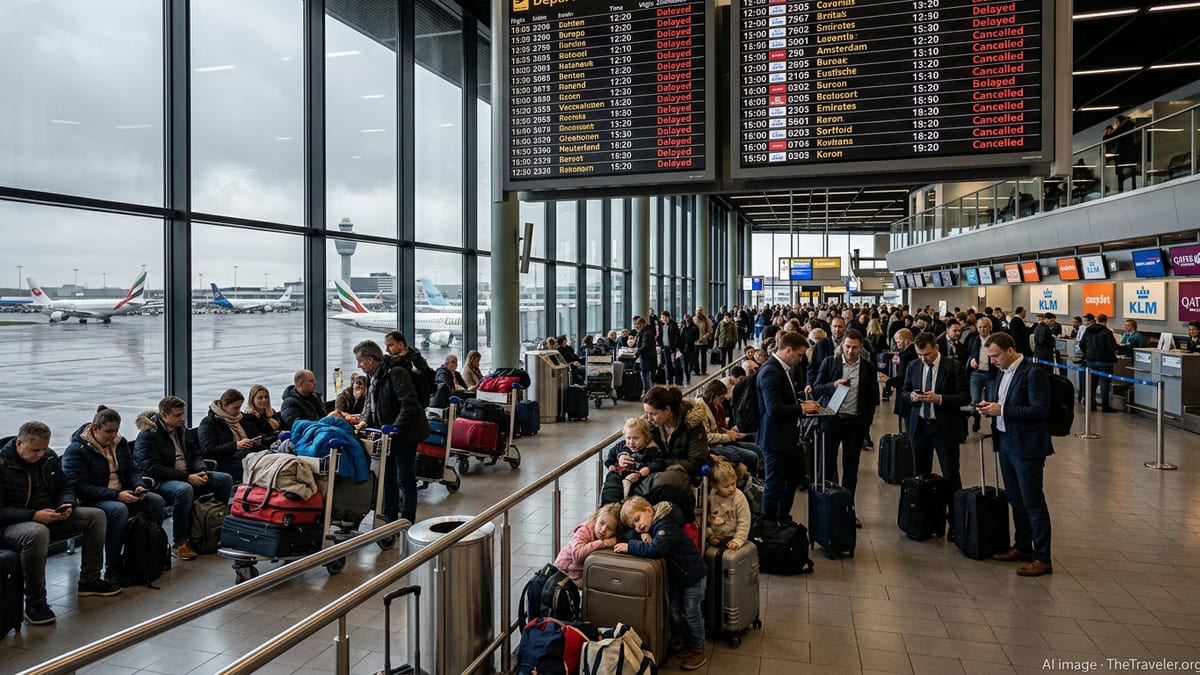
Amsterdam and Paris CDG Struggle With Heavy Disruptions
Amsterdam’s Schiphol Airport, one of Europe’s busiest transfer hubs, reported the bulk of the impact, with hundreds of delayed departures and arrivals creating rolling queues at security, check in and rebooking desks. Airport information screens showed wave after wave of late-running services across Europe, the Middle East and North America, with some departures pushed back by several hours.
Paris Charles de Gaulle, France’s primary international gateway, also reported a sharp spike in delays and a cluster of outright cancellations. While disruption there was less severe than in the Netherlands, the complicated web of codeshares and onward connections meant that even short delays in Paris cascaded into missed flights later in the day, especially on long haul routes.
Operational pressures, residual weather issues earlier in the week and capacity constraints across key European corridors all contributed to the disruption. Airlines said they were working to restore schedules, but acknowledged that knock on effects would likely persist into Monday as aircraft and crews remained out of position.
Flag Carriers and Gulf Airlines Hit Hard
KLM, the Dutch flag carrier and Schiphol’s dominant airline, bore much of the immediate impact. With a dense schedule of short haul European flights feeding its long haul network, delays early in the morning quickly spread across the system. Aircraft destined for North America, the Middle East and Asia were held up awaiting inbound connections, leaving passengers facing extended waits in crowded departure halls.
Qatar Airways and Saudia were among Gulf and Middle Eastern carriers affected on services linking Amsterdam and Paris with Doha, Riyadh and Jeddah. These routes are key connectors for travellers heading onward to Asia and Africa, and delays there rippled across multiple time zones. Some passengers arriving late into Doha and Riyadh found their onward flights had already departed, forcing rebookings for the following day.
Air Canada also reported disruptions on transatlantic services routed through Amsterdam and Paris. With peak season load factors already high, finding spare seats for stranded passengers proved challenging, especially for those travelling in groups or with complex itineraries that combined multiple airlines on a single ticket.
Global Ripple Effects From Dubai to Oslo
The operational chaos in the Netherlands and France was quickly felt far beyond Europe. Flights from Dubai and other major hubs heading to Amsterdam and Paris were held on the ground or slowed en route as air traffic control and ground handlers tried to ease congestion at arrival banks. That, in turn, put pressure on already stretched airport operations in the Gulf, where crews and aircraft work to tight turnaround windows.
Frankfurt, Manchester and Oslo were among the European cities reporting secondary disruption as passengers missed their onward connections from Schiphol and Charles de Gaulle. Airlines scrambled to rebook customers onto later departures, adding extra strain to services that were already close to full. In some cases, travellers were re-routed via entirely different hubs such as London Heathrow or Zurich in an effort to get them closer to their final destination.
Industry analysts noted that Europe’s tightly interconnected hub and spoke system is particularly vulnerable when two major nodes experience problems on the same day. A relatively small number of cancellations and a few hundred delays at a pair of large airports can quickly translate into widespread schedule instability across the continent and beyond.
Passengers Face Long Queues and Limited Options
Inside the terminals, the disruption translated into long lines at customer service counters and transfer desks as travellers sought rerouting, hotel vouchers and meal assistance. With many airlines prioritising digital self service, call centres and mobile apps were also overwhelmed, leaving some passengers refreshing their screens for hours while seats on alternative flights quickly disappeared.
Families with young children and elderly travellers were among the worst affected, with reports of people sleeping on benches or airport floors while awaiting new departure times. Staff circulated with water and snack vouchers in some areas, but many stranded passengers complained of limited information and fast changing estimates on when their flights might finally leave.
Travel rights experts reminded passengers flying from or within the European Union that they may be entitled to compensation or reimbursement under EU261 rules, depending on the cause and length of the delay or cancellation. However, they also cautioned that claims can take weeks or months to process, particularly after large scale disruption when airlines face a surge of requests.
Airlines Race to Reset Schedules
By late afternoon, operations teams at KLM, Air France and their alliance partners were working to reassemble aircraft rotations and crew rosters for the coming days. Priority was given to reuniting disrupted passengers with their checked baggage and to operating key long haul departures that would otherwise leave travellers stranded far from home.
Carriers signalled that they would deploy larger wide body aircraft on selected routes where possible, in an attempt to clear the backlog, and would open limited additional seats for rebookings on partner airlines within their alliances. Nevertheless, the combination of high seasonal demand and ongoing instability elsewhere in the global network meant that some travellers were warned they might not depart until one or two days later than planned.
Airports and airlines urged passengers with upcoming departures from Amsterdam or Paris to check their flight status regularly and to allow extra time at the airport. With aircraft and crews scattered across multiple regions after a day of disruption, flight schedules for Monday were expected to operate, but with continued pockets of delay until networks could fully recover.