

More news on this day
Hundreds of travelers across Saudi Arabia, the United Arab Emirates, Kuwait and Egypt are facing mounting frustration after at least 77 flights were terminated and more than 80 delayed in a new wave of Middle East aviation disruption affecting Saudia, Etihad, Oman Air and EgyptAir.
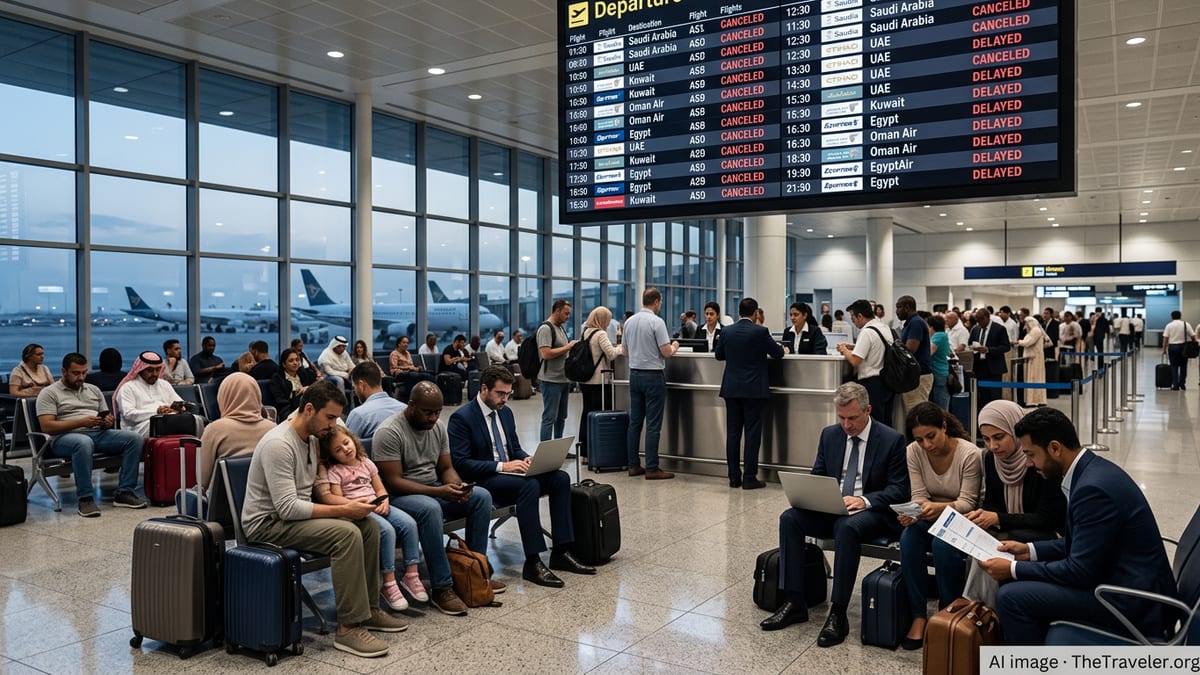
Conflict-Driven Airspace Closures Paralyze Key Hubs
The latest round of cancellations comes as the wider Middle East conflict continues to reshape airspace maps across the region. In recent days, large sections of airspace over the Gulf and parts of the Levant have been closed or heavily restricted, forcing airlines to ground services, reroute aircraft and trim already reduced schedules. Authorities in Saudi Arabia, the UAE, Kuwait and Egypt have all confirmed operational constraints, with airports that normally function as high-capacity transfer points now operating at a fraction of their usual throughput.
While total cancellations number in the thousands across the region since late February, the current tally of at least 77 terminated and 80 delayed flights tied specifically to Saudia, Etihad, Oman Air and EgyptAir reflects the acute pressure on national and regional carriers trying to maintain viable networks. Short-notice airspace notices to airmen, shifting security assessments and intermittent clearance windows have made reliable scheduling extremely difficult, according to regional aviation analysts and airport officials.
In practice, that has translated into rolling waves of disruption on core routes linking Jeddah, Riyadh, Dammam, Abu Dhabi, Dubai, Muscat, Kuwait City and Cairo with major markets in Europe, South Asia and North Africa. Flights that do operate are often flying longer routings to skirt no-fly zones, adding hours to journey times and further straining aircraft and crew availability.
The knock-on effect is being felt far beyond the Middle East. Airlines across Europe and Asia that rely on Gulf and Red Sea hubs to connect long-haul passengers are reporting missed connections, diversions and aircraft stranded out of position, amplifying the impact of each cancellation well beyond the immediate region.
Saudia, Etihad, Oman Air and EgyptAir Forced to Trim Networks
Flag carrier Saudia has been among the hardest hit, with multiple daily services to Gulf neighbors and key regional capitals canceled or truncated as Saudi airports adjust to evolving airspace constraints. Industry data indicate that dozens of Saudia flights to destinations such as Dubai, Abu Dhabi, Kuwait City and select Levant routes have been suspended over the past several days, with at least a portion of those falling within the latest 77 terminated flights figure.
Etihad Airways, based in Abu Dhabi, has likewise been operating on a restricted schedule, prioritizing a limited number of trunk routes while canceling a series of short-haul services around the Gulf and to nearby conflict-affected areas. The carrier has advised passengers that its flight program remains subject to rapid change and has urged travelers to verify their flight status immediately before leaving for the airport, noting that further cancellations and delays are possible as authorities reassess risk.
Oman Air, which traditionally plays a key role linking Muscat with Gulf, South Asian and European destinations, has also cut back flying in response to regional airspace closures. Routes to Kuwait, the UAE and select Middle Eastern cities have seen a cluster of terminations and extended delays, with some aircraft redeployed to maintain longer-haul services viewed as strategically critical. Aviation tracking data show that Oman Air has canceled a number of flights touching Saudi Arabia and Kuwait, adding to the tally of disrupted operations affecting travelers in those countries.
EgyptAir, operating from Cairo, has fared somewhat better in terms of overall network integrity but has still been forced to cancel and delay flights that traverse or approach restricted corridors. Several services connecting Egypt to the Gulf have been adjusted or scrapped entirely on particular days, particularly those that would normally route through or near currently sensitive airspace. The airline has emphasized that safety considerations remain paramount and that schedules will continue to be reviewed on a rolling basis.
Airports in Saudi Arabia, UAE, Kuwait and Egypt Under Strain
On the ground, airports across the four affected countries are grappling with the practical consequences of rapid-fire operational changes. In Saudi Arabia, Jeddah and Riyadh have seen dense crowds forming around airline service desks as passengers attempt to rebook flights or secure hotel vouchers after cancellations announced within hours of departure. While operations in parts of Saudi airspace remain open, the country’s role as both an origin and alternate routing point has led to fluctuating volumes and sudden surges at key terminals.
In the UAE, Dubai and Abu Dhabi have been operating with reduced schedules, following days of widespread cancellations and diversions after regional airspace was partially shut. Terminal departure boards at both airports continue to show a patchwork of statuses, with sequences of red "canceled" notifications punctuated by a smaller number of on-time and delayed flights. Airport managers say that ground handling teams are stretched, as they simultaneously process stranded travelers from earlier cancellations and manage boarding for newly reinstated limited services.
Kuwait International Airport has been contending with its own mix of grounded aircraft and constrained departures, particularly on routes operated by regional partners such as Saudia, Oman Air and select Etihad and EgyptAir codeshares. Travelers report long queues at immigration and transfer counters as passengers whose onward flights have been scrapped attempt to enter the country or find alternative connections, often with little clarity about when regular operations might resume.
Cairo International Airport, one of Africa’s busiest hubs, remains comparatively more active but is still feeling the strain as EgyptAir and partner airlines work around partial restrictions in neighboring airspace. Some inbound flights have been delayed on approach while air traffic controllers sequence traffic from rerouted corridors, and outbound passengers have been advised to arrive early in anticipation of longer check-in and security times linked to the broader regional security posture.
Passengers Face Long Waits, Limited Alternatives and Uncertain Timelines
For passengers, the numbers behind the 77 terminated and 80 delayed flights are manifesting as long hours on terminal floors, improvised overnight stays and a patchwork of rebooking options that can change by the hour. Many travelers describe receiving multiple schedule changes and then final cancellation notices within a single day, particularly for short-haul flights that airlines are more willing to cut in order to preserve limited long-haul capacity.
Rebooking has proved especially difficult for those traveling between secondary cities in the region, who often rely on a combination of Saudia, Oman Air or Etihad feeder services to link with major international flights. With those feeders heavily disrupted, travelers are being pushed onto a shrinking list of remaining services or advised to consider ground transfers to alternative airports in Saudi Arabia or Egypt that still have outbound capacity. That option, however, is not feasible for all, particularly families or those without valid visas for multiple countries.
Travel agents and call centers in Riyadh, Dubai, Kuwait City and Cairo report being inundated with requests as people scramble to salvage travel plans. Some airlines are offering flexible change policies and fee waivers, but seat availability remains a significant constraint. In many cases, the earliest rebooking options are several days out, and even those flights are flagged as "subject to change" as security and airspace assessments continue.
For now, authorities and carriers are urging patience and emphasizing that safety considerations will override schedule commitments for the foreseeable future. With the regional security situation still evolving and airspace restrictions under constant review, passengers across Saudi Arabia, the UAE, Kuwait and Egypt are being told to brace for continued uncertainty and to rely on real-time flight status checks rather than printed itineraries.