

More news on this day
More than 1,230 flights were delayed across major Australian airports in March 2026, as a combination of severe weather on the east coast, knock-on impacts from Middle East airspace disruptions and long-standing capacity constraints left travellers facing queues, missed connections and extended time on the tarmac.
Get the latest news straight to your inbox!
High Winds and Storms Batter the East Coast Hubs
Australia’s busiest gateways bore the brunt of March’s disruption, with Sydney and Brisbane recording repeated bouts of weather-related delays. Publicly available aviation data and traveller reports indicate that several peak travel days in late March were affected by strong winds and low cloud, prompting ground stops, runway changes and tighter spacing between arrivals and departures.
At Sydney Airport, high winds on March 27 led to widespread schedule slippage, with domestic services on popular routes such as Sydney to Brisbane and Sydney to Melbourne facing average ground delays of more than two hours, according to flight-tracking snapshots and passenger accounts. These conditions limited runway configurations and reduced the number of movements per hour, forcing airlines to push back departure times or hold aircraft at gates.
Further north, Brisbane experienced its own weather challenges earlier in the month, adding to the overall tally of disrupted services. Short but intense storm cells around the city created brief closures of arrival corridors and contributed to reactionary delays for flights arriving from and returning to southern capitals. As aircraft arrived late into Brisbane, turnarounds for outbound sectors lengthened, compounding delays throughout the day.
These local weather events came during a period of elevated demand around major events and school holiday travel, meaning that even modest reductions in capacity translated into large numbers of delayed passengers. With limited slack in airline schedules, the system had little room to absorb disruption once the first wave of delays took hold.
Global Airspace Turmoil Ripples into Australian Schedules
The March disruption was not solely a domestic issue. Turmoil in Middle East airspace, including missile and drone attacks reported in regional coverage, led to extensive cancellations and rerouting of flights through Dubai and other Gulf hubs. International reports described thousands of passengers stranded in the region as major carriers temporarily halted or reconfigured services.
Australia’s long-haul links to Europe and parts of Africa are heavily dependent on connections through Gulf and Asian hubs. When airlines such as Emirates, Qatar Airways and other carriers adjusted or suspended services through Dubai and surrounding corridors, passengers travelling from Australian cities found themselves facing missed onward connections, last-minute rebookings and extended layovers.
Publicly available information shows that some Australia to Europe itineraries were lengthened or rerouted via alternative hubs, while a small number of long-haul flights were cancelled outright over safety and routing concerns. Even when flights departed from Australian airports broadly on time, the uncertainty over arrival slots and onward connections added to the perception of disruption among travellers.
The combination of overseas airspace restrictions and domestic operational pressures underscored how interconnected Australia’s aviation network has become. A disruption thousands of kilometres away could quickly translate into delayed departures from Sydney, Melbourne, Perth or Adelaide as airlines adjusted aircraft rotations and crew schedules on short notice.
Strain on Airline Operations and Passenger Experience
Operational data and passenger feedback indicate that the wave of delays exposed underlying fragilities in airline and airport resourcing. Years of lean staffing models and tight turnarounds have left limited margin for error when conditions deteriorate, whether due to weather, congestion or overseas events.
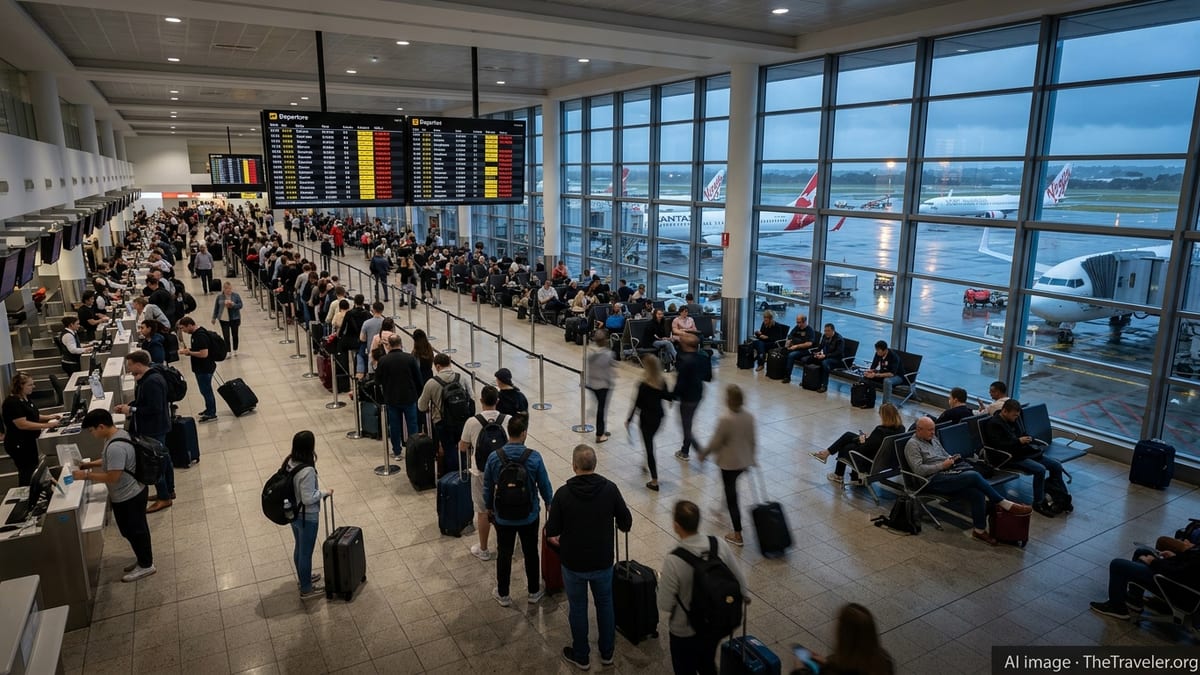
Reports from travellers in March 2026 described long queues at check-in and security in some terminals during morning and evening peaks, as well as crowded gate areas when departure times were repeatedly pushed back. With aircraft arriving late from previous sectors, ground handling teams faced compressed windows to turn jets around, increasing the likelihood of further slippage as baggage, catering and cleaning competed for time.
Airlines sought to minimise outright cancellations by operating delayed services where possible, which contributed to the tally of more than 1,230 late departures and arrivals across the network. While this approach helped keep many itineraries technically intact, it also meant passengers arrived at their destinations hours behind schedule, often missing rail connections, hotel check-in windows or business commitments.
In some cases, long delays triggered the need for overnight accommodation and meal support. Publicly available policy documents and commentary on Australia’s planned passenger rights charter highlight that, while assistance and rebooking are expected, cash compensation for delays is not currently standard practice, leaving many travellers bearing indirect costs such as lost time and disrupted plans.
Regulatory Focus on On-Time Performance and Passenger Rights
The disruption in March 2026 unfolded against a backdrop of growing scrutiny of airline punctuality and passenger protections in Australia. Government transport statistics for recent years have already documented relatively high levels of delays and cancellations across the domestic network, prompting calls from consumer advocates and some policymakers for stronger safeguards.
Submissions to federal reviews and publicly released discussion papers in 2024 and 2025 signalled an intention to introduce a formal passenger rights framework. Draft proposals emphasised clearer obligations for airlines to provide rebooking options, refunds and basic care such as meals and accommodation when flights are significantly delayed or cancelled for reasons within an airline’s control.
The spike in delays during March 2026 is likely to intensify debate over how far such protections should extend and whether Australia should move closer to compensation regimes in place in parts of Europe. Industry bodies have previously warned that any new scheme must balance consumer rights with the operational realities of a geographically isolated country prone to weather volatility and long-haul operations.
For regulators and policymakers, the latest disruption offers a fresh dataset on how airlines, airports and passengers cope during periods of elevated stress. Observers will be watching closely to see whether March’s performance accelerates the timeline for implementing a more robust passenger rights code.
Outlook for the Australian Aviation Network
Looking ahead, analysts note that many of the drivers of March’s disruption are unlikely to disappear quickly. Seasonal weather patterns along the east coast will continue to pose challenges during stormy periods, while global geopolitical tensions and shifting airspace restrictions may keep long-haul routings in flux.
At the same time, infrastructure and capacity upgrades are gradually coming into focus. New airports and terminal expansions, including the development of curfew-free facilities in Western Sydney and ongoing improvements at existing hubs, are intended to provide additional flexibility and resilience once they come online later in the decade.
Airlines are also adjusting their networks and fleet strategies, reshaping long-haul services and adding capacity on trunk domestic routes in response to sustained demand. If accompanied by investments in staffing, ground handling and air traffic management, these changes could help the system absorb shocks more effectively than it did in March 2026.
For travellers, the events of March serve as a reminder of the importance of flexible itineraries, adequate connection times and comprehensive travel insurance, particularly when journeys rely on multiple international hubs. While more than 1,230 delayed flights represent a difficult month for Australia’s aviation network, they also provide a clear impetus for reforms aimed at making future disruptions less frequent and less painful for passengers.