

More news on this day
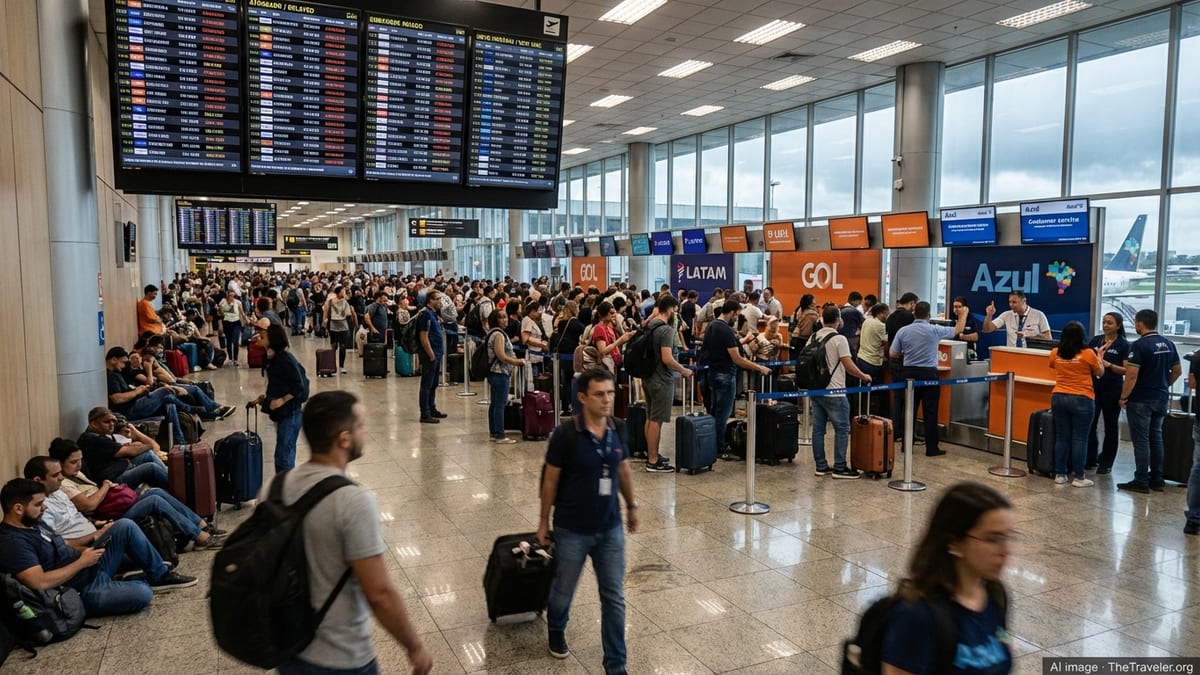
Hundreds of travelers were left waiting in crowded terminals on February 25 and 26 as widespread delays and cancellations at Belo Horizonte’s Tancredo Neves/Confins and São Paulo-Guarulhos international airports disrupted at least 141 flights and grounded services operated by Gol, LATAM, Azul, Air France and other carriers across Brazil’s busiest air corridors.
Weather and Technical Issues Converge on Brazil’s Busiest Hubs
According to operational data compiled over Tuesday and Wednesday, the disruption was triggered by a combination of adverse weather, temporary air traffic control restrictions and overnight technical glitches affecting traffic flows into southeastern Brazil. These factors slowed the capacity of control centers to sequence arrivals and departures at both Guarulhos, the country’s largest international gateway, and Confins, Minas Gerais’ main hub.
Monitoring platforms tracking live operations across Brazil reported that the two airports together saw at least 141 delayed movements and eight outright cancellations within a 24-hour window, affecting both morning bank departures and late-evening connections. The knock-on effects rippled through São Paulo’s Congonhas and Rio de Janeiro’s Galeão airports, further complicating recovery for airlines attempting to re-balance aircraft and crew.
Guarulhos, which recently reclaimed the title of Latin America’s busiest airport after handling more than 47 million passengers in 2025, is particularly vulnerable when weather or system issues strike during peak waves. Any slowdown in arrivals can quickly cascade into gate shortages, missed connections and rolling delays across the domestic and international network that depends on its banks of flights.
At Confins, which has been experiencing strong growth and surpassed one million passengers in January alone, a heavy late-summer storm pattern over Minas Gerais forced temporary spacing between aircraft and limited departures to the southeast corridor. Regional aviation analysts note that such constraints, even when lasting only a few hours, can disrupt schedules for the rest of the day on routes linking Belo Horizonte to São Paulo, Brasília and northeastern capitals.
Airlines Scramble as Domestic and Long-Haul Routes Suffer
The delays struck at the heart of Brazil’s commercial aviation system, impacting Gol, LATAM and Azul, which together dominate domestic traffic and operate a dense web of connections through Guarulhos and Confins. Staff at both airports were seen manually rebooking travelers, issuing meal vouchers and trying to locate scarce hotel rooms as aircraft missed their planned departure slots and rotation plans unraveled.
International services were not spared. Long-haul flights operated by Latin American and European carriers, including services branded by Air France and partner airlines, faced late departures as incoming aircraft and crew were held in holding patterns or forced to divert to secondary airports. Several overnight transatlantic departures left hours behind schedule, raising the risk of missed onward connections in Europe and North America the following morning.
Passengers reported waiting in queues stretching across check-in halls and toward security at Guarulhos, where boarding gate changes and repeated schedule updates became common throughout the day. At Confins, travelers described crowded seating areas and limited information over public address systems as airlines waited for confirmation of new departure slots from air traffic control.
Operational planners say that during such irregular operations events, carriers must choose between holding flights for connecting passengers or departing with empty seats to restore aircraft positioning. Those trade-offs, made route by route, contributed to the uneven recovery pattern, with some domestic shuttles between São Paulo and Belo Horizonte resuming more quickly than longer northbound and international sectors.
Stranded Travelers Face Long Queues and Limited Options
For passengers on the ground, the disruption translated into a day and night of uncertainty. Families returning from summer trips, business travelers and international visitors all contended with repeated boarding time changes and limited real-time information on mobile apps as airlines updated schedules in small increments.
At Guarulhos, where a new automated people-mover recently began linking the rail station to passenger terminals, the volume of delayed travelers created crowded platforms and baggage claim areas as people shuttled between terminals searching for updated gate information or alternative flights. Airport staff deployed additional teams to help direct passengers, but many reported waiting in line for over an hour to speak with a representative.
In Confins, the recently opened Ruby hotel inside the terminal reached capacity quickly as delayed travelers and flight crews sought last-minute rooms rather than attempt overnight returns into Belo Horizonte. Others were directed to nearby hotels or offered vouchers, though availability in the surrounding metropolitan area tightened as the evening wore on.
Social media posts from stranded passengers showed improvised sleeping arrangements on terminal floors and benches, with some travelers stating they had been on the move for more than 20 hours between connecting flights. While airlines emphasized that safety and regulatory constraints dictated flight dispatch decisions, frustration grew among those facing missed meetings, lost vacations days and additional expenses.
Infrastructure Growth Meets Operational Vulnerability
The episode comes at a time when both Guarulhos and Confins are highlighting record traffic and new investments to accommodate rising demand. Guarulhos has announced expansion projects following a record year in 2025, while Confins has been promoted as a growing hub for Minas Gerais, with passenger totals and connectivity sharply higher than pre-pandemic levels.
Industry experts point out that the same concentration of flights that boosts efficiency and connectivity also creates vulnerability when weather or systems falter. With so much of Brazil’s air network funneled through a handful of megahubs, a disruption of a few dozen movements at those airports can quickly affect hundreds of flights and tens of thousands of travelers nationwide.
Aviation analysts argue that strengthening coordination between airlines, airport operators and air navigation services will be critical to reducing the impact of similar events in the future. Proposals under discussion include more dynamic slot management in bad weather, clearer communication protocols to passengers, and contingency plans that spread traffic more evenly across secondary airports during peak disruption windows.
Passenger advocacy groups say that, as Brazil’s aviation sector returns to strong growth, the expectations for reliability and clear communication are rising in parallel. This week’s cascading delays at Confins and Guarulhos will likely renew calls for stricter performance benchmarks, expanded passenger care obligations and transparency around the causes and management of major operational breakdowns.
What Travelers Should Expect in the Coming Days
While airlines moved swiftly to re-accommodate the most affected passengers, schedule adjustments are expected to linger for at least another day as carriers attempt to reposition aircraft and crews. Travelers with bookings through Guarulhos, Confins and other southeastern hubs over the coming 24 to 48 hours are being advised to monitor their flight status frequently and allow additional time at the airport.
Airlines have signaled that they will offer free rebooking in many cases where delays or cancellations exceed several hours, particularly on domestic sectors involving the Minas Gerais and São Paulo markets. However, seat availability on popular routes remains constrained, especially for those seeking to travel together in groups or maintain existing connections to international long-haul flights.
Airport operators at Guarulhos and Confins have stressed that core infrastructure, including runways, terminals and ground handling, remains fully functional, and that the disruption is primarily a result of traffic flow restrictions and weather-related constraints rather than any structural failure. With forecasts calling for more stable conditions as the week progresses, they expect operations to gradually return to normal cadence.
For now, though, the episode serves as a reminder of how quickly Brazil’s interconnected aviation system can seize up when its busiest hubs are squeezed. For the hundreds of travelers still working their way through the backlog of disrupted flights, the priority remains simple: a confirmed seat, a reliable departure time and a smooth arrival at their final destination.