

More news on this day
Cairo’s role as a vital bridge between Europe, Africa, and Asia is under intense strain as the ongoing Middle East airspace crisis triggers major delays and cancellations, with more than 100 flights disrupted in and out of the Egyptian capital and across its regional network.
Get the latest news straight to your inbox!
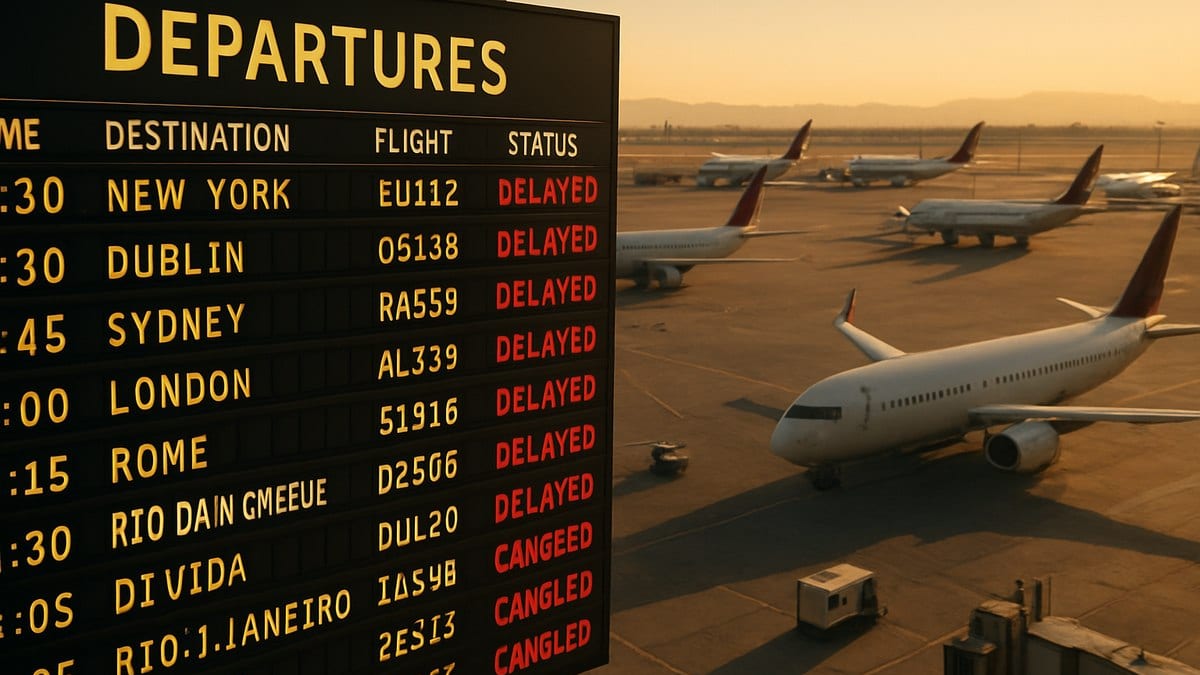
Cairo Strained as Diversions Converge on a Single Hub
Publicly available tracking data and regional aviation updates indicate that Cairo International Airport has become one of the busiest diversion points as airlines circumvent closed or restricted skies over Iran, Iraq, Jordan, Kuwait, Qatar, Bahrain, the United Arab Emirates, and parts of Israel and Syria. With alternative corridors funnelling traffic over Egypt and the eastern Mediterranean, operations at Cairo have shifted rapidly from normal schedules to crisis management.
Reports from aviation analytics platforms and regional media show that at least 106 flights connected to Cairo and other Egyptian airports have been cancelled, heavily delayed, or rerouted over recent days. Many of these disruptions involve services that would normally transit Gulf hubs or overfly the now-restricted central Middle East corridor, forcing aircraft to replan via North Africa and the Red Sea and crowding already busy approach paths into Cairo.
Egyptian airspace itself remains open, but the sharp rise in unscheduled arrivals and lengthy reroutes is putting pressure on ground handling, crew rostering, and turnaround times. Flight monitoring snapshots suggest peaks of late-evening congestion in Cairo, with diverted long-haul services arriving in tight waves, complicating gate allocation and baggage handling and cascading into further knock-on delays.
Operational summaries published by logistics and airline partners describe Egypt as both a lifeline and a pressure point. While the country offers one of the few continuous corridors between Europe and Asia that avoids the core conflict zones, that same status is magnifying the impact of every delay or cancellation in neighboring states on Cairo’s own punctuality metrics.
How 106 Disrupted Flights Ripple Across the Region
The tally of at least 106 disrupted flights linked to Cairo includes outright cancellations, heavily delayed departures, and aircraft forced to divert to or from Egyptian airports at short notice. Many of these involve services on routes connecting Europe, India, and Southeast Asia with the Gulf, which once relied on tightly timed transfers at hubs such as Dubai, Abu Dhabi, and Doha.
With those hubs constrained or operating reduced schedules, a portion of this traffic has shifted to Cairo and other North African gateways. The result is a complex web of missed connections: a cancelled or late inbound from the Gulf can strand passengers booked onward to African or European destinations, while a delayed long-haul arrival into Cairo may force airlines to hold or retime regional feeders serving cities in the Levant and North Africa.
Industry operations updates describe a “domino effect” playing out across timetables that were built for normal transit flows. When crews reach duty-time limits after extended reroutes around closed airspace, subsequent rotations can be cancelled or rescheduled, adding to the total count of disrupted flights and eroding network reliability. For Cairo, this translates into sudden gaps where an aircraft or crew should be, followed by unexpected surges when diverted flights finally arrive.
The 106-flight figure therefore represents more than a single day’s turbulence. It is a snapshot of rolling disruption, in which each fresh airspace advisory or missile alert elsewhere in the region sends new shockwaves through Cairo’s departure boards, even as previous days’ delays continue to be worked through.
Global Airspace Crisis Redraws Routes Over Egypt
The underlying trigger for Cairo’s current difficulties is the wider Middle East airspace crisis, rooted in escalating conflict involving Iran, Israel, and the United States. Since late February, multiple states have closed or severely restricted their skies to civil aviation, pushing airlines to abandon direct routings across the Gulf and northern Middle East and instead hug safer but longer southern or western paths.
Eurocontrol and other European aviation bodies have reported steep reductions in direct Europe–Middle East traffic, with many carriers now tracking south over Egypt and the Red Sea before turning east toward the Indian subcontinent and Southeast Asia. Similar reroutes are visible in data compiled by global flight-tracking providers, which show dense flows over Egypt at times when traffic charts for Iran, Iraq, and the Gulf are nearly blank.
Specialist freight and logistics bulletins describe Egypt as “restricted but operational,” a designation that reflects both persistent congestion and the continued availability of its airspace and major airports. Cargo operators serving disrupted markets in the Gulf, Levant, and South Asia are increasingly using Cairo as an intermediate point, further adding to traffic density at the hub and contributing to the 106-flight disruption tally.
These altered routes have a direct cost dimension, as airlines contend with longer flight times, higher fuel burn, and tighter crew margins. While such changes are framed as safety-driven responses to a fast-moving conflict, they also represent a reshaping of global aviation geography in which Cairo, for now, sits at the crossroads.
Travelers Face Long Queues, Uncertain Timelines, and Limited Options
For passengers, the statistics translate into crowded terminals, extended layovers, and uncertain arrival times. Travel-industry coverage from Egypt, the Gulf, and India describes stranded travelers sleeping in departure halls, queuing at rebooking counters, and scrambling for the few available alternative routes that still connect Europe, Africa, and Asia.
Consumer travel advisories emphasize that many disruptions affecting Cairo are indirect. A traveler whose itinerary merely connects through the city can be affected by a cancellation in Dubai or Amman, or by a reroute that forces a late arrival into Egypt and causes a missed onward connection. In some cases, passengers are being reprotected on itineraries that loop through multiple continents, adding 10 hours or more to journeys that previously relied on a single Gulf transit.
Rights and compensation depend heavily on where the journey begins and which airline operates the affected sector. Legal and passenger-rights briefings note that European Union regulation on delays and cancellations can apply to Cairo-linked flights departing from EU airports, though broad conflict-related airspace closures are typically treated as extraordinary circumstances, limiting eligibility for cash compensation even as rebooking and refunds remain mandatory.
Insurance providers and travel associations are also urging passengers to read the fine print on disruption coverage, as some policies distinguish between routine operational delays and those triggered by declared conflicts or government-imposed airspace restrictions. For many travelers currently caught in the 106-flight disruption wave, assistance from airlines and consular services is more immediately relevant than any potential reimbursement months later.
Outlook: Prolonged Volatility for Cairo and Regional Links
Forecasts from aviation consultancies and regional think tanks suggest that volatility is likely to persist as long as airspace closures and intermittent missile or drone activity remain a feature of the Middle East security landscape. Even if partial reopenings occur, airlines may continue to avoid certain flight information regions, keeping Egypt in its current role as a primary detour corridor and leaving Cairo exposed to further spikes in congestion.
Egypt’s civil aviation planners are working within an environment of rapidly changing notices to air missions, shifting insurance thresholds, and evolving airline risk assessments. Any fresh escalation that affects currently open corridors over Saudi Arabia or the eastern Mediterranean could further concentrate traffic into Egyptian airspace, raising the prospect that the 106 recorded disruptions may be a precursor to even larger swings in operational stability.
For regional connectivity, the immediate concern is the resilience of links between secondary cities that rely on Cairo as a gateway. Persistent cancellations and delays on “spoke” routes feeding into the hub risk isolating some destinations from long-haul networks, particularly where alternative overland routes are constrained or where neighboring countries are themselves grappling with airspace restrictions.
With no clear timeline for a full restoration of normal airspace patterns across the Middle East, travelers and airlines alike are preparing for an extended period in which Cairo remains indispensable but unpredictable, simultaneously a safe harbor and a chokepoint in a region-spanning aviation crisis.