

More news on this day
Cairo International Airport has been hit by major disruption as 106 flights were delayed, cancelled, or rerouted in recent days, highlighting Egypt’s increasingly fragile role as a regional aviation lifeline amid a widening Middle East airspace crisis.
Get the latest news straight to your inbox!
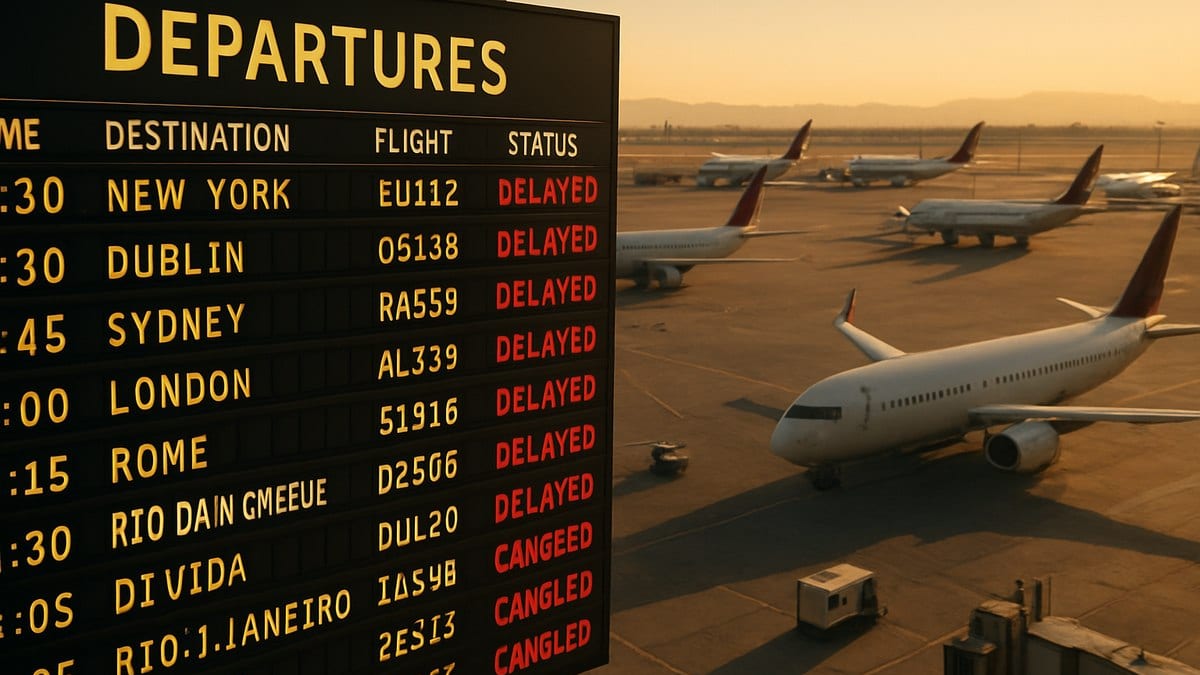
Cairo Struggles Under Sudden Wave of Disruptions
Published coverage and flight-tracking data indicate that Cairo International Airport has absorbed a sharp spike in operational strain as airspace closures across Iran, Iraq, Israel, Jordan, and parts of the Gulf continue to ripple through regional networks. Aviation monitoring platforms show that 106 flights touching Cairo over a short window were disrupted, ranging from multi-hour delays to outright cancellations, as carriers scrambled to redesign routings around closed corridors.
The disruption has not been limited to a single airline or route. Egypt’s flag carrier and multiple foreign operators have adjusted schedules into and out of Cairo as upstream hubs in the Gulf and Levant remain either closed or heavily restricted. With many long-haul itineraries now funneled through Egypt as an alternative bridge between Europe, Africa, and Asia, Cairo’s terminals have seen surging transit volumes at the same time that punctuality has sharply deteriorated.
Publicly available information from regional airport operators shows that congestion has become most acute during overnight and early-morning banks, when diverted flights compete for limited slots and ground-handling capacity. Travelers report extended waits at check-in counters, immigration queues, and rebooking desks as disrupted traffic ripples through the system.
Airline advisories reviewed by TheTraveler.org recommend that passengers departing from Cairo allow significantly more time at the airport than usual, reflecting a combination of congested airspace, crowded terminals, and frequently changing departure times.
Egypt’s Corridor Role Grows as Gulf Hubs Stall
Egypt’s position between Europe, Africa, and the broader Middle East has become more prominent since hostilities intensified in late February and several states imposed sweeping civil aviation restrictions. Analyses published by regional media note that thousands of flights per day were being cancelled or rerouted at the peak of the crisis, after Iran, Israel, and multiple Gulf and Levant countries curtailed overflights for safety reasons.
As major hubs such as Dubai, Abu Dhabi, Doha, and other Gulf gateways have faced closures or severe capacity cuts, carriers have increasingly threaded their Europe–Asia operations through remaining corridors over Turkey, northern routes, or Egyptian skies. Recent reporting from Egypt-focused outlets describes Cairo emerging as a critical transit point, with added services and diversions arriving from Europe, Africa, and secondary Middle Eastern cities seeking stable airspace and ground capacity.
This realignment has come at a cost. Aviation-focused analysis platforms estimate that detours around blocked airspace are adding between one-and-a-half and five hours to many intercontinental flights, leading to higher fuel burn and crew costs. Those pressures have translated into tighter aircraft rotations and a thinner margin for delay recovery at Cairo, where a single late arrival can cascade across multiple onward connections.
Industry commentary suggests that Egypt’s civil aviation authorities and airport operators are attempting to balance growing demand for safe routings with finite runway, apron, and terminal resources. The 106 disrupted Cairo flights are being cited by analysts as an early indicator of how fragile that balance has become under prolonged regional stress.
Regional Shockwaves: From Closed Skies to Rerouted Networks
The airspace crisis stems from a chain of security developments that has reshaped flight operations across West Asia and the eastern Mediterranean. Safety bulletins from European and international regulators over the past weeks have advised carriers to avoid, or significantly limit, operations over Iran, Iraq, Israel, Jordan, Lebanon, Qatar, the United Arab Emirates, and parts of Saudi Arabia, leading to an unprecedented contraction in available routings.
According to aggregated data from aviation analytics firms cited in recent news coverage, cumulative cancellations linked to the current phase of the conflict have climbed into the tens of thousands. Major Middle Eastern and European airlines have suspended or reduced services to key hubs, while some Asia–Europe flights have been forced to add technical stops in out-of-the-way airports to refuel after longer detours.
These constraints have transformed the Middle East’s traditional role as a seamless bridge between continents into a patchwork of ad hoc corridors. Turkey and Egypt feature prominently among the remaining options, together with selected paths over Saudi Arabia and more northerly tracks. With so many flows compressed into fewer lanes, even minor disruptions at one airport can rapidly propagate to others, which helps explain why a localized weather system over Greater Cairo recently triggered outsized delays for already-stressed networks.
Experts quoted in aviation trade publications note that while airspace restrictions are framed as temporary, the persistence of conflict and evolving risk assessments make it difficult for airlines to commit to firm restoration timelines. That uncertainty is feeding directly into Cairo’s operational volatility, as timetables are updated repeatedly and aircraft are shifted between routes at short notice.
Travelers Face Missed Connections and Patchwork Workarounds
For passengers, the operational picture translates into missed connections, overnight airport stays, and complicated rebooking journeys. Consumer-facing travel advisory sites describe cases of travelers bound for Gulf and Levant destinations being rerouted through Cairo only to find their onward legs delayed or cancelled, turning what was once a simple two-sector itinerary into a multi-stop odyssey.
Public guidance from airlines and passenger-rights platforms stresses the importance of monitoring flight status in real time and avoiding airport trips without confirmed bookings. Several carriers have introduced flexible rebooking or waiver policies for itineraries touching the most affected airspaces, allowing customers to shift dates, reroute via alternative hubs, or request refunds, depending on fare conditions.
Travel forums and social media accounts tracking the disruption highlight that network pressure is especially severe on peak Europe–Asia days, when capacity through Egypt and Turkey is tightest. With 106 Cairo flights impacted in a short period, seat availability for disrupted passengers has become highly constrained, and last-minute one-way fares on remaining routes have climbed.
Advisory pieces now encourage travelers transiting Cairo to carry essentials in hand luggage, anticipate possible overnight stays, and review visa and transit rules in case an unplanned hotel stop outside the airport becomes necessary. While most operations continue to run, the probability of extended delay for itineraries that rely on tight connections has risen markedly.
Outlook: Prolonged Volatility and Gradual Adjustments
Forecasts from aviation consultancies surveyed in recent reporting suggest that volatility around Cairo and the wider region is likely to persist as long as airspace closures and security alerts remain in force. Some airlines have begun to tentatively rebuild schedules to select Gulf destinations under controlled conditions, but many long-haul services continue to avoid the most heavily restricted zones.
Industry observers expect Egypt to retain an outsized role in regional connectivity in the coming weeks, with Cairo, Hurghada, Sharm El Sheikh, and other airports occasionally receiving diverted flights when neighboring states tighten or relax restrictions at short notice. Each such adjustment can temporarily relieve pressure on certain routes while intensifying it on others, keeping operations in a state of near-constant recalibration.
For now, the tally of 106 disrupted Cairo flights serves as a snapshot of a moving target rather than a final figure. As schedules are redrawn around the crisis, the city’s status as both a beneficiary of rerouted traffic and a victim of cascading delays underscores how interconnected the Middle East’s aviation system has become, and how sharply global travel can be affected when a key region’s skies are partially closed.