

More news on this day
Air travelers across Argentina faced significant disruption as 78 delays and 11 cancellations affected Aerolíneas Argentinas, Flybondi, and JetSMART operations in and out of Buenos Aires, Córdoba, Bariloche, and Rosario, according to early operational data and local media monitoring.
Get the latest news straight to your inbox!
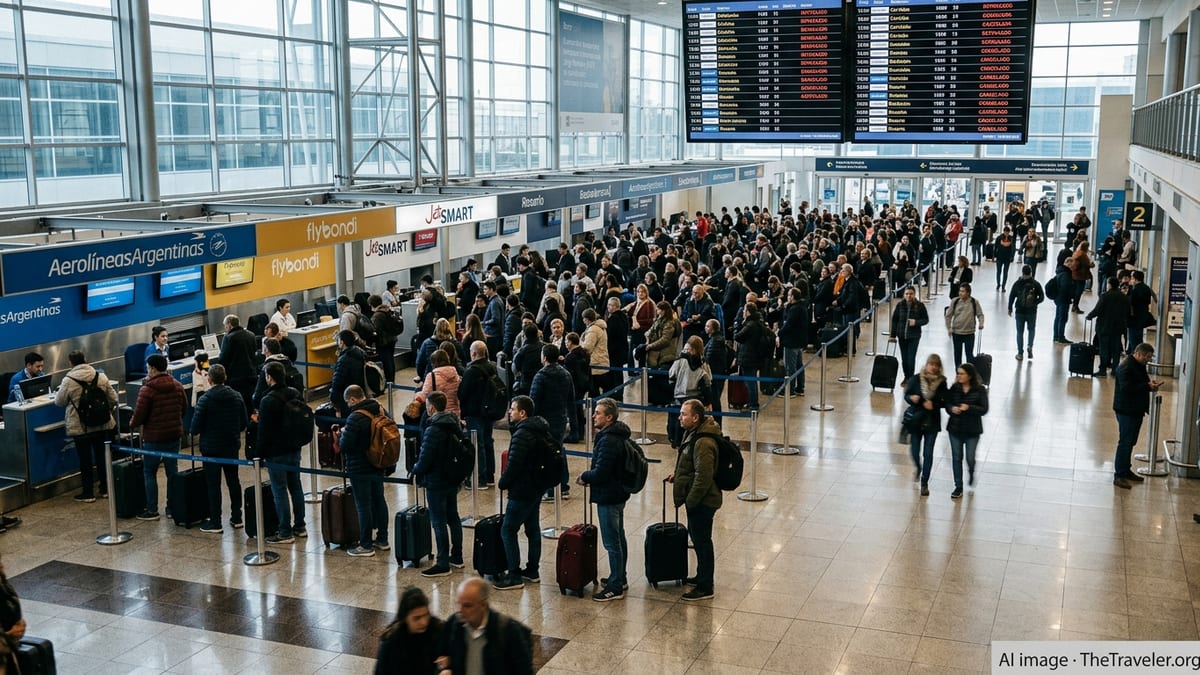
Widespread Delays Across Argentina’s Main Air Corridors
The latest wave of disruption has been concentrated on some of Argentina’s busiest domestic corridors, with Buenos Aires, Córdoba, Bariloche, and Rosario all reporting elevated levels of delayed departures and arrivals. Publicly available airport boards and flight-tracking platforms show that the majority of affected flights were short-haul domestic services linking these key cities.
The 78 delays recorded over the current operational cycle largely involved departures pushed back by one to three hours, with some services experiencing longer ground holds. The situation has been particularly visible at Buenos Aires’ Aeroparque Jorge Newbery, a central hub for domestic traffic, where Aerolíneas Argentinas, Flybondi, and JetSMART all maintain dense schedules connecting the capital with provincial centers such as Córdoba and Bariloche.
Smaller but accumulating disruptions were also noted at Córdoba’s international airport and at Bariloche, an important gateway for Patagonia-bound tourism. Rosario, which connects with Buenos Aires and seasonal leisure routes, has seen a smaller volume of flights overall, but a higher-than-usual proportion of them running behind schedule.
Operational data suggest that while delays were spread across all three carriers, low-cost operators Flybondi and JetSMART, with tighter aircraft rotations and leaner scheduling, appeared particularly exposed to knock-on effects once the day’s schedule began to slip.
Cancellations Add Pressure for Passengers and Airlines
Alongside the delays, 11 outright cancellations have further complicated travel plans, forcing passengers to seek rebooking options on later flights or with competing carriers. Publicly accessible flight-tracking information indicates that several of these cancellations involved links between Buenos Aires and interior cities, notably Bariloche and Córdoba, which are currently in high demand for both business and leisure travel.
For Aerolíneas Argentinas, the cancellations add to an already complex operational environment in which the national carrier balances hub-and-spoke services from Buenos Aires with federal routes linking provincial cities directly. For Flybondi and JetSMART, the cancellations underscore ongoing scrutiny of reliability in Argentina’s competitive low-cost segment, where tight margins and high aircraft utilization can magnify the impact of schedule disruptions.
Rebooking efforts have reportedly led to longer lines at check-in counters and service desks at impacted airports, especially during peak travel periods. While some passengers have been accommodated on same-day departures, others have had to accept overnight stays or substantial itinerary changes, particularly on routes with limited frequency.
Published commentary from consumer forums and social media suggests heightened frustration among travelers who had planned tight connections or time-sensitive itineraries, especially on routes such as Buenos Aires to Bariloche that are heavily used by international visitors combining multiple destinations within Argentina.
Buenos Aires, Córdoba, Bariloche, and Rosario Under the Spotlight
The disruption has once again placed Argentina’s airport network in the spotlight. Buenos Aires remains the primary domestic hub, with Aeroparque handling a dense wave of departures to cities including Córdoba, Bariloche, and Rosario. Publicly available operational statistics show that these routes rank among the busiest in the country, making them particularly vulnerable when irregular operations occur.
Córdoba, functioning as both a destination and a connecting node, continues to grow as a federal hub, with Aerolíneas Argentinas, Flybondi, and JetSMART all operating from the city. Delays and cancellations in Córdoba therefore tend to reverberate beyond a single point-to-point route, creating secondary effects across the wider domestic network.
Bariloche, a year-round tourism magnet with pronounced seasonal peaks, has seen periodic congestion during high-demand periods. Any loss of capacity due to cancellations or extended delays on Buenos Aires and Córdoba services can quickly affect hotel check-ins, tour departures, and onward ground transportation schedules in the city.
Rosario, while smaller in volume, plays an important regional role in central Argentina. When services linking Rosario to Buenos Aires or other key destinations are disrupted, travelers often have fewer alternative flights to choose from on the same day, magnifying the impact of each individual cancellation or long delay.
Potential Causes: Congestion, Weather, and Operational Strain
Early assessments based on airline statements to local media, airport operator updates, and meteorological information point to a combination of factors behind the latest disruption. Periods of adverse weather around Buenos Aires and the central region, including low visibility and gusty winds, have periodically affected approach and departure flows in recent weeks, prompting air traffic restrictions and sequencing delays.
In addition to weather, high demand on key domestic routes has increased the strain on aircraft and crew availability. Public reports have highlighted how tight turnarounds in the low-cost model can leave little buffer when an early-morning delay cascades through the rest of the day’s schedule. Once the first rotation is affected, subsequent services on the same aircraft can quickly fall behind or become candidates for cancellation.
Infrastructure constraints at some airports, such as limited gates during peak hours and taxiway saturation, also contribute to on-the-ground congestion. Published coverage of Argentina’s aviation sector has frequently noted that modernization programs are ongoing at several terminals, and that temporary works or capacity limits can exacerbate bottlenecks during busy travel periods.
Sector analysis available from government and industry reports further indicates that Argentina’s domestic market, which rebounded strongly after the pandemic, is still calibrating capacity and schedules to match demand, leaving airlines vulnerable when operational conditions deteriorate.
What Passengers Are Being Advised to Do
Given the elevated number of delays and cancellations, public travel advisories and airline guidance emphasize the importance of checking flight status frequently on official channels before leaving for the airport. In Argentina’s domestic market, same-day schedule changes remain relatively common, especially among low-cost carriers, making real-time information critical for passengers.
Consumer advocacy groups and travel advisories recommend that travelers build additional buffer time into itineraries involving onward connections, particularly when combining domestic flights with international departures from Buenos Aires. They also highlight the value of flexible tickets, travel insurance, and payment methods that offer some protection or recourse when cancellations occur.
For those already at the airport when disruptions are announced, publicly available guidance stresses the need to contact the airline through multiple channels, including mobile apps, websites, and service counters, to secure rebooking options as early as possible. Seats on later flights, especially to high-demand destinations such as Bariloche and Córdoba, can sell out quickly once irregular operations begin.
While the current episode of disruption may ease as weather and operational conditions stabilize, the concentration of delays and cancellations across Aerolíneas Argentinas, Flybondi, and JetSMART serves as a reminder that Argentina’s fast-growing domestic aviation market continues to face reliability challenges, particularly on its busiest routes.