

More news on this day
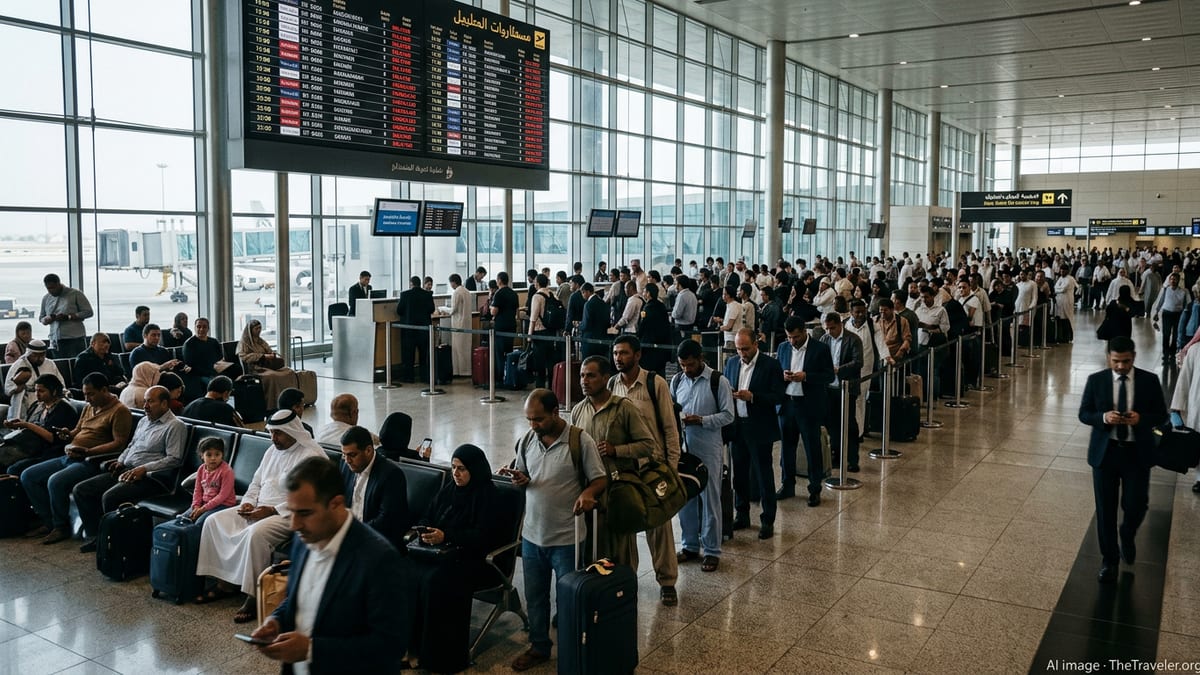
Hundreds of passengers traveling through Saudi Arabia’s busiest airports faced significant disruption this week, as widespread flight cancellations and delays by Gulf Air, Saudia, Qatar Airways and other carriers rippled across hubs in Jeddah, Riyadh, Dammam and Medina.
Get the latest news straight to your inbox!
Airspace Instability Pushes Saudi Hubs to Breaking Point
Publicly available aviation, security and industry reports indicate that the latest wave of travel disruption is closely tied to the ongoing regional crisis that has unsettled airspace across the Gulf since late February 2026. With airspace closures, rerouted corridors and periodic security alerts affecting neighboring states, Saudi Arabia’s role as one of the few remaining major east–west corridors has intensified operational pressure on its airports.
Jeddah’s King Abdulaziz International Airport and Riyadh’s King Khalid International Airport, already among the region’s busiest hubs, have seen growing numbers of schedule changes as airlines adjust flight paths to avoid affected airspace. Dammam’s King Fahd International Airport and Prince Mohammad bin Abdulaziz International Airport in Medina have also reported elevated disruption, particularly on services linked to Gulf hubs traditionally used for long-haul connections.
According to published coverage and airline operational updates, carriers are juggling capacity, crew availability and revised routings in real time. This has contributed to clusters of cancellations and rolling delays, with some departures repeatedly rescheduled before ultimately being withdrawn from the timetable.
Industry observers note that while Saudi airports remain open, the combined effect of regional missile and drone activity, changing overflight permissions and heightened security measures has left schedules far more fragile than usual for late March.
Gulf Air, Saudia, Qatar Airways and Others Trim Schedules
Gulf-based airlines have been at the center of the turmoil, with Gulf Air, Saudia, Qatar Airways and several other regional carriers all adjusting their operations in and out of Saudi Arabia. Publicly available airline notices and passenger communications show that these changes range from outright cancellations to last-minute aircraft swaps and extended ground holds.
Saudia, as the national carrier, remains heavily exposed across all four affected airports, operating dense domestic networks and international routes that rely on stable regional airspace. Schedule data and traveler reports suggest that services linking Saudi cities to major Gulf hubs have been particularly vulnerable, as carriers re-evaluate the viability of traditional transit patterns.
Qatar Airways, which has already been operating a reduced network in response to airspace closures around Doha, has issued a series of rolling guidance documents and waiver policies for ticketed passengers. These measures have been updated several times during March, reflecting evolving security assessments and operational constraints. Passengers connecting via Saudi airports on Qatar Airways codeshares or interline itineraries have in some cases been forced into rebookings onto alternative routings or partner airlines.
Gulf Air and other regional airlines have likewise broadened their rebooking windows and, in selected cases, enabled more flexible refund or credit options for disrupted itineraries. However, travelers report that access to these remedies often depends on whether a particular flight has been officially canceled, adding a further layer of uncertainty.
Passenger Experience: Rolling Delays and Last-Minute Changes
Accounts shared on public forums and social media over recent days describe a patchwork of experiences for travelers passing through Jeddah, Riyadh, Dammam and Medina. Some passengers have reported relatively smooth journeys despite wider regional tension, while others recount multiple last-minute cancellations, overnight airport stays and repeated reissuance of boarding passes as airlines try to salvage connectivity.
On certain city pairs, such as domestic links between Riyadh and Dammam or international routes feeding into Jeddah from neighboring Gulf states, travelers have described flights being re-timed several times before eventually disappearing from departure boards. In other instances, aircraft have departed with substantial delays after extended waiting periods at the gate as airlines awaited updated routing clearances.
These unpredictable shifts have posed particular challenges for those with onward connections, many of whom planned itineraries through Saudi airports precisely because they appeared more stable than hubs directly affected by airspace closures. As one recurring pattern, passengers who proactively secured backup tickets on alternative routings have sometimes fared better than those who waited for formal cancellation notices, although this strategy involves additional upfront cost and complexity.
Publicly available travel advisories emphasize the importance of monitoring airline apps and official communication channels closely on the day of travel, as some schedule changes are being confirmed only hours before departure. Airport check-in staff and call centers have faced heavy workloads, contributing to longer wait times for assistance.
Knock-On Effects for Pilgrims and Regional Travelers
Beyond business and leisure travelers, the disruption has significant implications for religious visitors heading to the holy cities of Mecca and Medina. Medina’s airport, in particular, acts as a crucial gateway for pilgrims arriving from across the Muslim world. Reports indicate that fluctuating schedules have forced some visitors to reroute through alternative Saudi gateways or delay their trips altogether.
With Ramadan drawing closer on the calendar, tour operators and travel agencies specializing in pilgrimage travel are watching the situation closely. Publicly accessible industry commentary suggests that operators are revisiting group itineraries, adding buffer days or exploring routings that minimize exposure to the most volatile transit points, including certain Gulf hubs currently affected by airspace restrictions.
Regional travelers who rely on short-haul links for work, family visits or medical appointments are also feeling the impact. Markets such as Bahrain, Qatar, the United Arab Emirates and Jordan are tightly interconnected with Saudi Arabia, and any disruption in one hub can quickly cascade across multiple airports. As airlines prioritize long-haul and high-yield routes, some secondary regional services are experiencing disproportionate cuts, further narrowing options for time-sensitive trips.
Travel planners note that even where flights are operating, extended routings around affected airspace can add substantial flight time and fuel cost, with potential implications for fares if current patterns persist.
What Travelers Through Saudi Arabia Should Expect Next
Looking ahead to the coming days, publicly available analytical notes from aviation and risk consultancies suggest that flight operations across Jeddah, Riyadh, Dammam and Medina are likely to remain fluid. While there is no indication that Saudi airports will close, airlines are expected to continue fine-tuning schedules as the regional security picture evolves and as neighboring airspaces adjust their own restrictions.
For passengers booked on Gulf Air, Saudia, Qatar Airways and other carriers using Saudi hubs, the key variables will be routing viability, crew positioning and the duration of elevated alert levels across the Gulf. Some airlines have already introduced special commercial policies allowing date changes or alternative routings within defined travel windows, though the exact terms and cut-off dates differ from one carrier to another.
Travel industry guidance advises passengers to build extra time into connections, avoid tight same-day transfers where possible, and maintain flexibility on travel dates. Keeping contact details updated in airline booking systems is especially important so that carriers can push real-time notifications about re-timings, cancellations or rebooking options.
Analysts point out that once regional airspace patterns stabilize, airlines may gradually restore a greater share of their previous schedules. Until then, travelers moving through Saudi Arabia’s major airports should be prepared for continued disruption, with the possibility of sudden changes to even seemingly confirmed flights as conditions shift.