

More news on this day
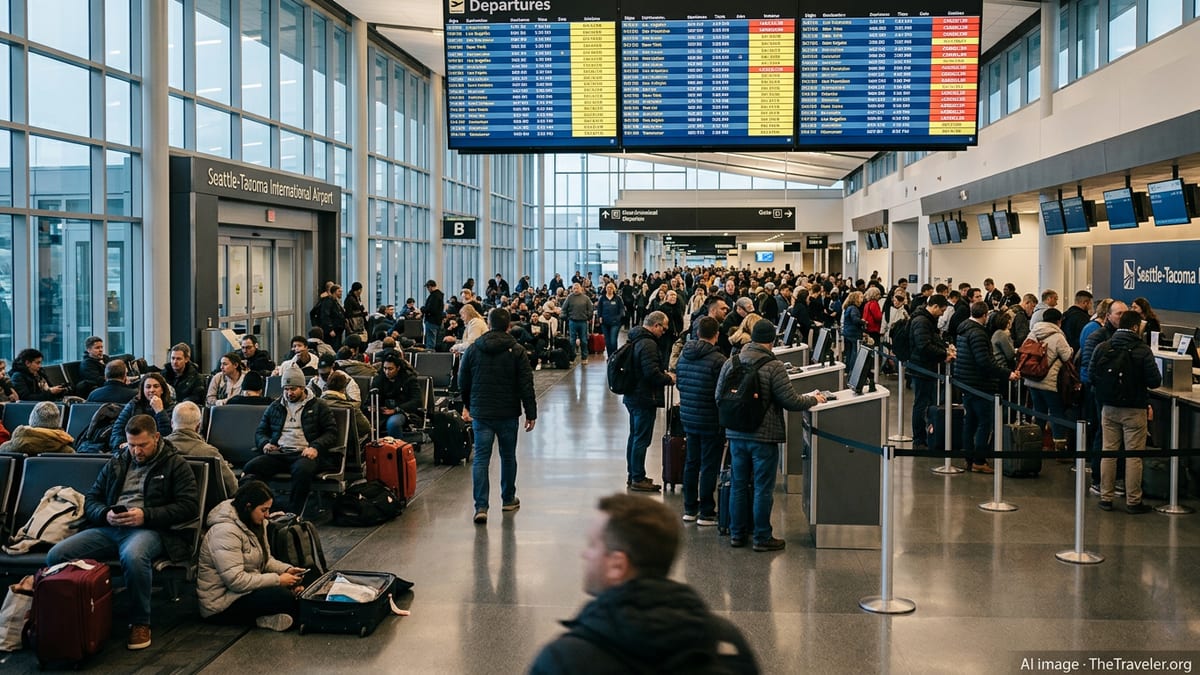
Hundreds of passengers traveling through Seattle-Tacoma International Airport on Saturday are facing significant disruptions after 193 flights were reported delayed and 71 canceled, affecting key routes to cities including Los Angeles, San Francisco, New York, and Vancouver.
Get the latest news straight to your inbox!
Wide-Ranging Impact on West Coast and Transcontinental Routes
Publicly available flight-tracking data shows a sharp spike in operational disruptions at Seattle-Tacoma International Airport, with delays and cancellations rippling across some of the airport’s busiest corridors. Services to Los Angeles and San Francisco, two of Sea-Tac’s most heavily traveled domestic destinations, are among the hardest hit, with travelers encountering rolling departure pushes, gate changes, and missed connections downline.
Transcontinental flights to New York are also affected, compounding problems for passengers relying on early-morning departures to make same-day meetings or onward international connections. Even relatively short-haul international services to Vancouver have seen schedule disruptions, with regional travelers contending with both ground holds and crew-related delays.
Sea-Tac is a critical hub for both business and leisure traffic across the Pacific Northwest, and disruptions of this scale quickly ripple through the broader network. Travelers departing other airports and connecting through Seattle report missed onward flights, unplanned overnight stays, and rebookings that push arrivals back by many hours.
According to published aviation data, Seattle is a primary origin or connection point for high-demand routes up and down the West Coast and across the United States, meaning concentrated disruptions on a single day can affect passengers far beyond Washington State.
Weather, Congestion, and Operational Strain Combine
Reports from passengers and publicly available information indicate that the disruption coincides with challenging winter weather in the Puget Sound region, adding pressure to an already busy March travel period. Snow and ice can reduce the capacity of runways and taxiways and require extensive de-icing of aircraft, slowing the flow of both arrivals and departures.
Aviation data and past winter events show that when weather reduces capacity at a major hub, air traffic managers often impose ground delay programs that limit the number of departures and arrivals in each time block. This can lead to a domino effect in which even flights scheduled outside peak storm periods depart late or are canceled because aircraft and crews are not where they need to be for subsequent legs.
Operational strain is further compounded when aircraft spend extended periods on the ground waiting for gates or de-icing, tying up both physical infrastructure and staff. As delays stretch, crews can reach duty-time limits, forcing airlines to cancel or significantly reschedule services even after the most severe weather has passed.
Similar patterns have been observed during recent nationwide disruption days, when relatively localized storms or infrastructure bottlenecks at a few major airports have cascaded into thousands of delays and cancellations across the United States.
Knock-On Effects for Passengers Across North America
The disruption at Seattle-Tacoma is having noticeable consequences for travelers well beyond the Pacific Northwest. Because Sea-Tac is closely linked with California’s largest hubs and New York-area airports, disruptions on routes to Los Angeles, San Francisco, and New York create mismatched aircraft rotations and missed connections across the network.
Travel industry analyses of similar events show that once a critical mass of flights is delayed or canceled at a hub, passengers heading for secondary destinations are often affected next. Travelers connecting onward from Seattle to cities across the western United States and Canada, including Vancouver, frequently rely on tight connection times that can be upended by even modest initial delays.
According to published coverage of recent large-scale disruption days, delays of more than an hour can quickly cascade into missed connections, forcing airlines to rebook travelers on later departures or alternate routings. This in turn places additional pressure on remaining open seats, often filling later flights to capacity and leaving some travelers with limited same-day options.
For international passengers, missed transborder or transoceanic flights can be particularly problematic, especially when services operate once daily or a few times per week. In those cases, travelers may face waits of 24 hours or more for the next available departure.
What Travelers Can Expect and How to Minimize Disruption
Publicly available information from airline and flight-tracking platforms suggests that conditions at Seattle-Tacoma may remain unstable for several hours as airlines work through backlogs of delayed departures and arriving aircraft. Even as the number of active cancellations levels off, residual delays are likely while crews and aircraft are repositioned and de-icing or ground operations catch up.
Consumer guidance from transportation regulators and travel advocacy groups consistently emphasizes that passengers whose flights are canceled and who choose not to travel are generally entitled to refunds rather than vouchers. Travelers whose flights are significantly delayed may also be able to seek alternative routings at no additional fare, subject to airline policies and seat availability.
Recent analyses of major disruption events indicate that travelers who monitor their flights across multiple platforms, including airline apps and independent trackers, often receive updates more quickly than those relying solely on airport departure boards. Same-day adjustments, such as switching to earlier departures, alternate connection cities, or even different airlines, can sometimes reduce total delay times.
For those yet to depart for the airport, travel advisories commonly recommend arriving earlier than usual during periods of disruption, especially for international flights. Longer lines at check-in, security, and customer service counters are typical on days when large numbers of passengers are rebooked or seeking assistance at the same time.
Sea-Tac’s Role as a Growing Hub Under Scrutiny
The latest wave of delays and cancellations comes as Seattle-Tacoma International Airport continues to handle robust passenger volumes and expand its role as a major West Coast hub. Public data from airport and transportation agencies highlights the airport’s extensive network of nonstop destinations, including frequent daily services to Los Angeles, San Francisco, New York, and Canadian gateways such as Vancouver.
Travel and aviation analysts have previously pointed to the challenges of balancing rapid growth with the need for resilient infrastructure that can withstand shocks ranging from severe weather to air-traffic constraints and staffing pressures. As passenger numbers rise, even short-lived disruptions can leave little slack in the system, increasing the risk that local issues will cascade into multi-city delays.
The current disruption is likely to renew discussion about the tools available to reduce the impact of such events on travelers, including investments in de-icing and ground-handling capacity, better coordination between airlines and air traffic controllers, and clearer communication to passengers during rapidly evolving situations.
For now, travelers at Seattle-Tacoma International Airport and across the broader network remain focused on a more immediate goal: getting to their destinations as safely and efficiently as conditions allow, while airlines and airport operators work to restore normal operations across affected routes.